What Are the Minimum Requirements for Product Schema Markup?
Product Schema: Minimum Requirements for Rich Results (Google)

Product Schema (Product/Offer/Review): What's the minimum? requires at least 'name', 'image', and a nested 'Offer' with 'price' and 'priceCurrency' to prevent Google Search Console errors. For rich search results, it's crucial for this markup to also include a 'Review' or 'AggregateRating', as star ratings significantly boost click-through rates. Without these basic fields, Google often ignores structured data, which negatively impacts your organic visibility.
Correctly implementing the minimum Product Schema requirements (Product/Offer/Review) enhances search engine visibility.
Optimizing structured data helps search engines understand the context of your offerings. Ensure the data is consistent with the visible content and validate it using the Rich Results Test. Use JSON-LD to prevent errors and focus on mandatory fields like name, image, and price information for optimal presentation.

What is Structured Data for E-commerce?
Structured data is a standardized format for providing information about a webpage and classifying its content. For e-commerce businesses, this is essential because search engines like Google use this code to better understand the context of a product page. By adding specific labels to the source code, you help algorithms instantly recognize details such as prices, stock status, and customer reviews. This process forms the basis for obtaining rich snippets in search results, which can significantly improve your online store's visibility compared to competitors.
Implementing Product Schema requires a precise approach to the technical architecture.
From a technical perspective, Schema.org is the universal language used for this purpose. It enables online stores to engage in a direct dialogue with search engines. Without this data, a search engine sees only a collection of words and images, but with the correct markup, the machine understands that a number represents the current selling price and that five stars indicate a positive user experience. This understanding is crucial for modern SEO strategies, where relevance and authority are central.
The Essence of Product Markup

Correctly setting up a Product Schema implementation guide for online stores helps prevent Google Search Console errors.
"Structured data is not just a technical trick; it's a fundamental requirement for any modern online store serious about search engine visibility."
To meet the basic requirements of search engines, you must consider the following components within your Product Schema implementation:
- Product name (Name)
- Clear description (Description)
- Price and currency (Price and priceCurrency)
- Item availability (Availability)
- Average rating score (AggregateRating)
Ignoring these fields can lead to a lower click-through rate because you'll miss out on ad-like listings in the search results. For more in-depth information on technical specifications, consult the official documentation on Schema.org for a complete overview of all available properties.
Ultimately, the goal of Product Schema strategies is to provide a seamless user experience. When a consumer searches for a specific item and immediately sees the price and stock availability in the search engine, the likelihood of that click leading to a conversion increases. It minimizes friction in the purchasing process and ensures your data remains consistent across various platforms. By focusing on the minimum requirements, you lay a solid foundation upon which you can later build more complex data structures to further strengthen your online presence.
Product Schema is Essential for E-commerce Success
Implementing structured data is essential for e-commerce success, but many webmasters wonder where the line is. When applying Product Schema, it's about meeting the strict requirements of search engines like Google to qualify for rich snippets. Without the correct basic fields, a search engine will simply ignore the data, causing you to lose the opportunity for visual enhancements in the search results. Therefore, it's crucial to understand which properties are mandatory and which are merely recommendations for optimal display.
The core of Product Schema (Product/Offer/Review) always starts with the product's name.
Mandatory Fields for Product and Offer Types
To generate valid product markup, you must at least define the object's 'name'. However, a product without price information is incomplete for a search engine. This is where the 'Offer' type comes in. Within this section, you must specify the price and currency. Without these elements, Search Console will report errors. The trick is to find the balance between technical correctness and the available data in your backend, ensuring the minimum requirements for Product Schema (Product/Offer/Review) implementation are always met.

Beyond price, availability is a critical aspect of Product Schema configuration. Google often expects you to indicate whether a product is in stock via the 'availability' property.
"Correctly nesting Offer and Review within the Product type is the only way to simultaneously display the coveted stars and pricing information in search results."
When we look at the 'Review' or 'AggregateRating' components of Product Schema, we see that these are often optional for validation but essential for click-through rates. If you decide to add reviews, you must include at least the average rating and the total number of votes. Omitting these details while still declaring the type will lead to warnings in your testing tools. For more technical specifics, consult the official Schema.org documentation.
Consistency is the keyword for every online store.
List of Minimum Requirements for Validation
To ensure your minimum Product Schema implementation is flawless, use the following list as a checklist for your JSON-LD script:
- Product Name: The textual title of the specific item.
- Price: A numerical value without any currency symbol.
- Currency: The ISO code (e.g., EUR or USD).
- Availability: The stock status (e.g., InStock).
- Rating Value: The average score if reviews are displayed.
Ignoring these basic fields will diminish the return on your SEO investment. While it's tempting to only fill in the name, current search engine standards compel us to be more comprehensive. By strictly adhering to Product Schema guidelines, you build a solid foundation for your organic visibility and directly improve the user experience from the search results page.
Mandatory Properties for Product and Offer Types
When you start working with structured data for e-commerce, it's essential to understand that Google has strict requirements for the fields you fill in. The foundation of a successful implementation begins with the Product type, where the item's name and a clear description are absolutely necessary to even qualify for rich search results. Without this basic data, the search engine will ignore your information, causing you to lose the chance for visual enhancements in the search results. Understanding the Product Schema helps you prioritize mapping your database fields to the correct Schema.org properties, preventing errors in Search Console.
The core of Product Schema lies in validation by search engines.
Essential Fields for the Offer Type
Within a product's structure, the Offer type is responsible for commercial details such as the item's price, currency, and availability. Google requires at least the 'price' and 'priceCurrency' properties to display a price tag in search results, which directly impacts your pages' click-through rates. Additionally, the 'availability' property is crucial, as consumers want to see if a product is in stock directly in the search engine before clicking through to your online store. Correctly filling in these fields within the Product Schema framework ensures a trustworthy brand image and prevents potential customers from being disappointed by incorrect information.
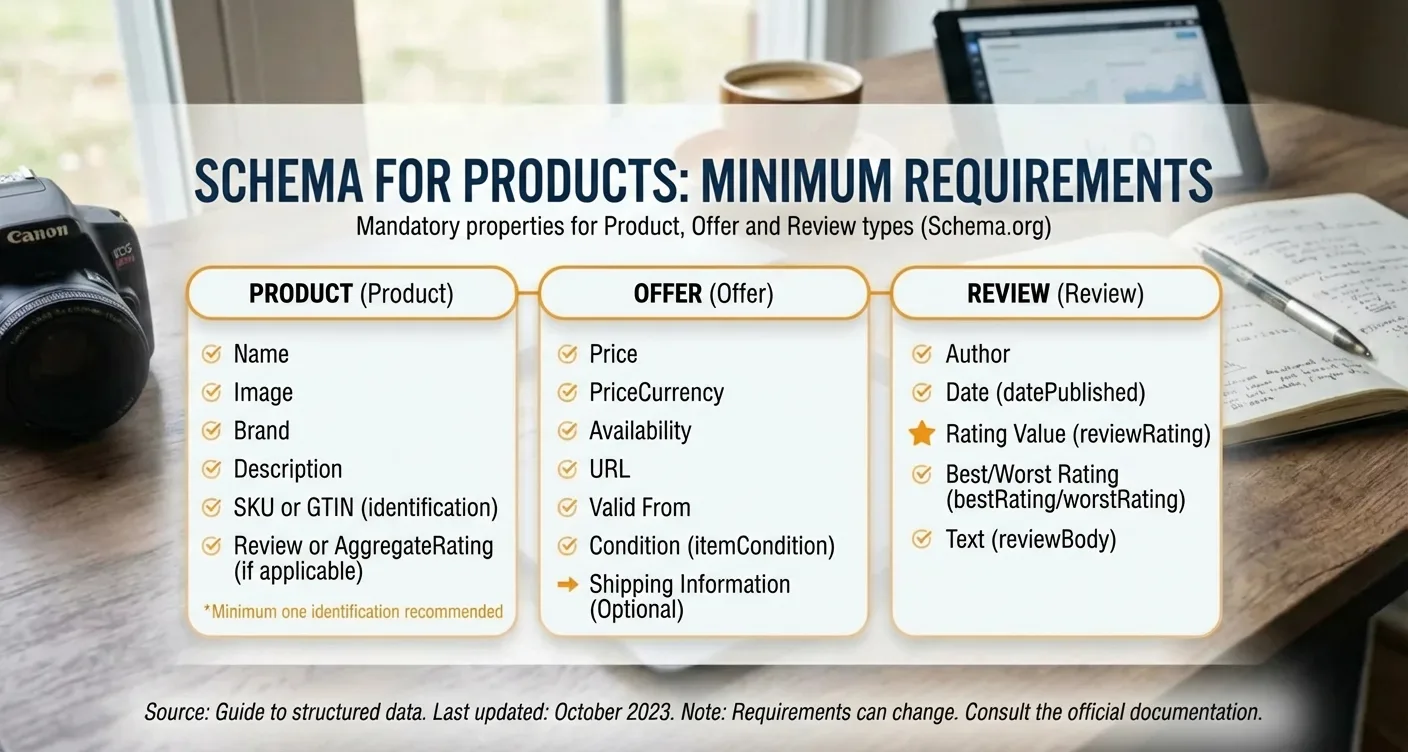
It is advisable to always consult the official Schema.org documentation for the most recent updates on mandatory fields.
"Consistently applying the minimum requirements for product data is not just a technical necessity but a strategic advantage in a saturated digital market."
In addition to price and availability, unique identifiers such as GTIN, MPN, or brand are often mandatory for specific product categories. Although some fields are marked as optional, Google often considers them necessary for generating complete 'Rich Snippets' in practice. Ignoring these identifiers can lead to warnings that negatively impact the visibility of your Product Schema strategy. By adding these codes, you link your product to a global database, significantly improving its discoverability.
Validation and Debugging of Product Data
The implementation process doesn't end with placing the code; you must actively verify that the data complies with the guidelines for Product Schema for online stores. Use Google's Rich Results Test to confirm that the mandatory fields for both the Product and Offer types are correctly recognized and processed. If fields are missing, the tool will precisely indicate which property is absent, such as a missing price quote or an invalid currency notation. A flawless implementation of the Product Schema concept is the only way to retain the coveted stars and pricing information in organic search results.
When filling in the data, pay attention to the following points:
- Ensure the price is always a numerical value without currency symbols in the price field.
- Use the ISO 4217 standard for currency, such as 'EUR' for euros.
- Check that the product name precisely matches the text on the page.
- Verify that images meet Google's minimum resolution requirements.
Accurate completion of the Product Schema system significantly strengthens your website's authority.
Review and Rating Schema: Minimum Requirements
When working with structured data for e-commerce, it's essential to understand which fields Google strictly requires to display rich snippets. For Product Schema, an AggregateRating or an individual Review is indispensable. Without these elements, the search engine will not display the familiar star ratings in search results, directly impacting your offering's visibility. The system expects at least a numerical value for the score and an indication of the total number of reviews to ensure reliability.
The Technical Structure of Reviews
In practice, developers must ensure that the code's nesting is correct within the main subject of the page.

Correctly configuring Product Schema for online stores requires attention to detail when filling in 'ratingValue' and 'reviewCount'. Google enforces strict guidelines where the data in the code must also be actually visible to the human visitor on the landing page. If there is a discrepancy between the hidden metadata and the displayed text, this can lead to manual action or simply the ignorance of your structured data by search algorithms.
"A valid implementation of reviews not only boosts the click-through rate but also strengthens consumer trust even before they visit your website."
When defining Product Schema, you must consider the following components:
- The 'itemReviewed' property that links to the physical or digital product.
- An 'author' field for individual reviews to verify authenticity.
- The 'bestRating' and 'worstRating' values if you deviate from the standard five-star scale.
- The publication date of the review for relevance.
Validation and Debugging
It is advisable to always perform a validation test using the official tools after implementing the Product Schema technical guide. You can use the Rich Results Test to see if the stars are correctly recognized. Errors are often caused by missing fields, such as the currency in the 'Offer' section, which indirectly affects the display of Product Schema.
Ensure the data is dynamically updated as new customer reviews come in on your platform.
Common Mistakes When Implementing Product Schema
Correctly configuring structured data is a highly precise process where minor oversights can immediately have significant consequences for organic visibility in search engines. A very common mistake is the systematic omission of essential fields within the Product Schema guidelines. As a result, Google simply cannot generate rich snippets. Often, online stores fill in the product name but forget to specifically define price validity, currency, or current stock status in the source code. When the syntax does not exactly match the official documentation, the crawler completely ignores the data, rendering the technical effort wasteful.
Another critical oversight is placing reviews that are not directly related to the specific product on the relevant page. In practice, we often see that information in the code does not match what the visitor visually sees on the screen. This is considered misleading by search engines. It's crucial to understand that the price in the JSON-LD code must exactly match the price on the order button. Therefore, always use tools like the Rich Results Test to check whether your implementation complies with current standards and avoids errors that could harm your ranking.
Furthermore, many administrators forget to correctly specify the currency, which is essential for international discoverability. Simply copying code without adjusting your CMS's variables often leads to incorrect data exports. A strategic error is also displaying general company reviews on a specific product page. Search engines demand that review data pertains specifically to the product shown. Mixing this data can even result in manual actions from Google, undermining your authority.
Always ensure you use the most up-to-date fields for 'Offer' and 'Review' nesting during implementation. By proactively avoiding these common pitfalls, you maximize the chance of getting those coveted stars in search results. This significantly improves the click-through rate without unnecessarily complicating the technical structure for your server management. Therefore, always test after every update to your website theme or plugins to ensure the integrity of your data.
Correctly implementing structured data is essential for e-commerce success. Ensure you fill in at least the name, price, and availability for a valid display. When you start working with Product Schema (Product/Offer/Review), it's crucial to prevent Google Search Console errors. By strictly following the mandatory fields, you increase your chances of prominent rich snippets, directly leading to a higher click-through rate and better organic visibility for your online store.
A fully optimized schema includes not only the basics but also reviews and brand information for maximum consumer trust. Check your current code today with the Rich Results Test to meet the latest search engine requirements. Do you need help with the technical setup of your product data? Contact our specialists directly for a thorough audit. This is the best way to consistently stay ahead of your competition.
Frequently Asked Questions
What are the minimum requirements for Product Schema (Product/Offer/Review)?
To have valid product markup, you must at least add the product's name and an 'Offer' or 'Review'. Without a price or a rating, Google will not display the item as a fully-fledged rich result in search results.
How do you correctly apply the Offer property within your product schema?
Within the Offer section, you must specify at least the price and currency to prevent Search Console errors. This is an essential part of the Product Schema (Product/Offer/Review): what is the minimum? for e-commerce websites.
Why is adding Review data important for SEO?
Adding reviews ensures that stars appear in search results, significantly increasing the click-through rate (CTR). Together with product information and offers, it forms the basis for a trustworthy online presentation.
When do you receive warnings in Google Search Console about your product markup?
You receive warnings when optional fields such as 'brand', 'sku', or 'description' are missing from your code. While these are not fatal errors, filling in these fields helps make your product more discoverable and understandable for search engines.
How SEO Supercharged helps you here
SEO Supercharged is fully online (service area: worldwide, online), so you can use it from anywhere.
The platform is built for SEO Specialists, Online Store Owners, Web Developers, E-commerce Managers, Digital Marketing Agencies, Affiliate Marketers, Dropshippers, Technical SEO Consultants, Content Marketers, SMB Entrepreneurs with an Online Store.
You can use it for, among other things, Product Schema Audit, Structured Data Implementation, Review Snippet Optimization, Merchant Center Schema Check, Schema Error Resolution (GSC), Rich Snippet Strategy, E-commerce Schema Consultancy.
Want to tackle this directly? Structure your shop with the Productmap Architect, or start a free SEO analysis.
Related articles
- Product Map Architect: Categories, Filters, Canonicals, and Scalable E-commerce SEO
Learn to build a scalable e-commerce SEO structure: categories, faceted filters, canonicals, internal links, schema, and unique product content—avoiding.
- Beyond Price & Picture: Why Great Product Pages Drive Sales
Learn why optimized product pages need compelling content, unique images, FAQs, and SEO data to rank higher, convert visitors, and boost sales.
- Unique Product Descriptions: Avoid Thin Content for Better SEO
Learn how to write unique product descriptions that avoid thin content for superior SEO results. Optimize your online store now to boost conversions and.
- WooCommerce Push: Field Mapping & Export Best Practices for Flawless Data Synchronization
Learn about WooCommerce push: field mapping & export best practices for flawless data synchronization. Optimize your data export strategy now!
- Comprehensive Product Page SEO Template for E-commerce Success
Unlock higher rankings and boost conversions with our comprehensive product page SEO template. Optimize every field for maximum organic visibility and.