The On-page SEO Checklist (Scoring Model): What's 'Good Enough' for Google?
On-page SEO Checklist & Scoring Model: What's Good Enough?

When optimizing content, our On-page SEO Checklist (Scoring Model): What's 'Good Enough'? serves as a crucial benchmark for success. This model helps determine whether your page meets the technical and content requirements of search engines to rank highly. Many marketers strive for perfection, but a score of eighty percent is often sufficient to build authority. It’s all about balancing readability with algorithm-friendliness, focusing on title tags, meta descriptions, and internal linking structure. By applying these methods, you prevent over-optimization while maintaining relevance.
The key points of this model are:
- Focus on the most important HTML elements and headings.
- Avoid over-optimization by using natural language.
- Use the checklist for consistency within your SEO strategy.

Focus on quality over quantity for sustainable search engine results.
What Exactly Does an On-page SEO Checklist (Scoring Model): What's 'Good Enough'? Entail?
When we discuss website optimization, the question often arises: how far should one go to achieve results? An On-page SEO Checklist (Scoring Model): What's 'Good Enough'? is essentially a structured method for measuring the quality of individual web pages based on technical and content criteria. This isn't just about ticking boxes; it's about understanding the balance between search engine requirements and the visitor's user experience. In practice, many administrators strive for perfection, while the question "what is good enough?" is crucial for managing time and resources efficiently without harming rankings.
Finding the right balance between technical perfection and practical feasibility is at the heart of every modern SEO strategy.
The Foundations of the Scoring Model
An effective scoring model considers various variables such as titles, headings, internal linking structures, and content relevance. Within an On-page SEO Checklist (Scoring Model): What's 'Good Enough'?, weighting factors are often used; after all, not every element carries the same weight for search engine algorithms. For instance, an optimized H1 tag is often more important than the exact length of a meta description. By quantifying these elements, a marketer gains a clear overview of a page's current status. This helps prioritize adjustments that have the greatest impact on search visibility, especially when considering affordable search engine optimization for your website that still delivers results.

It's important to realize that a one hundred percent score isn't always necessary to appear at the top of search results. Often, a score that is simply better than that of direct competitors in the same niche is sufficient.
"The art of SEO is not pleasing a machine, but convincing the machine that you offer the best solution for the human user."
When Does Optimization Stop?
Determining the endpoint of an optimization round is closely linked to market saturation and your domain's authority. Within the framework of an On-page SEO Checklist (Scoring Model): What's 'Good Enough'? for local businesses, we primarily look at local relevance and page speed. Once the basics are in place, such as correct headings and images with alt text, every extra minute of work often yields diminishing returns. The scoring model for on-page optimization helps you recognize when you've reached the law of diminishing returns. At that point, the page is "good enough," and you can monitor results using tools to see if the desired positions are achieved.
The On-page SEO Checklist (Scoring Model): What's 'Good Enough'? is therefore a dynamic instrument that evolves with market developments and competitor actions.
- Analysis of key HTML elements like title tags and meta descriptions.
- Check for the logical structure of headings (H1 to H6).
- Evaluation of keyword density without falling into keyword stuffing.
- Assessment of the internal linking structure to relevant landing pages.
- Check for mobile-friendliness and overall content loading speed.
In short, the On-page SEO Checklist (Scoring Model): What's 'Good Enough'? methodology enables you to precisely determine the line between an underperforming page and a page ready to rank. It prevents you from endlessly tweaking details that search engines barely notice, while major opportunities for improvement remain untouched. By adopting a pragmatic approach, you ensure a healthy balance between quality and quantity in your content strategy.
The Most Important Elements of an Effective SEO Scoring Model
To propel a website to the top of search results, a structured approach is indispensable. A robust scoring model serves as a compass for marketers and website owners. This isn't just about ticking off a list; it's about understanding the interrelationship between technical optimization, content quality, and user experience. When we look at the On-page SEO Checklist (Scoring Model): What's 'Good Enough'?, we see that the focus shifts from pure keyword density to semantic relevance and authority. An effective model weighs different factors more heavily than others, depending on the current algorithms of search engines like Google. The goal is to create a measurable score that provides immediate insight into the improvement areas of a specific page.
A good model critically examines the balance between technical aspects and readability for the end-user.
The foundation of any scoring model begins with the technical infrastructure. Without fast loading times and a mobile-friendly design, even the best content will perform poorly in rankings. In practice, we see that search engines often rate pages that are not technically sound lower. Therefore, it's essential to include elements like structured data and internal linking structures within the On-page SEO Checklist (Scoring Model): What's 'Good Enough'? for advanced users. Clear navigation not only helps search engine bots index the site but also increases the time a visitor spends on the page, which in turn sends a positive signal to the algorithm.
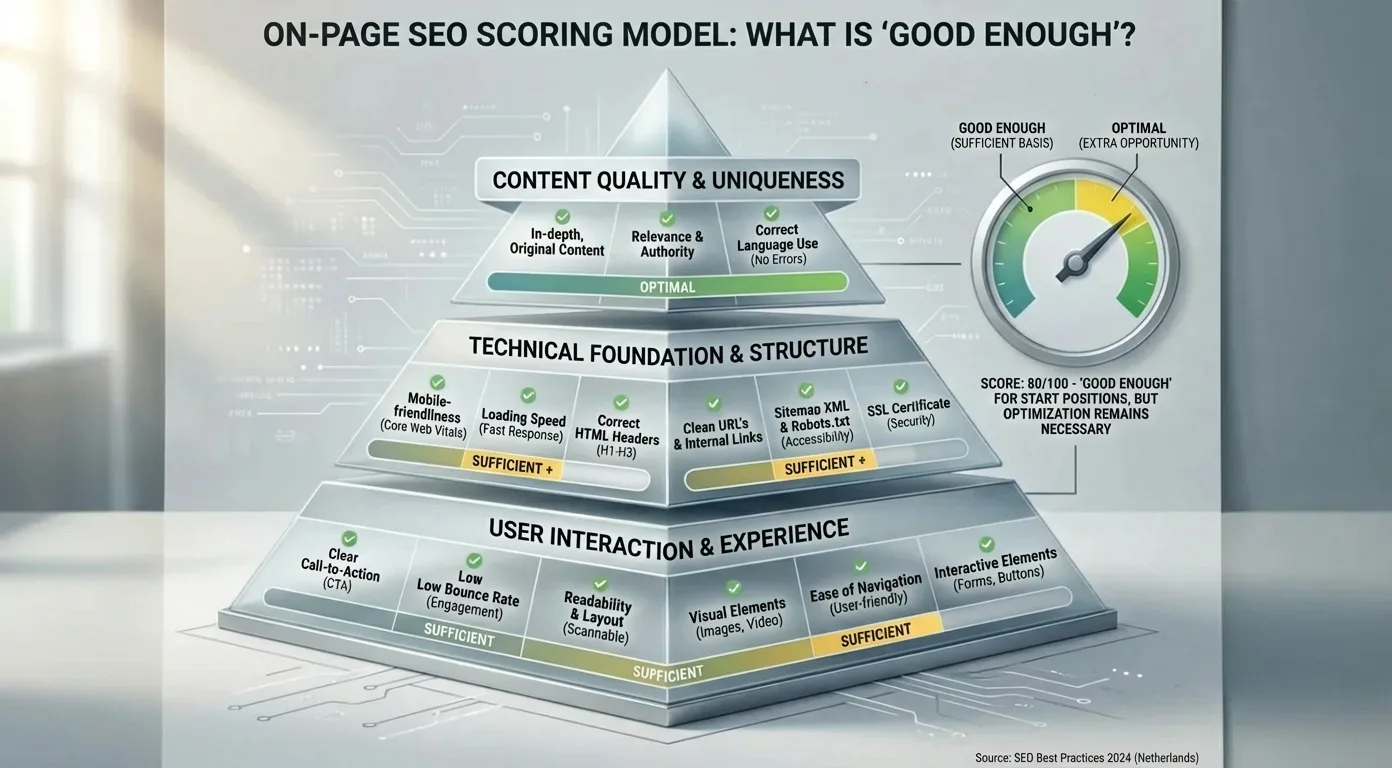
Within the On-page SEO Checklist (Scoring Model): What's 'Good Enough'? strategy, the relevance of headings and metadata plays a crucial role in determining the final score.
Content Quality and Semantic Relevance
Content is still king, but the definition of quality has evolved significantly in recent years. It's no longer enough to stuff a text with keywords; the context and intent behind the search query are now paramount. An effective scoring model evaluates whether the text answers the user's question and whether the information is unique and valuable. Here, we look at the On-page SEO Checklist (Scoring Model): What's 'Good Enough'? for better findability to determine if the depth of the text is sufficient compared to the competition. Using synonyms and related terms helps search engines better understand the page's topic without resorting to keyword stuffing.
"An SEO score is not a static number, but a dynamic representation of how well a page aligns with the ever-changing expectations of both search engines and human visitors."
To ensure the effectiveness of your model, you can prioritize the following elements:
- The presence of the main keyword in the H1 tag and the first paragraph.
- The use of alt text for images for better accessibility.
- The internal linking structure to relevant pages like our WordPress blog tips for more authority.
- The readability score based on the Flesch Reading Ease index.
- The presence of a clear 'Call to Action' that helps the user further.
It's important to remember that the On-page SEO Checklist (Scoring Model): What's 'Good Enough'? method should always be adapted to the specific niche in which you operate. What works for a webshop may be less effective for an informative blog. For more in-depth information on search engine technical guidelines, you can consult the official documentation from Google Search Central. By consistently measuring and optimizing based on an established scoring model, you lay a solid foundation for long-term organic success and a higher conversion rate on your website.
Content Quality vs. Technical Optimization: Finding the Balance
In the world of search engine optimization, a tension often arises between the creative side of content creation and the rigid demands of technology. A website that is technically perfect but adds nothing in terms of content will rarely rank highly, while fantastic texts without the right structure remain invisible to algorithms. It's all about finding the golden mean where the user is central without ignoring the search engine. When we look at an On-page SEO Checklist (Scoring Model): What's 'Good Enough'?, we see that the highest scores are achieved by pages that exude authority while loading lightning-fast on every device.
The technical foundation is key, but the content is why visitors stay and convert into customers.
The Synergy Between Code and Text
It's essential to understand that Google now looks at the user experience as a whole, meaning that technical aspects like loading speed directly influence how the quality of your content is perceived. If a page is slow, the visitor will leave before reading the first sentence, resulting in a high bounce rate. Within an effective On-page SEO Checklist (Scoring Model): What's 'Good Enough'? for modern websites, technical optimization must support readability through a logical heading structure and optimized media. For those struggling with the technical side, consulting resources on why a site loads slowly can be essential to restore balance. It's not about ticking boxes for an algorithm, but about creating a seamless experience where the technology invisibly does its work while the message shines.

A good balance also means not overdoing optimization, which often harms readability.
"The best SEO is invisible to the reader, but crystal clear to the search engine."
Prioritizing in Your Scoring Model
When applying an On-page SEO Checklist (Scoring Model): What's 'Good Enough'? in practice, one must prioritize elements that have the most impact on both ranking and user experience. This includes aspects like keyword relevance, internal linking structure, and mobile-friendliness. It's often tempting to spend hours on micro-optimizations, but in practice, a strong focus on the core needs of the target audience often yields better results than chasing a perfect technical score of one hundred percent. On-page SEO Checklist (Scoring Model): What's 'Good Enough'? for small business owners often suggests that a solid foundation is more important than complex technical stunts that suppress content.
- Focus on user search intent over keyword density.
- Ensure a clear hierarchy with H1, H2, and H3 tags for clarity.
- Optimize images for speed without compromising visual quality.
- Use internal links to relevant pages such as professional custom web design to distribute authority.
- Monitor performance using tools like Google Search Console to adjust where necessary.
Ultimately, the question with every On-page SEO Checklist (Scoring Model): What's 'Good Enough'? analysis is whether the page truly helps the visitor. If technology impedes content, or if content ignores technology, you lose potential reach. By uniting both worlds, you create a sustainable strategy that withstands algorithm updates and exceeds the expectations of the modern internet user.
Why 100% SEO Tool Scores Aren't Always Necessary
Many website owners become obsessed with the green lights in plugins like Yoast or Rank Math. While these tools offer excellent guidance, a perfect score of one hundred percent is not a guarantee for a top position in Google. Search engine algorithms are far more complex than the static rules of a plugin. Blindly following every suggestion can even lead to over-optimization, which severely harms the readability of your text. Therefore, it is essential to understand how to interpret the On-page SEO Checklist (Scoring Model): What's 'Good Enough'? in the context of real user experiences.
A score of eighty percent is often more than sufficient to perform excellently in search results.
When we look at the technical reality, we see that tools often look for the presence of keywords in specific places, such as the first paragraph or the alt text of images. However, Google now understands semantics and context. If you rigidly try to apply the On-page SEO Checklist (Scoring Model): What's 'Good Enough'? for advanced users everywhere, you lose the natural flow of your story. The algorithm values quality content that answers the user's search intent more than a text that exactly matches an outdated formula from an external analysis tool. Therefore, focus more on the value you provide to the reader than on achieving a theoretical perfection that adds little practical value.
The Pitfall of Over-optimization and Algorithm Updates
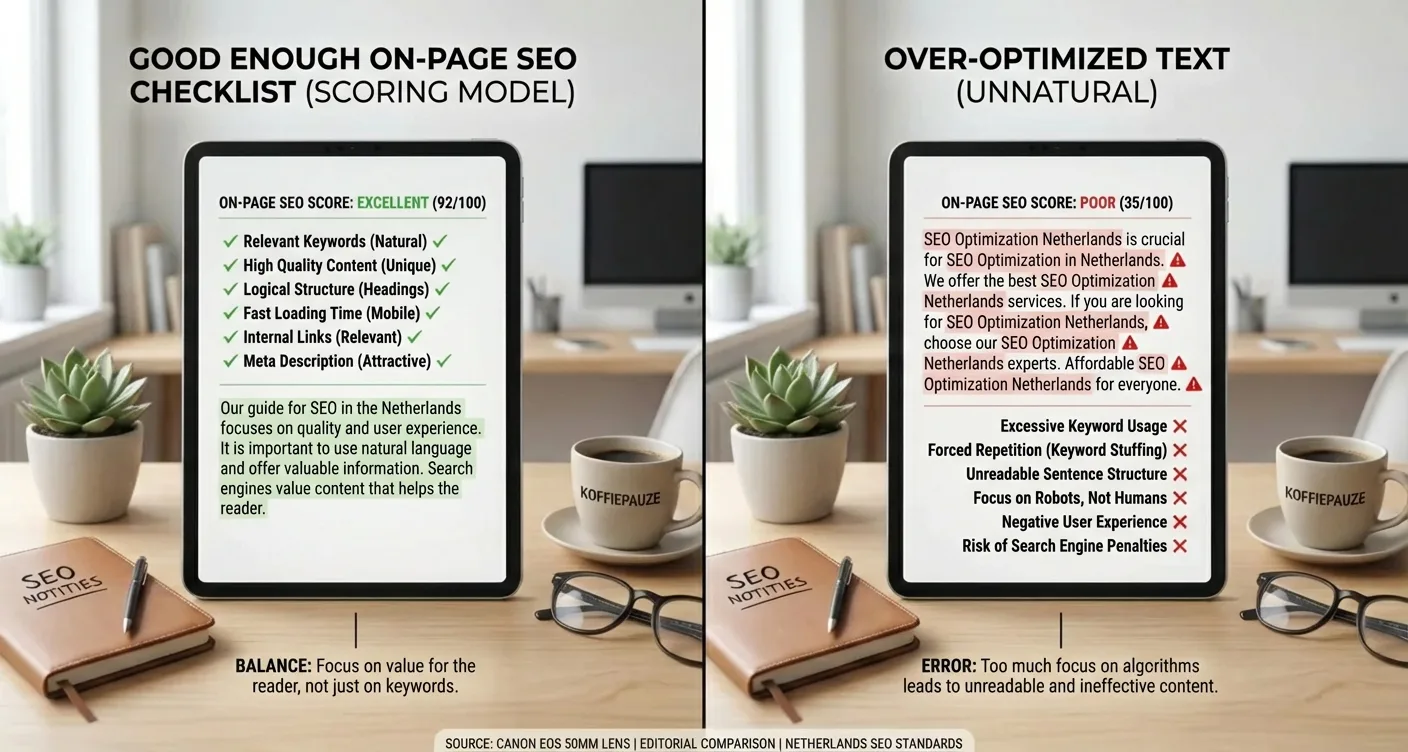
Over-optimization can lead to unnatural language that modern search engines actually penalize. If every sentence forcibly contains a keyword, visitors will notice immediately and leave the page faster. This increases your bounce rate, which is a negative signal for your ranking. Using the On-page SEO Checklist (Scoring Model): What's 'Good Enough'? method helps you find a balance between discoverability and readability. It is better to publish a text that reads well and is optimized at the most important points than a text that is technically perfect but no one wants to read.
Remember that search engines ultimately want to serve people, not just bots collecting data.
"SEO is not an exact science where one hundred percent is always better; it's about the relevance and authority you build within your niche."
Prioritizing within Your Optimization Strategy
Not every part of an SEO scan has the same impact on your final position. It is therefore crucial to know which elements you should address immediately and which you can leave as they are. By prioritizing an audit action plan, you prevent wasting hours on details that barely affect your traffic. In practice, a strong title and a clear structure often outweigh the exact density of a secondary keyword. Use the On-page SEO Checklist (Scoring Model): What's 'Good Enough'? approach to determine where your time yields the most value for your website's growth.
Use the following guidelines to determine when you can stop optimizing:
- The text reads fluently and contains no forced repetitions of search terms.
- The main headings provide a clear overview of the page's content.
- The meta description invites clicks without being misleading.
- The internal linking structure guides the visitor to relevant follow-up pages.
- The On-page SEO Checklist (Scoring Model): What's 'Good Enough'? guidelines for content creators have been applied to the most critical elements.
Ultimately, the On-page SEO Checklist (Scoring Model): What's 'Good Enough'? strategy is about efficiency. You want to see results without getting bogged down in endless adjustments that obscure the core of your message. According to the experts at Search Engine Journal, user experience (UX) is now one of the most important factors for success. If your content answers the user's question, Google will recognize this, regardless of whether your tool indicates a score of 90 or 100. Remain critical of software suggestions and trust your own judgment as a content expert to maintain the right balance.
The Role of Search Intent in Determining the Ideal SEO Score
Understanding search intent is the absolute cornerstone of any successful content strategy. When we look at the On-page SEO Checklist (Scoring Model): What's 'Good Enough'?, we must realize that a high numerical score in a tool has little value if the content does not align with what the user is actually looking for. Search engines like Google are becoming increasingly intelligent at recognizing whether a page satisfies an informational need or prompts a commercial action. Therefore, a rigid focus on technical parameters is secondary to the relevance of the information provided for the specific searcher at that moment.
Search intent determines whether your 80/100 score actually yields results in the search engine rankings.
When completing the On-page SEO Checklist (Scoring Model): What's 'Good Enough'? for advanced users, it is clear that the context of the keyword is decisive. An informative blog post about 'how to replace a faucet' requires a completely different structure and media usage than a product page for that same faucet. In practice, we see that pages that perfectly match the intent often rank higher than pages with a technically perfect score that miss the mark in terms of content need. It's about finding the right balance between technical requirements and the psychological expectation of the website visitor.
Different Types of Intent and Their Impact on the Score
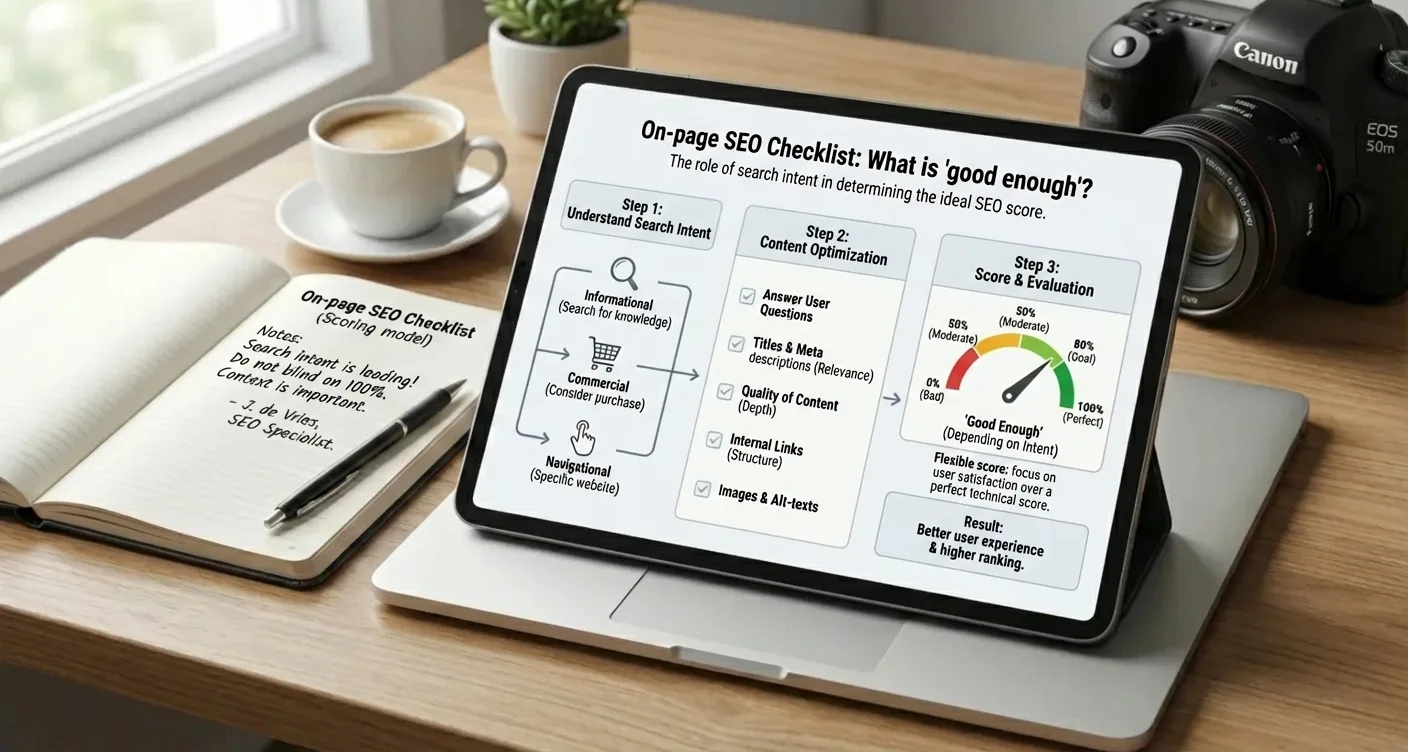
There are generally four main categories of search intent that influence how you apply the On-page SEO Checklist (Scoring Model): What's 'Good Enough'? strategy. First, there's informational intent, where the user seeks answers. Then we have navigational intent (searching for a specific website), commercial intent (researching for a purchase), and transactional intent (direct purchase readiness). Different priorities apply to each category within your optimization process. For example, on a transactional page, loading speed and a clear 'call-to-action' will weigh more heavily for the user experience than the total text length or keyword density.
"The best SEO score is not the highest score in a plugin, but the score that results in the highest satisfaction for the end-user entering via a search engine."
It is essential to critically review the On-page SEO Checklist (Scoring Model): What's 'Good Enough'? content guidelines to prevent over-optimizing for algorithms.
To determine if your content meets the intent within the On-page SEO Checklist (Scoring Model): What's 'Good Enough'? methodology, you can analyze the following elements:
- The current top 10 results in Google for your main keyword.
- The dominant type of content present (lists, videos, product pages).
- The specific questions answered in the 'People Also Ask' section.
- The visual presentation competitors use to help the user.
When you combine these insights with professional WordPress services, you create a foundation that goes beyond just text. It's about building an experience that seamlessly aligns with the customer's journey. According to Google Search Central documentation, providing a good user experience and relevant answers is the most important factor for long-term success. Ultimately, the On-page SEO Checklist (Scoring Model): What's 'Good Enough'? approach is truly successful if the visitor finds what they were looking for and doesn't immediately return to the search results.
Practical Steps to Prioritize Your Own On-page SEO
Setting the right course within your search engine optimization begins with understanding the balance between perfection and feasibility. Many website owners get caught up in an endless list of technical tasks, losing focus on the essentials. To work effectively, you need a system that places the most impactful changes at the top of your agenda. An On-page SEO Checklist (Scoring Model): What's 'Good Enough'? helps you distinguish between critical errors that directly harm your ranking and minor cosmetic adjustments that have little impact on your visibility in Google's search results.
First, focus on fundamentals like titles and meta descriptions before delving into complex schema markups.
When you start optimizing a specific page, it's essential to look at current performance and competition in the niche. Use an On-page SEO Checklist (Scoring Model): What's 'Good Enough'? for small business owners to ensure your content's foundation is solid. This means checking if the search intent matches what the user expects to find. In practice, we often see that pages that are not 100% technically perfect still rank excellently because their relevance and user experience are simply superior to the competition's.
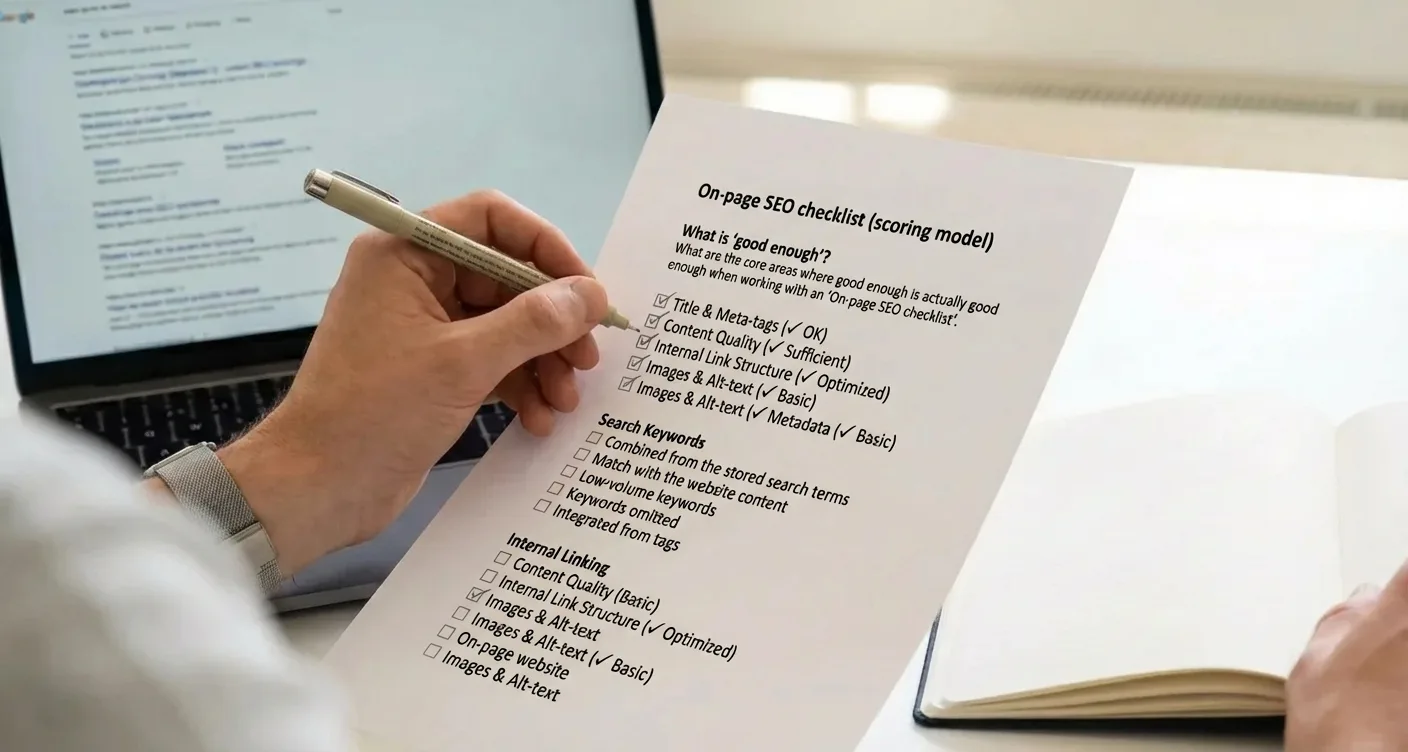
The Importance of Technical Stability and Speed
A crucial part of your priority list is your website's technical health, as a slow site can negate all other on-page efforts. If you notice that your pages load slowly or have technical errors, this should immediately be at the top of your On-page SEO Checklist priority list. A good starting point is WordPress speed optimization to ensure visitors don't bounce before the content loads. Without a solid technical foundation, optimizing keywords is often a wasted effort, as search engines prefer stable platforms.
Always ask yourself if an adjustment truly helps the user or if it's merely a checkmark for an algorithm.
"SEO is not a one-time task, but a continuous process of refining and prioritizing based on data and user behavior."
Step-by-Step Implementation of Your Optimization Plan
To structure your work, you can follow these steps, which often prove effective in practice:
- Analyze the top 3 results for your main keyword and compare their page structure with yours.
- Check if your main keyword, the On-page SEO Checklist (Scoring Model): What's 'Good Enough'? method, appears in the H1 and the first paragraph.
- Optimize the internal linking structure to pass authority to your most important landing pages.
- Verify the mobile-friendliness of the page, as most searches nowadays occur via smartphones.
It is advisable to use tools like Google Search Console to see which pages are already gaining traction and where a small improvement in the On-page SEO Checklist strategy for advanced users can make a big difference. By making data-driven decisions, you avoid wasting time on pages with little potential. Remember that 'good enough' means meeting user needs and minimum search engine requirements, without over-optimizing to the point of appearing unnatural.
Continuously monitor your progress and adapt your strategy as search engine results change.
Common Mistakes When Blindly Following SEO Checklists
Blindly ticking off lists is a pitfall that even experienced marketers often fall into. When one focuses purely on achieving a one hundred percent score in a specific tool, the true intent of the searcher is often lost. An On-page SEO Checklist (Scoring Model): What's 'Good Enough'? is intended as a flexible guide, not a rigid rulebook. The greatest danger is that the text feels unnatural to the human reader because it has been over-optimized for algorithms that are now much smarter than simply counting keywords. Google understands context and semantics excellently, meaning that a text written purely for a score often performs worse than a text that offers real value to the visitor.
The Obsession with Green Dots
Many website administrators become obsessed with the visual indicators of plugins like Yoast or Rank Math. They forget that a scoring method is only a tool to get the technical foundation in order and is by no means a guarantee for a number one position in search results.
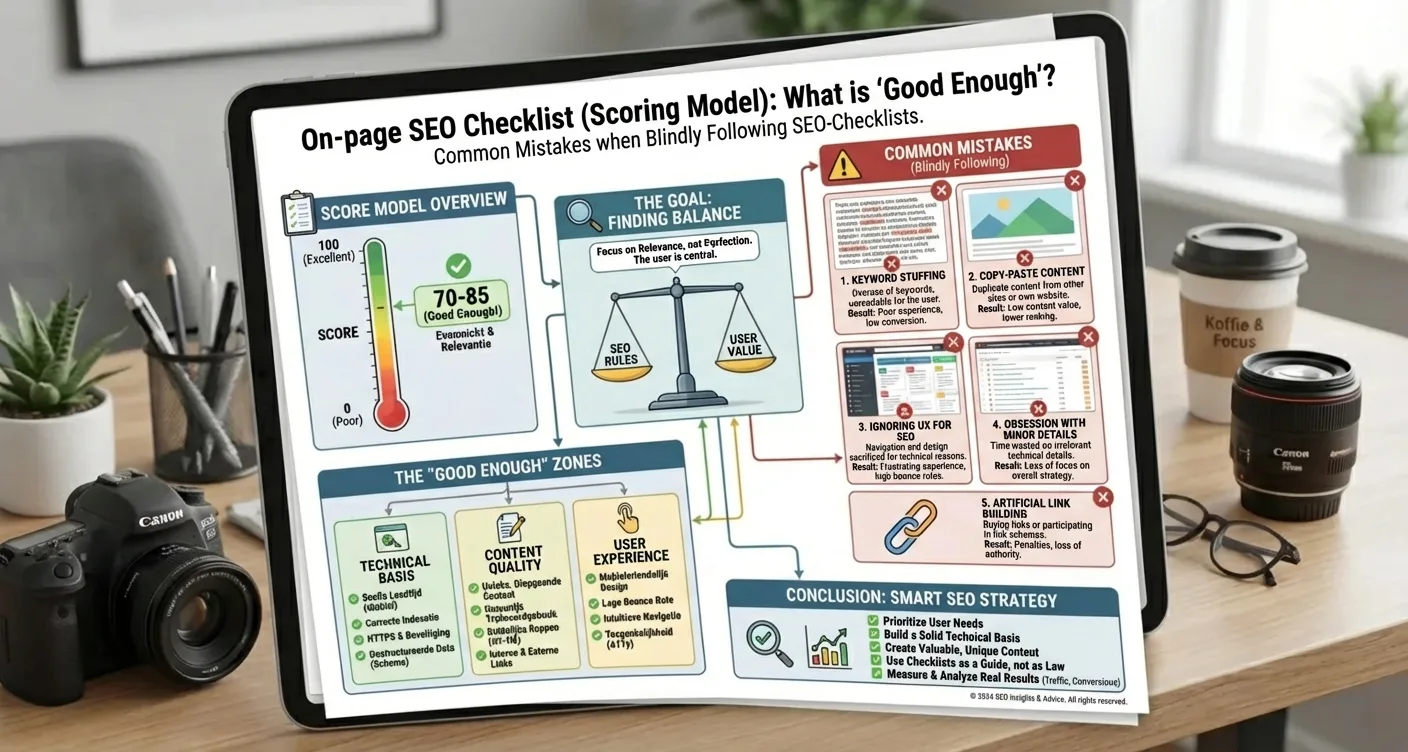
A common mistake is completely ignoring the user experience in favor of technical checkmarks. Think of excessive use of subheadings or forcing keywords into every paragraph. In practice, we see that this severely harms readability. For those looking to get off to a flying start, it's advisable to consider an optimized WordPress start where the balance between technology and content is central. Blindly following a checklist can lead to 'keyword stuffing,' which search engines penalize as manipulative behavior.
"SEO is not a mathematical formula you can solve by simply ticking boxes; it is the art of being relevant to your target audience."
Context Over Quantity
It's essential to understand that not every page requires the same treatment. A contact page needs a different strategy than an in-depth blog article. According to information from Google Search Central, creating unique, relevant content is still the most important factor for online success.
- Ignoring the search intent behind the terms used.
- Too much focus on internal link quantity instead of link relevance.
- Forgetting mobile display when optimizing.
- Not periodically reviewing the applied SEO guidelines.
Ultimately, it comes down to whether the page solves the user's problem. A too rigid approach can limit the creativity needed to truly stand out in today's saturated search results.
Conclusion: When Your On-page Optimization Is Truly 'Good Enough'
Achieving a perfect score in search engines is a noble pursuit, but in practice, it's about the balance between technical perfection and user experience. The question, "On-page SEO Checklist (Scoring Model): What's 'Good Enough'?", can be answered by looking at the competition and the searcher's intent. If your page loads faster, provides better answers, and is technically healthier than the top three results, then you have reached the point of 'good enough'. Blindly chasing a one hundred percent score in tools can sometimes even be counterproductive for the readability of your texts.
Often, we see administrators getting bogged down in details. An On-page SEO Checklist (Scoring Model): What's 'Good Enough'? for advanced users helps you prioritize content optimization.
The Balance Between Technique and Relevance
An effective On-page SEO Checklist (Scoring Model): What's 'Good Enough'? looks beyond just the presence of keywords. It's about the structure of your headings, the quality of your internal links, and how images are presented to both humans and machines. In practice, a page that checks eighty percent of the checklist but excels in unique value often performs better than a technically perfect but soulless page. Therefore, use the On-page SEO Checklist (Scoring Model): What's 'Good Enough'? for local entrepreneurs as a guide to determine where your focus should lie during the final optimization round.
"SEO is not a one-time task, but a continuous process of refinement where the user must always be central, above algorithms."
When applying the On-page SEO Checklist (Scoring Model): What's 'Good Enough'? strategy, it's essential to check the following points:
- Is the main text directly relevant to the search intent?
- Are internal links, such as to this customer review, logically placed?
- Do all visual elements load fast enough on mobile devices?
Ultimately, the On-page SEO Checklist (Scoring Model): What's 'Good Enough'? method is successful if you rise in rankings without losing the natural flow of your website. For more in-depth information on web standards, you can visit the W3C for technical guidelines.
Striving for perfection is noble, but in search engine optimization, pragmatism is often more effective for results.
A strong On-page SEO Checklist (Scoring Model): What's 'Good Enough'? helps you prioritize without getting lost in details. First, focus on the basics like titles, headings, and internal links before tackling every minor technical point. Consistency in quality outweighs a one-time perfect score that consumes too much time.
Frequently Asked Questions
What exactly does an On-page SEO Checklist (Scoring Model): What's 'Good Enough'? entail?
This model is a method to assess the quality of your webpage based on SEO factors like titles, meta descriptions, and content. It helps you determine when a page is sufficiently optimized to compete in search results without engaging in over-optimization.
How do you determine the ideal score for a specific webpage?
The ideal score depends on the competition in the search engine; you don't always need to achieve a 100% score. Within an On-page SEO Checklist (Scoring Model): What's 'Good Enough'?, we often aim for a score that is just slightly better than the current top results.
Why is a scoring model more effective than a simple checklist?
A scoring model weighs different factors more heavily than others, allowing you to prioritize changes with the most impact. This prevents you from wasting time on marginal improvements that do not significantly influence ranking.
When should you stop optimizing your on-page elements?
You stop when the extra effort no longer justifies the expected increase in search results. Once the user experience and relevance are optimal according to your checklist, the page is 'good enough' for publication.
How SEO Supercharged helps you here
SEO Supercharged is fully online (service area: online, worldwide), so you can use it from anywhere.
The platform is built for SME business owners with growth ambitions, Marketing managers at mid-sized organizations, E-commerce operators and webshop owners, SaaS companies and tech startups, B2B service providers and business consultants, Content and communication specialists, International exporters and global brands, Local entrepreneurs with a digital focus, Digital marketing agencies and agency owners.
You can use it for, among other things, GEO-strategy & AI-audit, Hybrid SEO & GEO content creation, LLM-visibility analysis, Structured Data & Schema optimization, Brand Authority & Citation building, E-E-A-T content optimization.
Want to tackle this directly? Optimize your SERP snippet with the SERP Optimizer, or start a free SEO analysis.
Related articles
- From Keyword to Winning SEO Page: Generator + SERP Optimizer
Discover a practical workflow to build winning SEO pages: from keyword research and intent mapping to content generation and SERP snippet optimization. Boost.
- SERP Testing: Boost Your Click-Through Rate with A/B Tests
Learn how to conduct effective SERP A/B testing to significantly increase your click-through rate. Get practical tips and strategies for more organic clicks.
- Meta Descriptions: Boost Clicks Without Clickbait
Discover how to boost your CTR with meta descriptions without clickbait. Improve organic search results today with practical tips for effective snippets.
- Clickable Title Tags: Patterns & Sector-Specific Examples
Master clickable title tags with proven patterns & sector-specific examples. Learn to boost your CTR, drive more organic traffic, and optimize your website now!
- The Fundamentals of Structured Data for Rich Results
Learn all about structured data for rich results: the dos and don'ts. Optimize your website and boost your CTR immediately. Read our expert tips now!