Why You Should Build a Sitemap and Website Structure First for SEO
Build a Sitemap First: Essential SEO Before Content
Why You Should Build a Website Structure or Sitemap First
Building a sitemap with a well-defined website structure is the optimal starting point. While many immediately think of content writing for SEO, truly effective SEO actually begins before you even create any content.
Your website first needs a clear structure. Think of it like a physical store: if all the products, shelves, and aisles are jumbled together, no one will quickly find what they're looking for. This applies to both your visitors and Google.
Consider your website as a store. Google acts like a new customer walking in. If everything is neatly organized with clear signage and pathways, that customer will quickly find what they need. But if it's a messy pile, they'll get lost and leave.
Google operates similarly. It deploys a 'robot' or crawler that navigates your site from link to link, aiming to grasp your website's purpose and identify its most important pages. The more transparent your structure, the better Google comprehends your content — and the greater your likelihood of ranking for relevant keywords.
A sitemap generator helps establish the correct site layout from the start.
- Which pages are essential?
- Which topics should be grouped?
- Which pages must avoid duplicate content?
- Which blog articles support specific services or products?
- What structures are your competitors already using successfully?
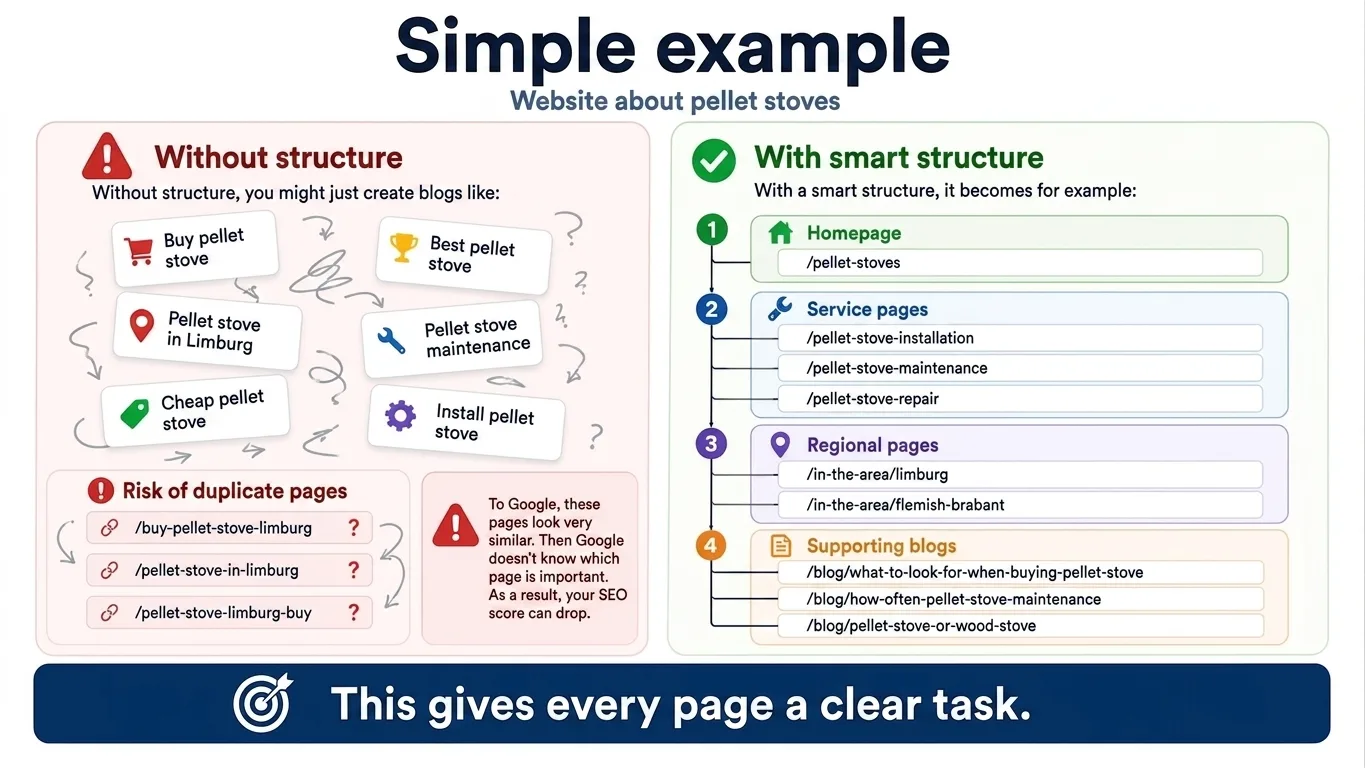
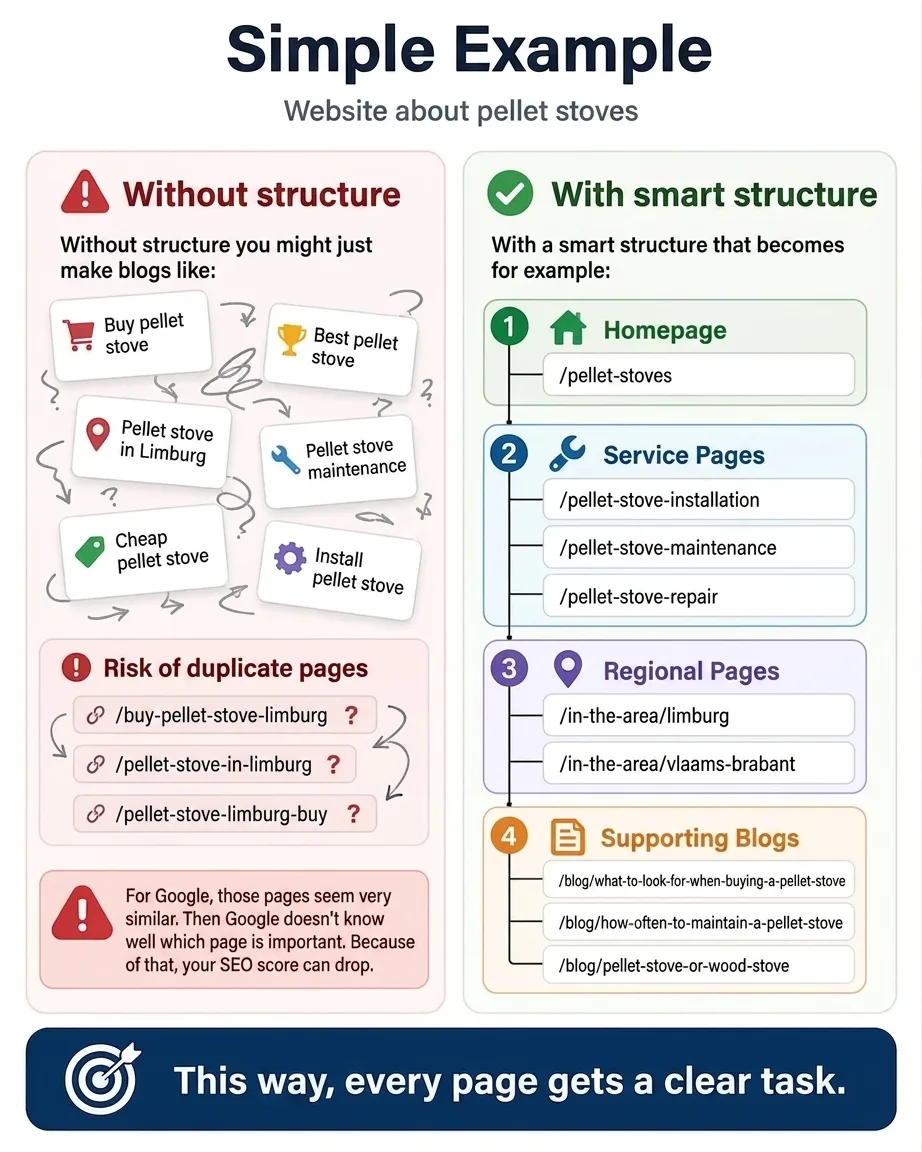
Simple Example
Imagine you have a website about pellet stoves.
Without a clear structure, you might haphazardly create blogs such as:
- Buy a Pellet Stove
- Best Pellet Stove
- Pellet Stove in Limburg
- Pellet Stove Maintenance
- Cheap Pellet Stove
- Install a Pellet Stove
This might seem fine, but without a plan, you can quickly create duplicate pages. For example:
/pelletkachel-kopen-limburg/pelletkachel-in-limburg/pelletkachel-limburg-kopen
To Google, these pages appear very similar. Google then struggles to determine which page is important, which can lead to a decline in your SEO performance.
With a smart structure, it could look like this:
Main Page
/pellet-stoves
Service Pages
/pellet-stove-installation/pellet-stove-maintenance/pellet-stove-repair
Regional Pages
/nearby/limburg/nearby/flemish-brabant
Supporting Blogs
/blog/what-to-look-for-when-buying-a-pellet-stove/blog/how-often-to-maintain-a-pellet-stove/blog/pellet-stove-or-wood-burner
This way, each page has a clear purpose.
Why is this important for Google?
Google wants to understand:
- what your website is about;
- which page is the most important;
- which page is relevant for specific search queries;
- which pages support each other;
- whether you have duplicate or confusing URLs.
Creating a well-crafted sitemap with a robust SEO structure ensures Google understands your website more quickly. This significantly boosts your chances of ranking for the right keywords.
⚠️ Beware of Duplicate Pages
Imagine you write one strong article about "pellet stove maintenance". Due to your site's settings, that same article suddenly appears at three different addresses:
jouwsite.be/blog/pelletkachel-onderhoudjouwsite.be/pelletkachel-onderhoudjouwsite.be/blog/pelletkachel-onderhoud?ref=facebook
To you, it's one article. To Google, these are three different pages with identical content — and it doesn't know which one is the authoritative version.
The consequence: your SEO authority is diluted across three weak pages, rather than being consolidated into one strong one.
Think of it like publishing a book under three different titles. Sales and reviews would be split across three versions, so none would become a bestseller — even though, together, they would dominate the charts.
💡 The Power of the Sitemap Generator
The sitemap generator is more than just a simple list-maker.
It begins by analyzing your market, your website, and your competitors. Following this analysis, it proposes a logical, search engine-friendly website structure.
The tool queries Google for both your site and those of your competitors, offering an immediate overview of how the top-ranking sites in your niche are built. This insight allows you to construct your own clear, optimized structure.
Concurrently, it identifies duplicate addresses, enabling you to select a single, clear canonical URL. This ensures all your SEO efforts are concentrated on that one correct page.
It helps you determine:
- which essential pages you need;
- which blogs will be most impactful;
- which URLs are logical and user-friendly;
- which topics should be grouped for clarity;
- where potential duplicate content issues might arise;
- how to build a more robust website structure for Google.
💡 In Summary
You're not just building isolated pages; you're constructing an entire SEO plan.
A strong structure serves as the foundation. Only after establishing this base should you begin generating content, blogs, service pages, and product pages.
This approach allows you to work smarter, prevent duplicate content issues, and provide Google with a clear roadmap for navigating your website.
In essence: your site becomes intuitive for both your visitors and for Google — and that's exactly what helps you rank higher.
Frequently Asked Questions About Sitemaps and Website Structure
Why is a sitemap important for SEO?
A sitemap helps Google understand which pages exist on your website and how they are interconnected. This makes it easier for Google to crawl and index your site effectively.
Should I create a sitemap before writing content?
Yes, that's generally the smarter approach. First, determine which pages you need and what purpose each page will serve. Then, you can write more targeted and effective SEO content.
What is the risk of duplicate pages?
If identical content exists on multiple URLs, Google struggles to determine which page is the primary one. This can dilute your SEO authority across several weaker pages.
What does 'canonical' mean?
A canonical tag specifies the preferred version of a page. It tells Google: this is the master URL that you should crawl, index, and rank.
What does the SEO Supercharged sitemap generator do?
The tool analyzes your website, market, and competitors. It then proposes a logical, optimized structure featuring clear pages, impactful blogs, and clean URLs free from confusion.
Does a strong website structure help you rank higher?
Absolutely. A clear, logical structure makes your website more comprehensible for both visitors and Google. This significantly increases your chances of being discovered for the right keywords and improving your search rankings.
Related articles
- Sitemap Architect: Build a Site Structure That Ranks (SEO, AI, GEO)
Learn to use Sitemap Architect for a content map boosting rankings, internal links, indexing & AI answers. Templates, checklists, pitfalls included.
- Scalable SERP Meta Optimization: Titles and Descriptions that Drive Clicks
Master scalable SERP meta optimization. Learn to craft click-worthy titles & descriptions that boost CTR, improve SEO strategy, & drive organic traffic. Get.
- Why WordPress XML Import Best Practices (and Pitfalls) Are Essential
Learn everything about WordPress XML import. Discover best practices and common pitfalls. Prevent errors and optimize your data transfer today. Read our.
- Multilingual Sitemaps: URL Structure & Hreflang Strategy for Global SEO
Master multilingual sitemaps, URL structure, and hreflang strategy for superior international SEO. Optimize your global website to attract more visitors now!
- Service Page Structure: From 6 Topics to 30 Pages Without Overlap
Optimize your service page structure: scale from 6 core topics to 30 unique pages without overlap. Learn to expand content and boost SEO. Read our guide!