Technical SEO for React Vite: Optimize Your Web Application
Technical SEO for React Vite: Optimize Your App for Search Engines
Optimizing technical SEO for React Vite is essential for modern web applications aiming for maximum visibility in Google. By focusing directly on server-side rendering (SSR) or pre-rendering within your strategy, you ensure that crawlers effortlessly index dynamic content. This approach prevents delays caused by heavy JavaScript files. Combining Vite's lightning-fast build times with React requires a specific strategy, ensuring that metadata, sitemaps, and structured data are correctly implemented for optimal results.
An effective approach to technical SEO for React Vite ensures search engines fully understand your application's context.
The core of advanced methods lies in minimizing 'time to interactive.' A strong configuration significantly enhances the user experience through faster load times.
- Implement SSR for quicker indexing.
- Dynamically optimize meta tags per route.
- Use code-splitting for shorter load times.
- Automatically generate an XML sitemap.
What is Technical SEO for React Vite and Why is it Crucial?

In the modern web landscape, the combination of React and Vite has rapidly become the standard for developers seeking speed and efficiency. However, without a well-thought-out approach to technical SEO for React Vite, these powerful applications risk remaining invisible to search engines like Google. The problem often lies in how JavaScript frameworks render content; if a search engine bot visits the page and finds only an empty HTML skeleton, indexing will fail. Therefore, it's essential to integrate technical optimizations directly from the start of your project, ensuring that Vite's rapid load times genuinely translate into higher positions in organic search results.
Understanding your application's architecture is the first step toward success.
The Synergy Between Speed and Search Visibility

When we discuss technical SEO for React Vite, we refer to the process of configuring the technical infrastructure of a Vite-powered React app so that crawlers can easily understand and rank its content. Vite offers a significant advantage with its Hot Module Replacement and fast build times, but the real challenge lies in client-side rendering (CSR). Without additional techniques like Server-Side Rendering (SSR) or Static Site Generation (SSG), your technical SEO strategy for React Vite may fall short. This is because metadata and content only appear after the script has fully executed in the user's browser. By bridging this gap, you ensure that both users and algorithms have an optimal experience.
Implementing advanced technical SEO methods for React Vite to improve indexing is no longer a luxury but an absolute necessity for competitive businesses.
Why Technical SEO Forms the Foundation
A solid technical foundation prevents your marketing efforts from being wasted on an inaccessible website. Within the ecosystem of technical SEO optimization for React Vite, we examine elements such as correct header tags, canonical URLs, and minimizing 'Time to Interactive.' If these elements are not in order, even the highest quality content will not perform well. It's about creating seamless interaction between the code and the search engine index. For more information on how to tackle this, you can explore affordable search engine optimization for your specific projects.
Follow these steps for a better structure:
- Ensure dynamic rendering of meta tags per route.
- Use tools like Vite-plugin-ssr for better pre-rendering.
- Optimize bundle size to maximize load speed.
- Verify that your React Vite technical SEO configuration returns correct status codes to crawlers.
"Vite's speed is impressive, but without a strong focus on technical SEO for React Vite, half its potential in search results remains untapped."
According to Vite's official documentation, the tool is designed for speed, but the responsibility for SEO lies with the developer's architectural choices. It's crucial to realize that technical SEO implementation for React Vite is a continuous process, starting with configuration and extending through to the application's final deployment.
Implementing Server-Side Rendering (SSR) with Vite
Implementing Server-Side Rendering (SSR) is a crucial step for anyone serious about the search visibility of modern web applications. When we consider technical SEO for React Vite, standard Client-Side Rendering (CSR) often falls short because search engines initially receive an empty HTML page. By configuring Vite for SSR, the complete HTML structure is generated on the server, giving crawlers immediate access to your website's full content. This process not only ensures faster indexing but also significantly improves the overall user experience by minimizing 'Time to Content.'
Utilizing technical SEO strategies for React Vite ensures metadata and titles are immediately available to bots.
The Technical Architecture of Vite SSR
Within a Vite environment, SSR requires a specific folder structure that distinguishes between the client entry and the server entry. The server entry is responsible for rendering React components into a string, which is then placed within an HTML template. This is an essential part of technical SEO optimization for React Vite, as it enables the server to deliver a fully populated page to both users and search engines. By leveraging Vite's built-in middleware, you can benefit from Hot Module Replacement during development, while serving an optimized build in production that responds rapidly to requests.
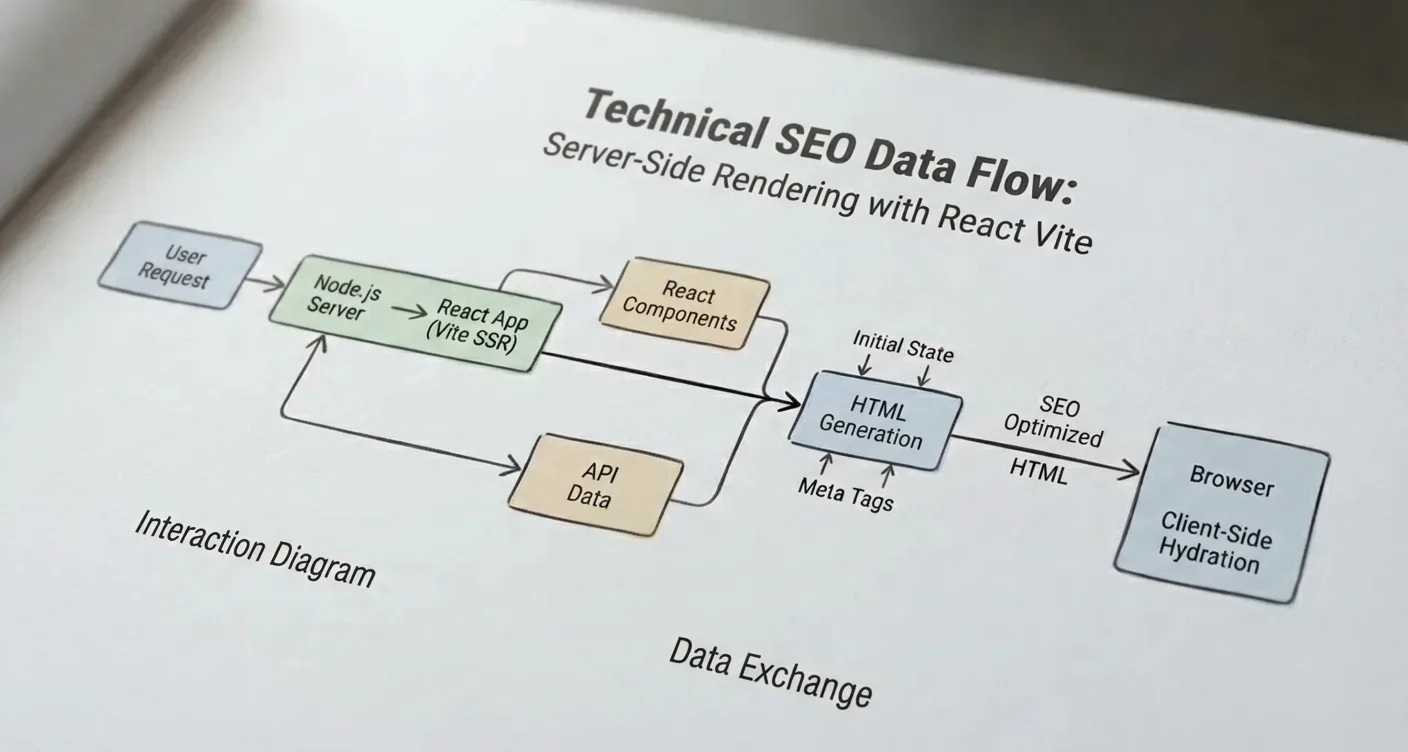
"SSR is no longer a luxury, but a necessity for complex applications that rely on organic search traffic."
Effective technical SEO for React Vite to improve indexing begins with correctly handling data fetching on the server before the page is sent to the browser.
Benefits for Search Engine Optimization
The impact of SSR on your rankings cannot be underestimated, especially since Google prioritizes pages that load quickly and are immediately readable. With technical SEO techniques for React Vite, you prevent the Googlebot from waiting for JavaScript execution, which often leads to delays in indexing your latest content. Furthermore, a solid server-side setup helps prevent errors in social media preview rendering, as platforms like Facebook and LinkedIn also rely on the initial HTML output to generate rich snippets. Remember that a secure environment also contributes to your authority; therefore, consider timely professional maintenance for your infrastructure.
- Direct display of critical content for search engines.
- Improved Core Web Vitals, specifically Largest Contentful Paint (LCP).
- Better support for social media crawlers and previews.
- Consistency in dynamic metadata rendering via technical SEO tools for React Vite.
For more in-depth information on configuring your build pipeline, you can consult the official Vite SSR documentation for the latest updates and best practices.
Ultimately, technical SEO for React Vite is about removing barriers between your content and the end-user, resulting in a robust digital presence.
Client-Side Rendering vs. Static Site Generation
When developing modern web applications, developers often face a crucial choice that directly impacts search visibility. Client-Side Rendering (CSR) is the standard method where the user's browser does the heavy lifting by executing JavaScript to build the page. While this provides a smooth user experience, it can be a stumbling block for search engines that struggle to index dynamic content. For an optimal technical SEO strategy for React Vite, it's essential to understand that while search engines like Google can render JavaScript, this process is often slower and requires more resources than with static pages. The difference between these techniques determines how quickly a crawler can understand and value your website's full content.
The Impact of Rendering on Search Engine Optimization

Static Site Generation (SSG) offers a powerful alternative by generating HTML files during the build process. This means that when a crawler visits, the complete content is immediately available without complex scripts needing to be executed. Within the context of a robust implementation, SSG ensures lightning-fast load times and superior indexing. This is especially important for websites with a lot of static content, such as blogs or informational pages, where speed and immediate text availability are top priorities for search ranking. By choosing the right architecture, you lay a solid foundation for your online presence and future growth.
"The choice between CSR and SSG is not just a technical decision, but a strategic move that determines how effectively your content is communicated to both users and search engines."
Hybrid Solutions and Performance
In practice, we often see that a hybrid approach yields the best results for complex projects. With tools like Vite, developers can statically generate specific parts of an application while interactive elements continue to function via client-side scripts. This significantly improves performance because critical content is immediately readable by bots. It's important to pay attention to the 'hydration' phase, where static HTML is made interactive again in the browser. Incorrect configuration here can lead to a deterioration of the user experience and SEO value, which can be prevented by adopting an advanced approach.
- CSR offers maximum interactivity but requires extra attention for search engine rendering.
- SSG guarantees the fastest 'Time to First Byte' and simple indexing of all textual data.
- Vite optimizes the development process, making the transition to SSG or SSR smoother.
- Proper configuration minimizes the load on search engine crawl budgets.
Combining these techniques requires expertise in professional web design to maintain the balance between speed and functionality. For more in-depth information on web standards, you can consult the Web.dev documentation. Ultimately, optimization is about delivering the right content at the right time, without technical barriers for the search engine index. A thoughtful choice prevents your website from remaining invisible in today's saturated search results.
The Importance of Dynamic Rendering for Search Engines
When we talk about modern web development, the gap between what a browser can process and what a search engine bot understands is crucial. For websites built with JavaScript frameworks, implementing technical SEO for React Vite is essential to ensure all content is correctly indexed. Dynamic rendering acts as a clever intermediary, determining which version of the page is shown to whom. While a regular visitor gets the full interactive experience via client-side rendering, Google's crawler receives a static HTML version that is immediately readable without executing heavy scripts. This prevents important information from being overlooked due to delays in the bot's JavaScript execution.
Without this technique, complex applications risk having their metadata or main content loaded only after the crawler has already left the page.
The Technical Synergy Between Vite and Crawlers
Within a modern workflow, the speed of the build tool plays a significant role in facilitating dynamic rendering. By utilizing technical SEO optimization for React Vite, developers can generate static snapshots faster, specifically intended for search engines. The process of advanced technical SEO implementation for React Vite in large-scale applications ensures the server recognizes when a user-agent like Googlebot visits. Instead of letting the browser do the heavy lifting, a pre-rendered version is served. This is not only beneficial for indexing but also lightens the search engine's resources, which can eventually lead to a higher crawl frequency and better visibility in search results.
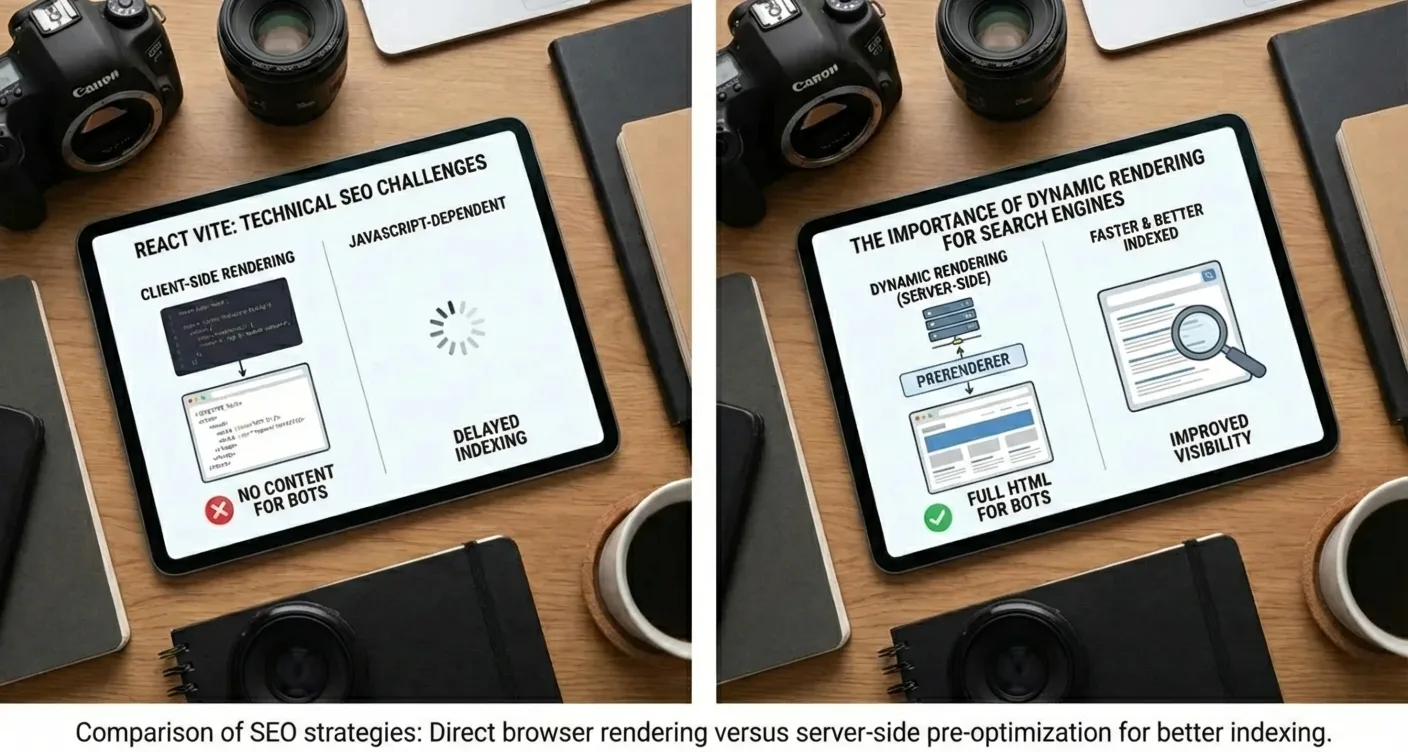
Implementing this strategy requires a deep understanding of how servers respond to specific headers. It's often a balance between performance and discoverability, where the architecture of technical SEO for React Vite is decisive. For more information on how content influences user experience, you can read about Core Web Vitals and content quality. The main goal always remains to make the threshold for search engines as low as possible.
Why Static Snapshots are Becoming the Standard
- Improved discoverability of asynchronously loaded data and components.
- Faster processing time for bots that don't support a full JavaScript stack.
- Consistent display of meta tags and structured data for social media.
- Reduction of the risk of 'blank pages' during the crawl process.
"Dynamic rendering is not a replacement for good code, but a necessary bridge for complex JavaScript environments to guarantee SEO success."
Ultimately, a strong technical SEO strategy for React Vite is about removing uncertainty. When search engines know exactly what to expect, the website's reliability in their algorithms increases. This process is closely connected to how internal links are processed; a topic further elaborated in our article on the internal link graph and orphan pages within complex sites.
Correctly configuring the server for dynamic rendering is the final step towards complete search engine friendliness.
Managing Metadata and React Helmet in a Vite Project
Managing metadata is a crucial part of a successful strategy for technical SEO for React Vite. In a Single Page Application (SPA), page content and URLs change without the browser fully reloading the page, which poses a challenge for search engines expecting static HTML. By using libraries like React Helmet Async, developers can dynamically adjust the HTML's head section for each specific route. This ensures that every page receives unique titles and meta descriptions, which is essential for Google's indexing. Without these dynamic adjustments, all pages would share the same metadata, significantly degrading the discoverability of individual content within modern web architecture.
Properly implementing dynamic metadata optimization for React Vite applications significantly improves the click-through rate in search results.
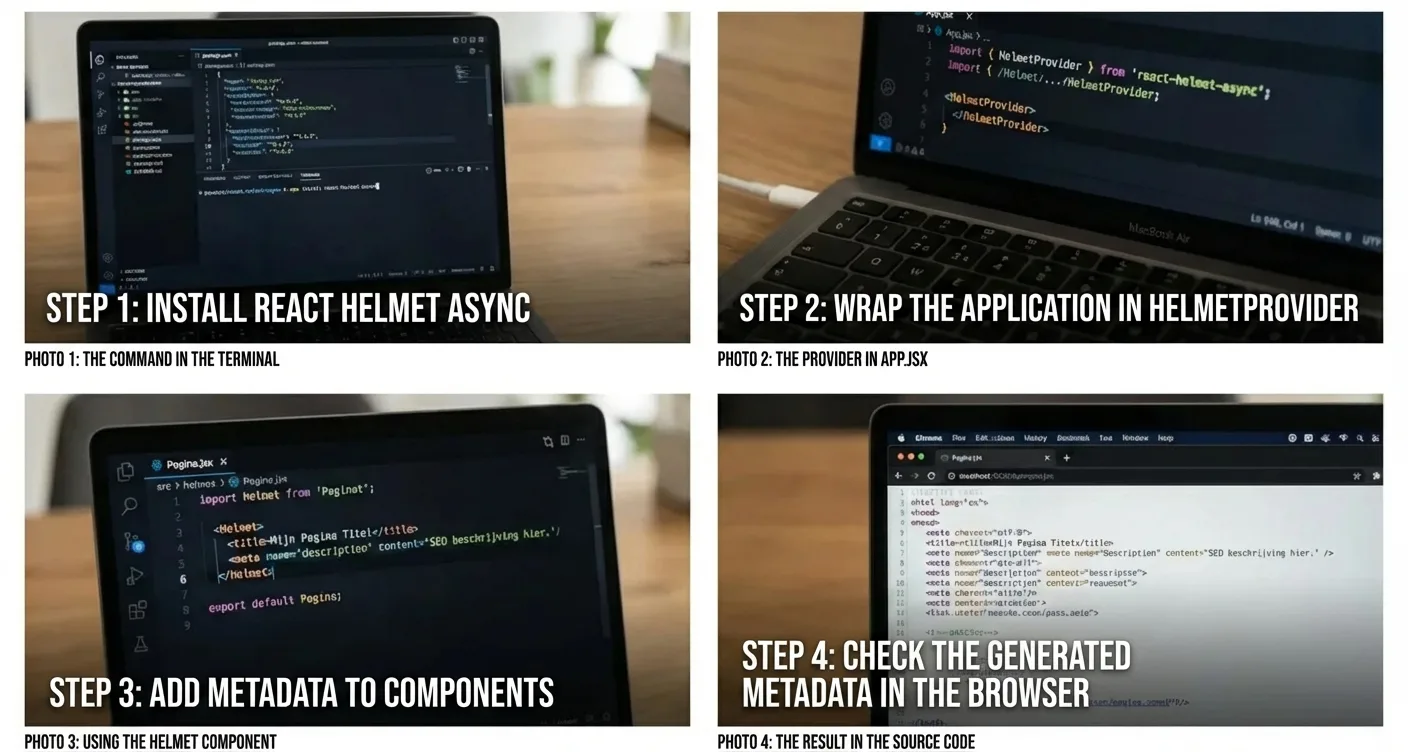
Implementing React Helmet Async
To begin with technical SEO optimization for React Vite, you need to configure the Helmet provider at the root of your application. This prevents memory leaks and ensures a consistent state of metadata across different components. In a Vite environment, the speed of Hot Module Replacement (HMR) is a significant advantage when testing these SEO tags. You can define specific tags per page, such as the canonical URL and Open Graph tags for social media. This helps search engines understand not only what the page is about but also how it should be displayed in search results and on platforms like LinkedIn or Facebook.
For a broader overview of digital services, you can check our WordPress services overview for additional support with web projects.
"Dynamically injecting metadata via React Helmet is the bridge between an interactive user experience and readability for search engine crawlers in a modern JavaScript environment."
When configuring technical SEO settings for React Vite, it's important to define the following elements per route for maximum impact on ranking:
- Unique page titles containing relevant keywords for the specific section.
- Meta descriptions that prompt action and accurately summarize the page's content.
- Canonical tags to prevent duplicate content issues with different URL parameters.
- Structured data (JSON-LD) to generate rich search results in Google.
Besides metadata, your project's load speed is crucial for the overall technical SEO score for React Vite. A slow site can lead to a higher bounce rate, regardless of how well your metadata is set up. For more information on speeding up web environments, read this article on making websites faster. Don't forget to consult the official React Helmet Async documentation for advanced configurations and best practices within your development process.
Finally, it's essential to regularly validate your technical SEO implementation for React Vite with tools like Google Search Console. This allows you to verify whether the dynamic tags are actually being picked up after the JavaScript files are rendered by the crawler.
Optimizing Core Web Vitals for Faster Load Times
Optimizing Core Web Vitals is now an essential part of any modern SEO strategy, especially when working with JavaScript frameworks. When we look at technical SEO for React Vite, it's clear that initial load time often presents a stumbling block for search engines. Google evaluates websites based on Largest Contentful Paint (LCP), First Input Delay (FID), and Cumulative Layout Shift (CLS). For a React application served via Vite, this means we must critically examine how the bundle is built and how the browser processes the code. By applying smart techniques, we ensure that users don't encounter a blank screen while scripts are loading.
Minimizing the JavaScript payload is crucial for a rapid technical SEO implementation for React Vite.
Improving LCP and CLS in a React Environment
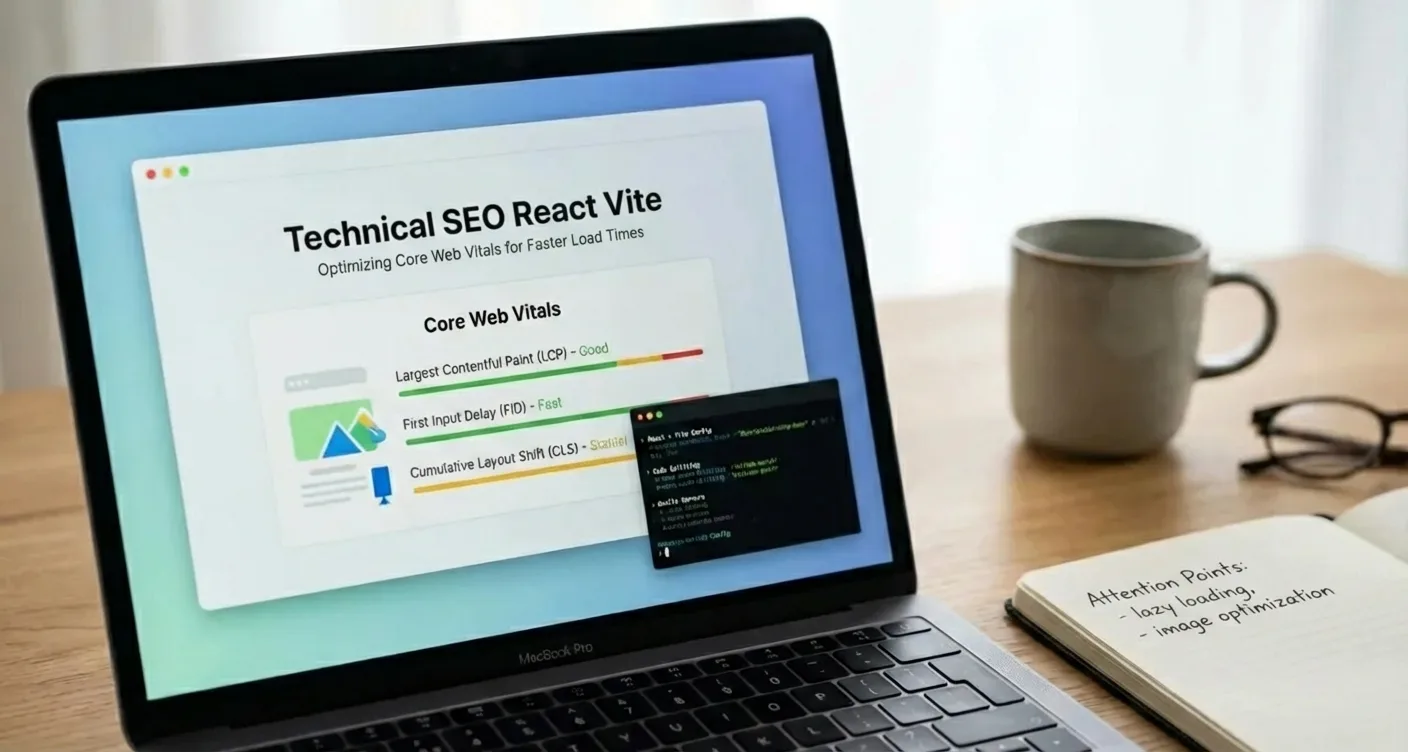
To improve LCP, we must prioritize the most important elements of the page over secondary scripts. Within the context of technical SEO for React Vite, we can utilize 'code splitting' and 'lazy loading' to load only the necessary components. This prevents the browser from having to process unnecessary data before the top of the page is visible. Additionally, preventing layout shifts (CLS) is of great importance. We achieve this by assigning fixed dimensions to images and advertisement containers, so content doesn't suddenly jump when a heavy script finishes loading. A stable visual experience is what Google expects from a modern website.
A good technical SEO strategy for React Vite starts with understanding how the browser prioritizes resources.
"The speed of a web page is not just a technical metric, but a direct reflection of the user experience you offer your visitors."
Server-Side Rendering and Hydration Strategies
While Vite excels in development speed, the production environment requires extra attention to Core Web Vitals. Using Server-Side Rendering (SSR) or Static Site Generation (SSG) can significantly accelerate the First Contentful Paint, as the browser directly receives HTML instead of having to wait for the full execution of JavaScript. In practice, we see that advanced technical SEO optimization for React Vite often leads to better indexing by search engines. The hydration process, where static HTML is made interactive, must proceed as efficiently as possible to keep FID low. For those who need assistance with this complex matter, it is advisable to consult an SEO expert experienced with these modern architectures.
Correctly configuring the Vite build setup is a fundamental step for technical SEO success for React Vite.
In addition to the technical setup, monitoring performance via tools like Google PageSpeed Insights is indispensable. Below are some practical steps to achieve immediate results:
- Use dynamic imports for heavy libraries that are not immediately needed.
- Optimize images by using modern formats such as WebP or Avif.
- Implement 'resource hints' like preconnect and preload for critical assets.
- Ensure an efficient caching strategy via the server or a CDN.
By consistently applying these methods within your technical SEO workflow for React Vite, you create a lightning-fast website that satisfies both users and search engines.
Configuring Sitemaps and Robots.txt for React Apps
Correctly setting up a sitemap and robots.txt file is a fundamental part of a successful technical SEO strategy for React Vite. Because React applications often use client-side rendering, search engines don't automatically recognize all available routes within the application. A dynamic sitemap acts as an essential roadmap that directs crawlers immediately to the correct deep pages, without them having to rely on complex navigation structures. For a modern workflow with Vite, this means integrating scripts that generate an up-to-date list of URLs during the build process based on your router configuration or external API data.
Always ensure your robots.txt file explicitly refers to the exact location of your sitemap to speed up Google's indexing.
Automating the XML Sitemap

Within a professional approach, manual updating of sitemaps is impractical, especially for growing platforms. You can use powerful plugins like vite-plugin-sitemap to automatically map all static routes during the build phase. For dynamic content, such as product pages or blog articles, it's essential to write a custom script that queries the database and adds these URLs directly to the XML file. This guarantees that search engines always find the most recent content. A well-structured sitemap prevents important pages from inadvertently remaining hidden, which is crucial for the discoverability of complex applications.
- Use the 'Sitemap:' declaration at the bottom of your robots.txt file for maximum clarity.
- Exclude sensitive folders like /admin or /temp to save crawl budget.
- Regularly test your configuration via Google Search Console to avoid errors.
"A sitemap is not just a list of links; it's a prioritization tool for search engines."
Managing robots.txt for Crawlers
The robots.txt file is the first stop for any bot visiting your site. During optimization, you must specifically indicate which scripts and assets are essential for rendering. Never accidentally block JavaScript files in the /assets/ folder, as Google needs these to fully understand client-side content. An incorrect configuration can lead to empty page indexing. By making smart exclusions, you save crawl budget and ensure search engines focus on pages that actually add value. For those needing help with a custom solution, a good foundation is indispensable. Consult the Google Search Central documentation for the latest standards.
Conclusion and Best Practices for Technical SEO in React Vite
Optimizing a modern web application requires a deep understanding of how search engines process JavaScript-based content. When implementing technical SEO for React Vite, it's essential to look beyond standard client-side rendering. By using techniques such as Server-Side Rendering (SSR) or Static Site Generation (SSG) via frameworks like Vite-plugin-ssr or Astro, you ensure that crawlers have direct access to your application's full HTML structure. This not only accelerates indexing but also improves the overall user experience by providing faster initial load times, which directly impacts your position in Google's search results.
The synergy between Vite and React offers developers unprecedented speed, but without the right strategy, valuable content often remains invisible to algorithms that struggle with complex scripts. A crucial aspect of technical SEO for React Vite is dynamically managing metadata. Use tools like React Helmet Async to generate unique titles and meta descriptions per route. In practice, consistent implementation of structured data (Schema.org) proves to help search engines better understand the context of your pages. Don't forget to optimize images and use modern formats like WebP, which benefits Core Web Vitals. For more insights on successful projects, you can refer to this client experience regarding technical optimization.
It is advisable to regularly perform an audit with tools like Google PageSpeed Insights to identify and address bottlenecks in your application's load time. Always continue testing how search engines perceive your site using the URL inspection tool in Google Search Console. This allows you to verify whether advanced rendering methods are functioning correctly. A well-structured sitemap and a flawless robots.txt file are indispensable for efficient crawl budget allocation.
In conclusion, technical SEO for React Vite is not a one-time task but a continuous process of refinement and monitoring to maintain a competitive advantage. By prioritizing SSR for critical landing pages, minimizing JavaScript bundle size through code-splitting, and maintaining a logical internal link structure, you lay a technically perfect foundation for all your marketing efforts.
Optimizing modern web applications requires a specific approach.
By focusing on technical SEO for React Vite, you ensure fast load times and excellent indexing. Use server-side rendering or static site generation to give search engines direct access to your content, while dynamically managing metadata for maximum relevance in search results.
Combining Vite's speed with a solid SEO strategy is essential for online success. Ensure your technical foundation is strong by critically examining hydration, sitemaps, and structured data. Are you ready to elevate your project's visibility? Start implementing these advanced techniques today and watch your organic traffic and conversions grow consistently through a superior user experience and technical perfection on every device.
Frequently Asked Questions
What is the importance of technical SEO for React Vite in modern web applications?
It is essential because standard React apps often struggle with search engine indexing. By applying technical SEO for React Vite, you ensure that search engines can crawl your site's content faster and more accurately.
How can you implement Server-Side Rendering (SSR) within a Vite project?
You can implement SSR by using frameworks like Vite-plugin-ssr or by migrating to a meta-framework such as Remix. This significantly improves technical SEO by sending fully rendered HTML to the browser.
Why is Vite's speed an advantage for your SEO strategy?
Vite offers an extremely fast development environment and optimized builds, resulting in better Core Web Vitals scores. Faster load time is a direct ranking factor, meaning technical SEO for React Vite contributes to a higher position in Google.
When should you choose prerendering instead of full SSR?
Choose prerendering when you have a static site with pages that don't change frequently. This is a cost-effective way to increase discoverability without the complexity of a full server environment.
How SEO Supercharged helps you here
SEO Supercharged is fully online (service area: in the cloud), so you can use it from anywhere.
The platform is built for Frontend developers specialized in React, SEO specialists at tech-oriented marketing agencies, Tech Leads and CTOs of Dutch SaaS startups, E-commerce managers of headless webshops, Freelance web developers (self-employed) with a focus on performance, Digital Agency Owners implementing modern tech-stacks, Full-stack developers working in the e-commerce sector, Junior web developers specializing in modern build tools.
You can use it for, among other things, Vite SEO Architecture Scan, Server-Side Rendering (SSR) Implementation, React Core Web Vitals Optimization, Indexability Analysis for Vite Apps, Metadata & Hydration Strategy, Static Site Generation (SSG) Migration, Vite Performance Tuning for SEO.
Want to tackle this directly? Check your technical SEO with the Page Audit, or start a free SEO analysis.
Related articles
- React/Vite SEO Guide: Indexing, Meta Tags, SSR/Prerendering, and Sitemaps (No-Fuss Approach)
Learn to make your React/Vite site SEO-proof. Master indexing, meta tags, canonicals, SSR/prerender choices, sitemaps, robots, & structured data for.
- Canonical & hreflang in your React Apps: The Correct Implementation Guide
Master canonical & hreflang for React apps. Learn top SEO strategies for Single & Multipage Applications to prevent duplicate content & boost global rankings.
- Structured Data Basics (Article, FAQ, Breadcrumb): What Truly Delivers Results?
Discover Structured Data Basics (Article, FAQ, Breadcrumb): what truly delivers results. Boost your SEO, improve CTR instantly. Learn more now!
- Dynamic, Multilingual, and Scalable Sitemap Generation for React Applications
Master dynamic, multilingual, and scalable sitemap generation for React apps. Boost your SEO, improve indexing, and ensure global visibility. Download our.
- Core Web Vitals for Speed, Conversion & SEO
Master Core Web Vitals for content sites to boost speed, user experience, and SEO rankings. Get practical tips for publishers to succeed!