Redirects and Canonical Conflicts: Common Errors and How to Fix Them
Redirects & Canonical Conflicts: Identify & Fix SEO Errors

Understanding Redirects and Canonical Conflicts: Common Errors and Fixes is crucial for a healthy website architecture and optimal search engine performance. When a URL contains both a redirect and a conflicting canonical tag, search engines become confused, often resulting in indexing issues and a loss of organic rankings. Correctly resolving these conflicts ensures that your pages' authority flows to the right destination without unnecessary delays. In practice, webmasters often send conflicting signals to Google, causing valuable content to simply disappear from search results due to technical oversights.
This guide covers the core aspects to effectively protect your rankings:
- Identifying conflicting signals between headers and tags.
- Repairing redirect chains that hinder crawl efficiency.
- Best practices for implementing technical SEO solutions.
- Monitoring indexing status after technical changes.

What Are Redirects and Canonical Conflicts: Common Errors and How to Fix Them?
In the complex world of search engine optimization, a website's technical structure is often the decisive factor for success. When we talk about Redirects and Canonical Conflicts: Common Errors and Fixes, we're referring to how search engines like Google interpret instructions about which page should be displayed. A redirect automatically sends a visitor and search engine from one URL to another, while a canonical tag indicates which version of a page should be considered the 'original'. When these two signals contradict each other, crawlers become confused, directly impacting your platform's organic visibility and user experience.
Understanding these technical signals is crucial for any webmaster striving for flawless indexing and strong authority within search results.
A common scenario where problems arise is during a site structure change or migration. For example, if you redirect a page via a 301 redirect to a new location, but that new location still has a canonical tag pointing back to the old, deleted URL, you create a logical loop. This phenomenon is central to the discussion on Redirects and Canonical Conflicts: Common Errors and Fixes. Search engines then no longer know which page to index: the page where the user lands, or the page the source code refers to. This can lead to pages completely disappearing from search results because the crawler cannot resolve the contradiction.
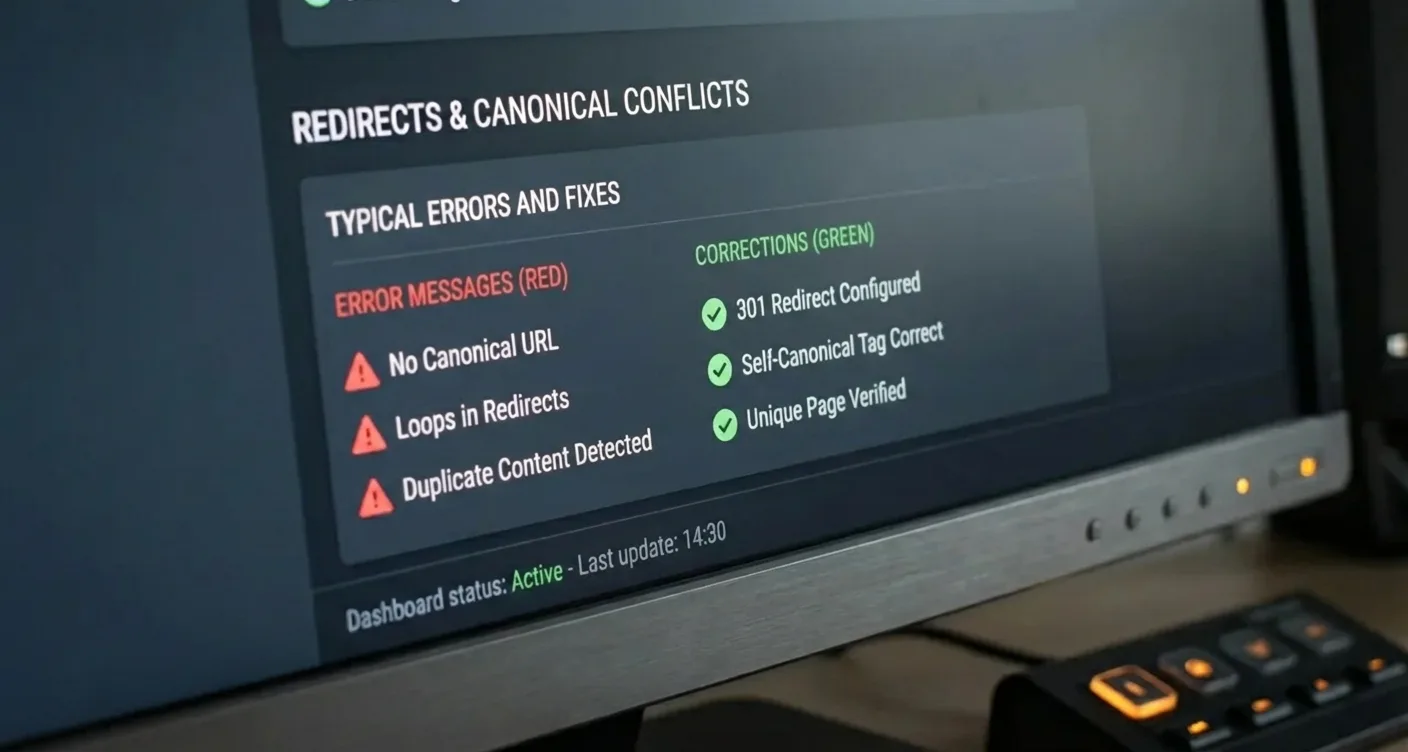
It is essential to remember that search engines prefer consistency above all else. When your server says "go left" via a redirect, but your HTML says "stay right" via a canonical, the page loses its value.
The Impact of Conflicting Signals on SEO
The consequences of **redirect and canonical conflicts** are often greater than initially perceived. Besides losing positions in search engines, it also wastes 'crawl budget'. Crawlers spend time deciphering erroneous paths instead of indexing new, valuable content. In practice, we observe that websites with many such conflicts are picked up more slowly by search engines. Therefore, it is of great importance to regularly perform a technical audit through the blog section of your website to identify and resolve such errors promptly before they damage your domain authority.
"A technical conflict between redirects and canonicals is like a signpost pointing to two different cities for the same destination; the visitor gets lost, and the guide eventually gives up."
These errors are often caused by automatic plugins or CMS settings that are incorrectly configured after an update. Manually checking HTTP headers and the source code is therefore a necessary step in the process of Resolving Redirects and Canonical Conflicts: Advanced Troubleshooting to maintain full control.
To gain a clear overview of where things often go wrong, we can use the following points as a guide for inspection:
- Redirecting a URL to a page that itself contains a canonical to a third URL.
- Using 302 (temporary) redirects where a 301 (permanent) redirect is required in combination with a canonical.
- Chains of redirects where the final destination does not match the canonical declaration.
- Pages that are accessible via HTTPS but have a canonical pointing to the HTTP version, while a redirect from HTTP to HTTPS is active.
If you ignore these elements, you risk search engines marking your site as unreliable. Resolving **redirect and canonical conflicts** begins by mapping out all active redirects. Use tools such as Google Search Console to see which pages are excluded by Google due to indexing issues. Often, messages like 'Indexed, though blocked by robots.txt' (or similar indexing exclusions) or 'Page with redirect' already provide an initial indication that something is clashing between server settings and on-page tags.
Systematically addressing these conflicts ensures a clear hierarchy that is understandable for both human visitors and algorithms.
Finally, it is important to realize that **redirect and canonical conflicts** are not only a technical problem but also a strategic one. An incorrect configuration can fragment link equity across multiple URLs instead of concentrating it on the most important page. By correctly using the canonical tag as a suggestion and the redirect as a hard instruction, you enforce a logical structure. Always ensure that the canonical URL is the final destination of every redirect chain to retain maximum SEO value and prevent confusion for search engines.
The Impact of Conflicting Signals on Your Google Ranking
When search engines like Google crawl your website, they look for unambiguous signals to determine which specific page holds authority. The problem arises when technical instructions directly contradict each other, which often happens during complex migrations or site structure changes. For example, if you set up a 301 redirect to page A, but the canonical tag on that same page points to page B, the indexing engine becomes completely confused. This confusion leads Google to decide not to rank either page optimally, directly harming your organic visibility. Understanding **Redirects and Canonical Conflicts: Common Errors and Fixes** is therefore essential for any webmaster who wants to strengthen their positions.
Conflicting signals waste crawl budget and significantly dilute your domain's link equity. In practice, we see that Google often makes its own choices in conflicts that do not align with your marketing goals.
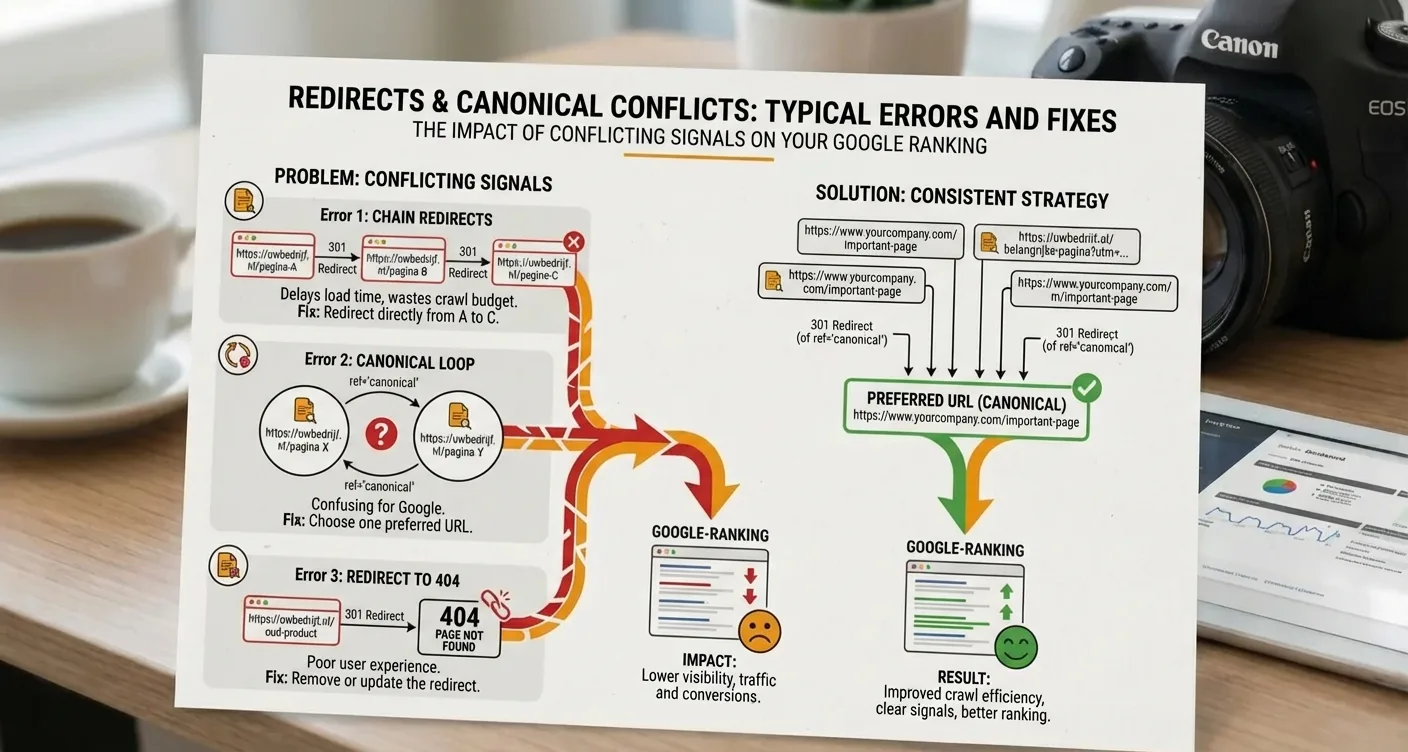
When the correct approach is not properly applied, an outdated page may remain in search results while the new content is ignored. This phenomenon is known as canonical confusion. It is crucial to remember that a canonical is merely a suggestion, while a redirect constitutes a compelling instruction. When these two are not aligned, the search engine often ignores both signals, resulting in a decline in the authority of your most important landing pages.
To prevent these issues, webmasters must perform regular audits. Pay particular attention to the following points to effectively manage **redirect and canonical conflicts**:
- Verify that the target page of a 301 redirect has a self-referencing canonical.
- Avoid chains where a canonical points to a page that is then redirected again.
- Ensure that all internal links point directly to the final URL without intermediate steps.
- Use tools like Google Search Console to see which URL Google has actually chosen as canonical.
Resolving these conflicts requires a meticulous look at the source code. A common mistake is implementing a canonical tag that refers to an HTTP version, while the site enforces HTTPS via a redirect. For those considering moving to a new digital environment, thorough preparation is crucial, similar to the steps in this emigration checklist for a smooth transition. By applying consistent strategies, you guarantee that link equity is correctly passed on. For more in-depth information on web standards, you can consult the documentation of the W3C. Ultimately, it's about providing a clear path for crawlers so that your most important content always receives the proper valuation in search results.
Action Plan for Resolving Technical SEO Conflicts
Systematically addressing technical errors begins with a thorough audit of the current URL structure and the associated signals sent to search engines. When a website sends both a 301 redirect and a canonical tag to different destinations, confusion arises for crawlers, negatively impacting indexing. Understanding Redirects and Canonical Conflicts: Common Errors and Fixes is essential to prevent authority from being fragmented across multiple pages that actually serve the same purpose within the site structure.
Always check that the canonical URL exactly matches the final destination page of an active redirect to prevent indexing issues.
Identification and Analysis of Erroneous Signals
The first step in the process is to identify all contradictory instructions in the HTTP headers and the HTML source code of the website. Common problems with **redirect and canonical conflicts** occur when CMS systems automatically generate tags that do not align with manual server settings. By using tools such as Google Search Console, webmasters can quickly find out which pages are being ignored by Google due to these conflicting signals.
"Consistency between the server response and page metadata is the foundation of a healthy technical SEO strategy."
After identification comes the correction phase, where priority must be given to removing superfluous chains. It is crucial to view *resolving redirects and canonical conflicts for websites* as an ongoing process, where every change in the URL structure must be directly mirrored in the canonical configuration. Use the following steps for this:
- Verify that the 301 redirect leads directly to the final URL without intermediate steps.
- Ensure that the rel="canonical" on the destination page refers to itself (self-referencing).
- Update internal links in the user dashboard to minimize unnecessary redirects.
- Remove old redirects that conflict with new **redirect and canonical configurations**.
Finally, monitoring re-indexing is necessary to confirm that the solution for redirects and canonical conflicts has been effective. A clean sitemap without error messages often results in better visibility and more efficient use of the crawl budget by search engines.
Properly managing **redirect and canonical conflicts** is crucial for a healthy SEO strategy and optimal indexing.
When search engines receive conflicting signals due to incorrect references, your website loses valuable authority. Consistently monitoring status codes and avoiding complex redirect chains ensures that Google understands your most important pages faster and values them higher in search results.
Do you want to prevent technical errors from hindering your organic growth? Start a thorough audit of your site structure today to immediately resolve all **redirect and canonical conflicts**. By taking action now, you not only improve the user experience for your visitors but also strengthen the technical foundation of your domain, which is essential for lasting success in this year's competitive search engine results. Contact our specialists for a professional analysis of your current link profile and technical configuration.
Frequently Asked Questions
What is the difference between a redirect and a canonical tag?
A redirect physically sends visitors and search engines to a new URL, while a canonical tag indicates which version of a page should be considered the original without moving the user. Incorrectly combining these two can lead to **redirect and canonical conflicts**, making **fixes** necessary to prevent indexing issues.
How do conflicts between redirects and canonicals arise?
Conflicts often arise when a page redirects to URL A, but the canonical tag on that same page points to URL B. This sends conflicting signals to search engines like Google, which can negatively impact your website's SEO value.
Why is it important to address redirect and canonical conflicts immediately?
When search engines receive conflicting instructions, they may stop indexing the correct pages or display the wrong URL in search results. By fixing these errors quickly, you ensure that link equity is correctly passed on and your organic positions are maintained.
When should you prefer a 301 redirect over a canonical tag?
You choose a 301 redirect when an old page no longer exists and you want to permanently direct all visitors to a new location. A canonical tag is more suitable for situations with duplicate content where both URLs must remain technically accessible to the user.
How SEO Supercharged helps you here
SEO Supercharged is fully online (service area: worldwide, online), so you can use it from anywhere.
The platform is built for SEO specialists, Web developers, Content managers, E-commerce owners, Digital marketing agencies, Webshop administrators, Freelance SEO consultants, IT project managers, Technical SEO analysts, In-house marketing teams.
You can use it for, among other things, Redirect audit & optimization, Canonical conflict analysis, Redirect loop repair, Migration redirect mapping, Duplicate content elimination, 404 error cleanup, Canonical tag implementation check.
Want to tackle this directly? Check your technical SEO with the Page Audit, or start a free SEO analysis.
Related articles
- React/Vite SEO Guide: Indexing, Meta Tags, SSR/Prerendering, and Sitemaps (No-Fuss Approach)
Learn to make your React/Vite site SEO-proof. Master indexing, meta tags, canonicals, SSR/prerender choices, sitemaps, robots, & structured data for.
- Canonical & hreflang in your React Apps: The Correct Implementation Guide
Master canonical & hreflang for React apps. Learn top SEO strategies for Single & Multipage Applications to prevent duplicate content & boost global rankings.
- Structured Data Basics (Article, FAQ, Breadcrumb): What Truly Delivers Results?
Discover Structured Data Basics (Article, FAQ, Breadcrumb): what truly delivers results. Boost your SEO, improve CTR instantly. Learn more now!
- Dynamic, Multilingual, and Scalable Sitemap Generation for React Applications
Master dynamic, multilingual, and scalable sitemap generation for React apps. Boost your SEO, improve indexing, and ensure global visibility. Download our.
- Core Web Vitals for Speed, Conversion & SEO
Master Core Web Vitals for content sites to boost speed, user experience, and SEO rankings. Get practical tips for publishers to succeed!