Practical E-E-A-T: Building Trust Without Fluff for SEO Success
Practical E-E-A-T: Build Trust & Authority for SEO Success

Practical E-E-A-T: building trust without fluff is at the core of modern SEO strategies, where authority and reliability are central to achieving higher rankings. By applying this method, you demonstrate to Google that your content is written by experts with genuine experience, which is essential for a sustainable online presence. It's all about making expertise tangible through source citations and factual accuracy.
Looking for immediate results? Use this approach to strengthen your domain authority. Implementing this strategy demands transparency; visitors must be able to directly verify who provides the information. This increases conversion rates because users feel secure trusting your advice.
- Showcase expertise through detailed author profiles.
- Boost authority with relevant external links.
- Enhance trustworthiness with transparent contact information.
- Focus on unique, practical insights.

The Core of Practical E-E-A-T: Building Trust Without Fluff
In the dynamic world of search engine optimization, the concept of E-E-A-T has evolved into a fundamental pillar for anyone who wants to be taken seriously by both algorithms and human visitors. The acronym, standing for Experience, Expertise, Authoritativeness, and Trustworthiness, forms the blueprint for how Google assesses content quality. However, many website owners get caught up in theoretical concepts without knowing how to concretely translate them onto their own pages. When we discuss practical E-E-A-T: building trust without fluff, we aim to eliminate vague marketing jargon and replace it with tangible evidence of competence. It's about not just claiming to be an expert, but ensuring your website's structure and content undeniably prove this to every visitor who lands on your page.
At its heart, practical E-E-A-T: building trust without fluff is about directly translating authority into user experience, where transparency takes top priority within your digital strategy.
To tackle this effectively, you must understand that Google's Quality Raters use guidelines that specifically examine the source of information. Is the author an experienced practitioner or a theoretician? For a topic like practical E-E-A-T: building trust without fluff, this means your content must resonate with the daily reality of your target audience. For instance, you can look at affordable search engine optimization for your website to see how small adjustments make a big difference in the perception of trustworthiness. Adding real case studies, mentioning specific certifications, and consistently updating outdated information are steps that directly contribute to a higher rating. It's a continuous process of refinement where every sentence should add value to the end-user, without unnecessary filler merely intended to boost word count.
Trust is the hard currency of the internet; without a solid foundation of credibility, even the most technically optimized website will fail to convert visitors into loyal customers.
A crucial component of this approach is demonstrating 'Experience.' Since the addition of the extra 'E,' Google places significant value on content derived from actual interaction with the subject. If you're writing about practical E-E-A-T: building trust without fluff methods for entrepreneurs, then show that you've overcome challenges in practice. This can be achieved through personal anecdotes, sharing unique insights not found elsewhere, or showcasing project photos. The goal is to create a connection that goes beyond mere text on a screen. By adding this human factor, you differentiate yourself from AI-generated content, which often lacks the depth and personal touch required for true authority. Implementing practical E-E-A-T strategies demands a critical look at your own content: does it truly offer a solution, or is it just a repetition of what others have already said?

The Role of Transparency and Source Attribution
Transparency is no longer optional in the modern SEO landscape. Visitors want to know who is providing the information and why they are qualified to do so. This means you need to optimize author biographies, provide clear contact details, and always link to reputable sources when making claims. According to the official Google Search Central guidelines, it's essential that content is created for people, not for search engines. When you're working on practical E-E-A-T: building trust without fluff on your website, you must ensure that every assertion is supported by facts or logic. This builds a foundation of integrity that is difficult for competitors seeking only quick gains to replicate. Structuring your information logically not only helps the user but also helps search engine crawlers better understand the context of your expertise.
Effective source attribution strengthens your own position as an expert, as it demonstrates that you are aware of the broader context within your field.
In practice, this means utilizing various elements to reinforce your message:
- Detailed author profiles with links to social media and previous publications.
- Citing scientific research or official reports for technical claims.
- Using Schema Markup to clarify the relationship between authors and entities.
- Regular audits of existing content to ensure relevance and accuracy.
- Clear articulation of editorial guidelines and how information is verified.
Applying practical E-E-A-T: building trust without fluff principles ensures your website becomes a beacon of reliability in a sea of misinformation.
"True authority isn't claimed; it's earned through consistent quality and unwavering honesty in every interaction with your audience."
Translating Expertise into Understandable Language
A common mistake when demonstrating expertise is using excessive jargon that deters the average reader. True expertise manifests in the ability to explain complex concepts simply, without losing their essence. Within the framework of practical E-E-A-T: building trust without fluff for SMEs, the art lies in making your knowledge accessible. This boosts 'Trustworthiness' because the reader feels understood and not intimidated. You build a bridge between your specialized knowledge and the customer's needs. By using clear language, you show that you master the subject so well that you can filter out complexity for your audience. This is a powerful form of building trust through content that yields immediate results in the form of longer session durations and lower bounce rates on your most important pages.
The goal is to guide visitors step-by-step through the process, anticipating their questions and doubts before they even formulate them.
When you consistently apply these principles, you create synergy among the various components of E-E-A-T. Your experience feeds your expertise, your expertise builds your authority, and all these factors combined result in unwavering trust from your target audience. The process of implementing practical E-E-A-T: building trust without fluff is not a one-time task, but a philosophy that must permeate every aspect of your digital presence. From how you respond to customer reviews to the depth of your blog articles, everything contributes to the larger picture. By focusing on the user and the value you provide, you automatically meet the strictest requirements of search engines, ultimately leading to higher rankings.
Concrete Steps to Demonstrate Expertise and Authority
To achieve online success, you must go beyond superficial texts; you need to prove that you master the subject matter. Implementing practical E-E-A-T: building trust without fluff begins by making your knowledge sources and the people behind the content transparent. Google places immense value on the 'Experience' and 'Expertise' of the author, which means every page should include a clear biography and relevant qualifications. By substantiating facts with external sources and internal case studies, you transform a simple blog post into an authoritative document that convinces both search engines and human visitors of your professionalism.
It's essential to understand that practical E-E-A-T: building trust without fluff for entrepreneurs revolves around tangible evidence rather than empty claims.
Optimize Your Author and Brand Profile
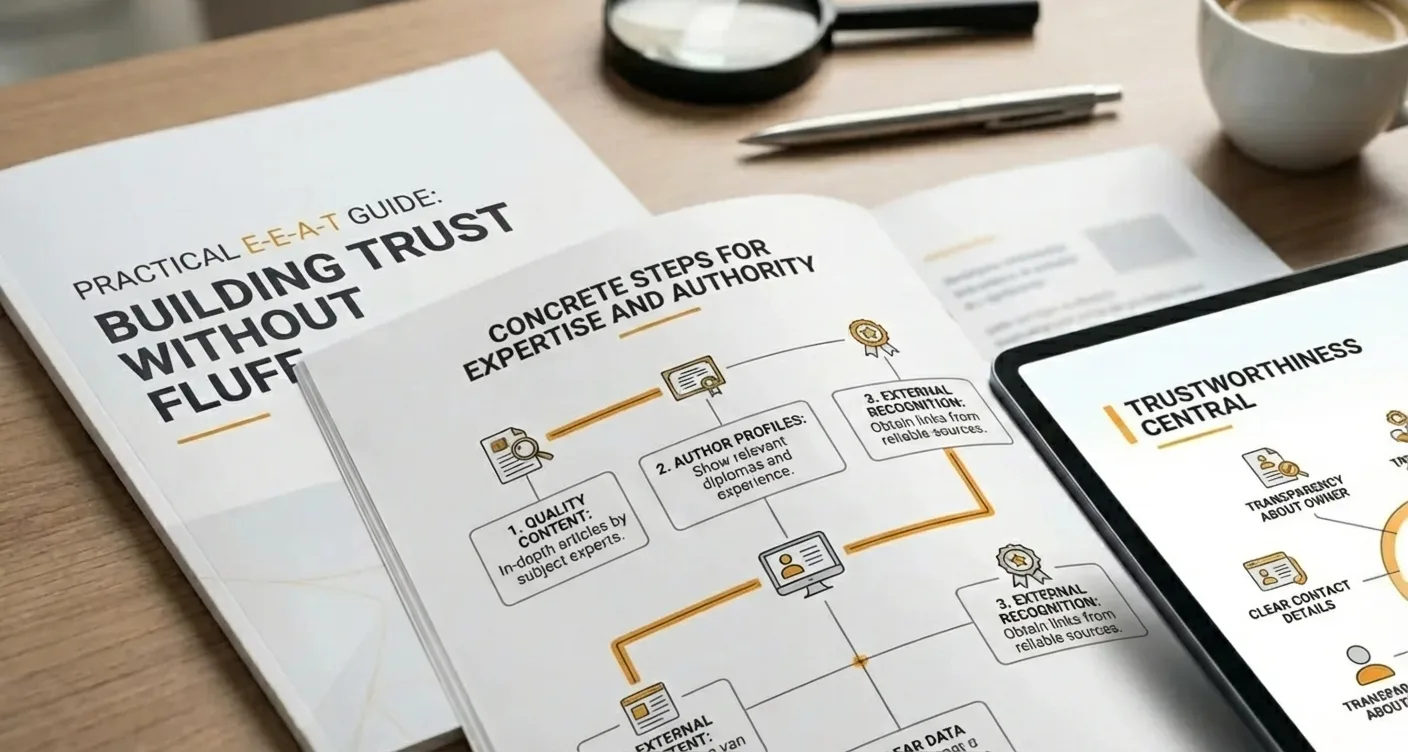
A strong foundation for practical E-E-A-T: building trust without fluff strategies is a consistent brand identity. This encompasses not only textual expertise but also a visual presentation that radiates trustworthiness. A well-designed brand kit helps establish a professional image across all platforms. When visitors recognize your logo and brand style, they more quickly associate it with the authority you build through your content.
"True authority isn't claimed; it's earned through consistent quality and transparency in every publication."
- Publish comprehensive author profiles with links to social media and previous publications.
- Refer to recognized certifications and relevant work experience within your field.
- Use structured data (Schema Markup) to clarify the relationship between the author and the topic.
- Regularly update outdated content to ensure the relevance of your practical E-E-A-T: building trust without fluff method.
Remember that a technically robust website forms the basis for your authority. A WordPress website design optimized for speed and user-friendliness reinforces the signal that you are a serious player in the market. According to Google Search Central guidelines, providing a secure and high-quality user experience is a direct factor in how trust is valued by algorithms.
Consistency is key to long-term success in search results.
Boosting Trustworthiness with Transparent Content Strategies
Today, the foundation of a strong online presence rests entirely on honesty and factual accuracy. In an era where misinformation constantly lurks, practical E-E-A-T: building trust without fluff is the only method to achieve sustainable results within modern search engines. This means you can no longer get away with vague promises or superficial texts written solely for algorithms. Instead, the focus must be on verifying sources, demonstrating genuine expertise, and providing value that is directly applicable to the end-user. By being transparent about who writes the content and precisely what methodologies are used, you create a bond with your audience that extends beyond a single visit to your website.
True authority only emerges when you consistently choose strategies that prioritize the visitor. To guarantee your platform's reliability, it's essential to combine technical optimization with in-depth content. A slow website, for example, can immediately harm a user's trust, even before they've read your text. That's why WordPress speed optimization is a crucial part of your broader strategy. Once the technical foundation is solid, you can focus on the substantive development of your texts. This includes mentioning author information, adding expert quotes, and regularly updating outdated information to maintain relevance in a rapidly changing market.
"Transparency in your editorial process is not just an ethical choice, but a strategic necessity for modern search engine optimization."
Implementing a sustainable approach requires a critical look at your current content and the courage to cut superfluous filler text. Always use clear source attributions for all factual claims you make. Additionally, ensure a well-organized structure with headings that accurately reflect the content and remove aggressive commercial language. Instead, focus on solving the reader's specific problem and showcase certifications or memberships from relevant industry organizations to confirm your status.
Ultimately, it's about proving your added value. According to Google Search Central guidelines, it's essential that content is created for people, not for search engines. By consistently adopting this human-centric vision, you build a brand that serves as a beacon of reliability within your niche.
Practical E-E-A-T: building trust without fluff is essential for online success.
By concretely applying expertise, experience, authority, and trustworthiness, you immediately improve your discoverability. Focus on facts, transparent source attribution, and genuine user experiences instead of vague marketing language. This way, you build a strong reputation with both search engines and your target audience.
Want to see immediate results? Start optimizing your content today by adding author information and substantiating your expertise with data. A strong focus on practical E-E-A-T: building trust without fluff ensures a sustainable advantage over the competition. Check out our additional guides for more in-depth tips on technical SEO and content marketing to unlock your full potential and structurally increase your conversions through organic channels.
Frequently Asked Questions
What exactly does Practical E-E-A-T: Building Trust Without Fluff entail?
It means moving beyond vague marketing terms and focusing on demonstrating genuine expertise, experience, authority, and trustworthiness. By showcasing concrete evidence like certifications and client case studies, you meet the core requirements of practical E-E-A-T: building trust without fluff.
How can you make an author's experience visible on a website?
You can do this by adding detailed author profiles that highlight the writer's relevant work experience and expertise. This is an essential part of practical E-E-A-T: building trust without fluff, as it directly shows the reader why the information is reliable.
Why is transparency about sources crucial for SEO success?
Transparency ensures that search engines and users can verify the facts in your content. By linking to scientific research or official documents, you strengthen your page's authority and avoid empty claims.
When can you expect results from E-E-A-T optimization?
While SEO is a long-term strategy, you often see improvements in rankings once search engines re-index your site and recognize the increased trustworthiness. Consistent updates to your 'About Us' page and contact details accelerate this trust-building process.
How SEO Supercharged helps you here
SEO Supercharged is fully online (service area: online, worldwide), so you can use it from anywhere.
The platform is built for SEO specialists, Content marketers, SME entrepreneurs, Copywriters, E-commerce managers, Marketing managers, Affiliate marketers, Webshop owners, Freelance communication consultants.
You can use it for, among other things, E-E-A-T content audit, Author authority optimization, SME content strategy, Trust signal implementation, Credibility scan, Expert review integration.
Want to tackle this directly? Create strong content with the Content Generator, or start a free SEO analysis.
Related articles
- AI Content Generator: Create Content That Ranks, Explains, and Converts (with Visuals)
Master our AI Content Generator to create articles & pages that rank high in Google & fuel AI answers. Learn intent, structure, internal links, visuals.
- Blog vs. Service Page: SEO and Conversion Differences
Blog posts vs. service pages: Learn why their SEO is similar but conversion strategies differ. Optimize your website for better results with expert tips!
- Internal Links in Content: Where, How Many, and Why They Are Crucial
Master internal linking for SEO success. Learn where to place internal links, how many to use, and why they're crucial for boosting rankings. Read more!
- Multilingual Content: Optimize Your International Website
Master multilingual content for NL/EN/FR/DE. Discover how to avoid duplicate content penalties, boost international SEO, and optimize your global website.
- Editorial Templates: 7 Proven Content Formats That Always Drive Engagement
Discover 7 effective editorial templates and content formats that always work to boost your reach and engagement. Optimize your content strategy with proven.