Blog vs. Service Page: SEO and Conversion Differences
Blog vs. Service Page SEO: Same Foundation, Different Conversion
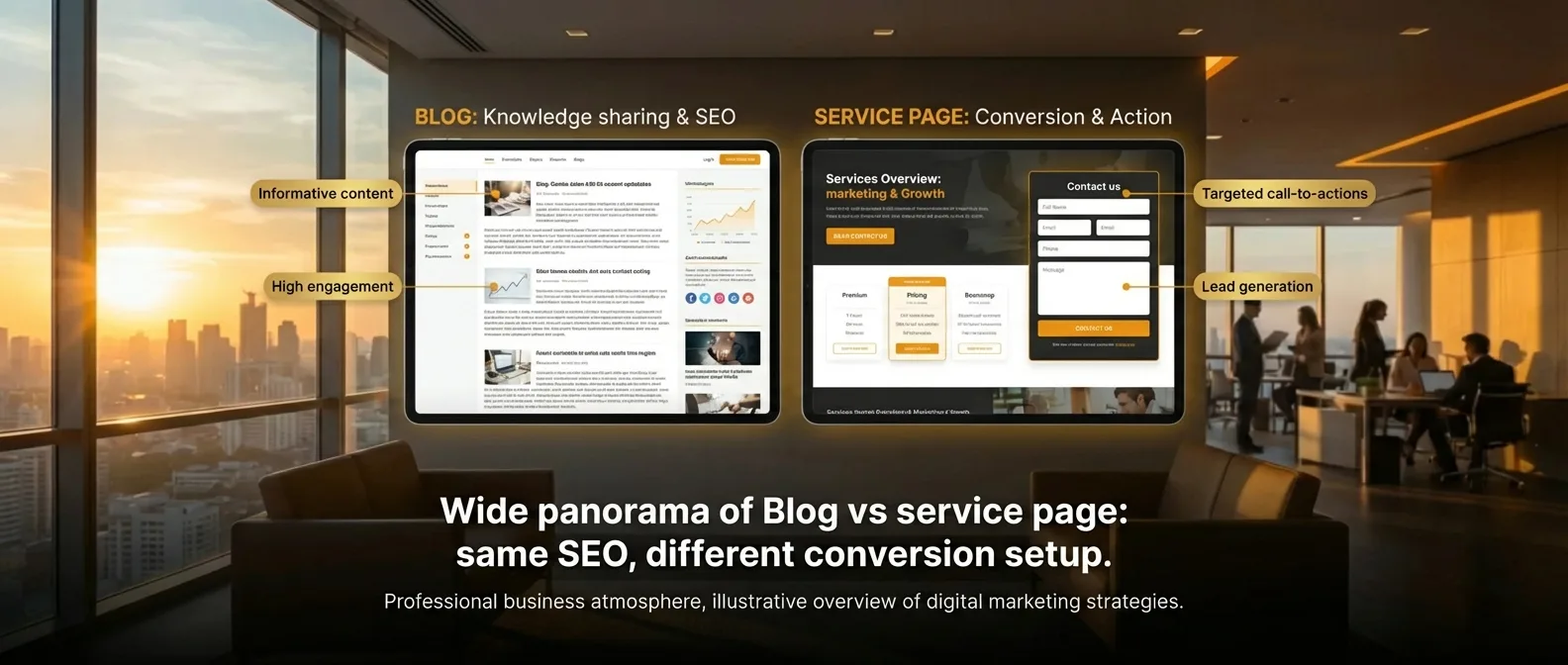
The discussion around Blog vs. Service Page: Identical SEO, Distinct Conversion Setups revolves around balancing informative content with direct sales encouragement. While both page types are technically optimized the same way for search engines, the methods for guiding visitors to action differ fundamentally. A blog post focuses on education and building authority, whereas a service page is designed to generate direct leads. Understanding this distinction is crucial for any marketer aiming for tangible results.
The core principle is that SEO brings visitors to your site, but the page structure determines if they become customers. Blogs focus on soft conversions, while service pages drive commercial actions. A well-thought-out strategy ensures a healthy mix of organic traffic and measurable growth.
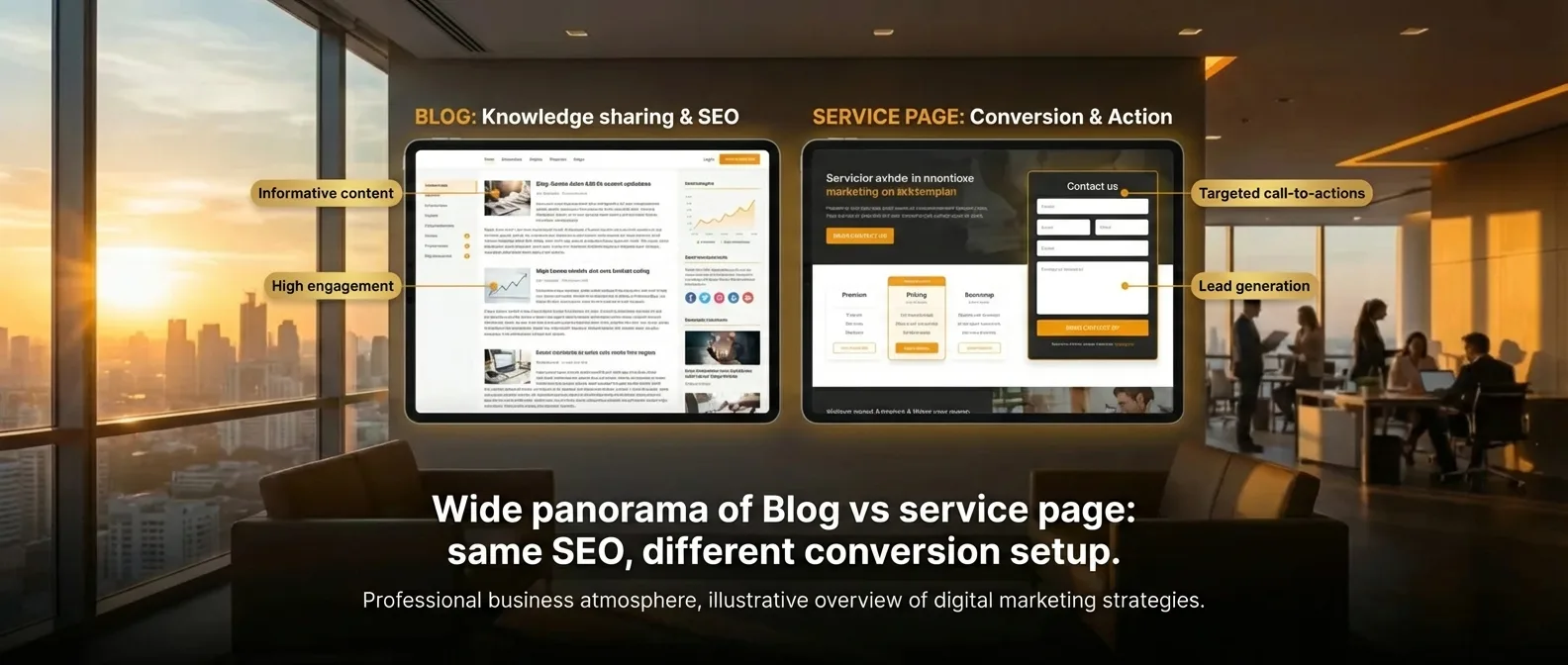
- SEO techniques remain identical for both page types.
- Blogs focus on providing information.
- Service pages drive direct actions.
The Fundamental Difference Between Blog Posts and Service Pages
In the complex world of digital marketing, there's often confusion about the specific roles of different page types within a website. Many entrepreneurs and marketers wonder why they need both in-depth informative articles and commercial landing pages to succeed online. The answer primarily lies in user intent. While the technical optimization behind the scenes often aligns, the specific approach for a Blog vs. Service Page: Identical SEO, Distinct Conversion Setups is crucial for your website's ultimate success. A service page, for instance, is specifically designed for direct sales and lead generation, whereas a blog post aims to educate, inspire, and build trust with an audience still in the research phase. Understanding this fundamental distinction is the first step toward a balanced content strategy that generates both authority and revenue.
Delving deeper into the dynamics of Blog vs. Service Page: Identical SEO, Distinct Conversion Setups, we observe that search engines like Google differentiate based on 'informational' versus 'transactional' intent. A user searching for "how SEO works" desires a comprehensive explanation, while someone searching for "hire an SEO agency" is ready to engage a professional service. Both page types adhere to the same strict rules for metadata, mobile-friendliness, and loading speed, yet their textual content differs drastically. A blog centers on solving a specific problem, whereas a service page highlights the unique selling propositions of your particular solution. It's therefore essential to know which strategic Blog vs. Service Page: Identical SEO, Distinct Conversion Setups approach you employ for each type of content you publish.
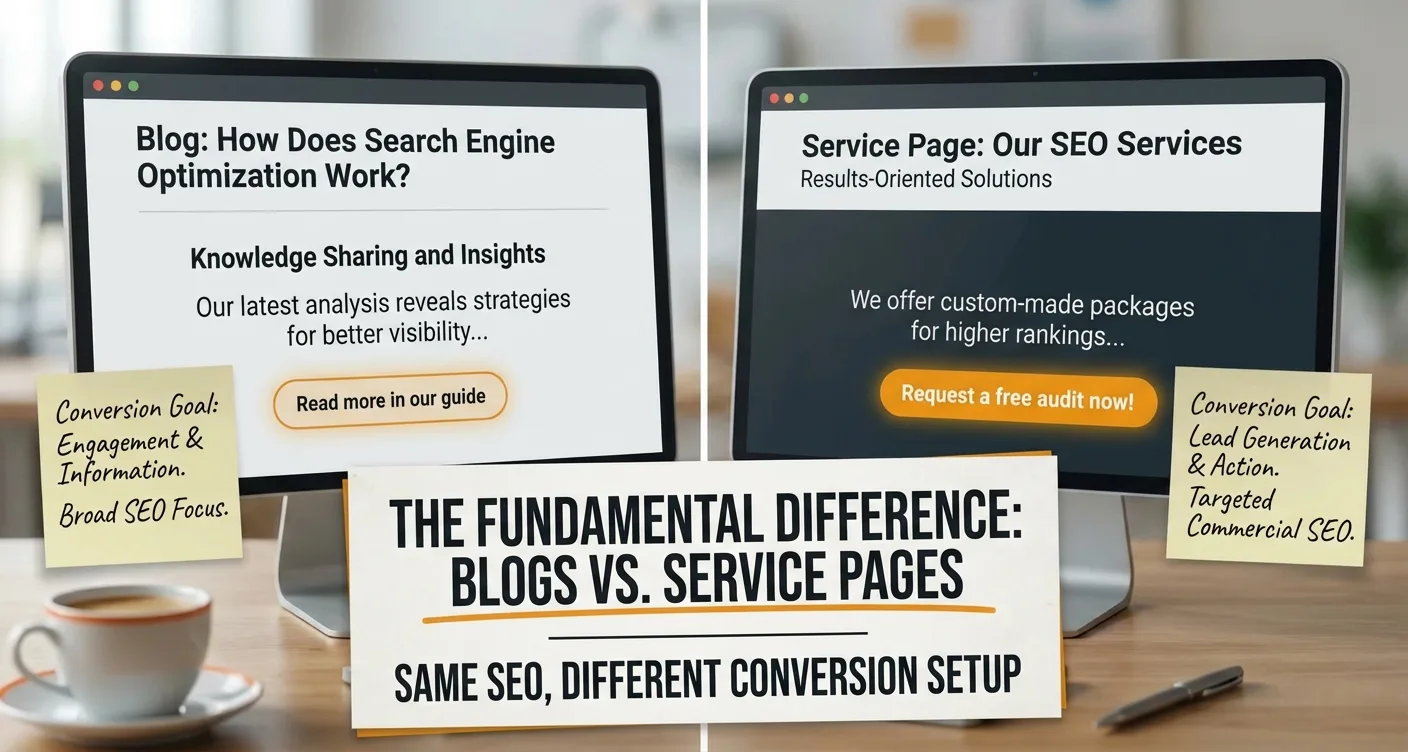
It's a persistent misconception that blog posts are less valuable because they don't lead directly to an immediate purchase. In practice, they serve as the indispensable top of the marketing funnel. By sharing valuable information through affordable search engine optimization for your website, you attract visitors you might never have reached through purely commercial terms. These visitors can later, as their needs become more defined, transform into paying customers on your service pages. The Blog vs. Service Page: Identical SEO, Distinct Conversion Setups methodology ensures you remain visible at every point in the customer journey.
The design of your page determines whether a visitor takes the desired action. In a Blog vs. Service Page: Identical SEO, Distinct Conversion Setups comparison, it's notable that the call-to-action (CTA) on a blog is often softer, such as signing up for a newsletter. On a service page, the CTA is more direct: "Request a quote." According to Google Search Central guidelines, providing a good user experience is essential for both types, but the path to that experience differs based on objectives. Blogs focus on readability and internal links, while service pages focus on social proof and guarantees. Ultimately, the Blog vs. Service Page: Identical SEO, Distinct Conversion Setups strategy is about balance. Without blogs, your website lacks the necessary context to build authority, and without strong service pages, traffic simply won't convert into sustainable revenue for your business.
Blog vs. Service Page: Identical SEO, Distinct Conversion Setups Explained
When we examine the architecture of a successful website, we often see a tension between informative content and commercial persuasiveness. The concept of Blog vs. Service Page: Identical SEO, Distinct Conversion Setups forms the core of a well-considered content strategy. While both page types aim for a high position in search results through relevant keywords and technical optimization, the visitor's intent fundamentally differs. A blog post typically targets the orientation phase of the customer journey, whereas a service page is designed to fulfill an immediate need or solve a specific problem for the user.
The essence of Blog vs. Service Page: Identical SEO, Distinct Conversion Setups lies in understanding the psychology behind the click.
For a blog post, the reader is often seeking education or inspiration. Therefore, the conversion setup needs to be more subtle, focused on building authority and trust. This could involve offering a whitepaper or a newsletter subscription. On a service page, however, the visitor is typically further along in the decision-making process. Here, the conversion setup for service-oriented pages revolves around direct action, such as requesting a quote or booking an introductory call. Ignoring this distinction can lead to a high bounce rate, even if your SEO performance in Google is excellent.
Technical Overlap and Strategic Differences
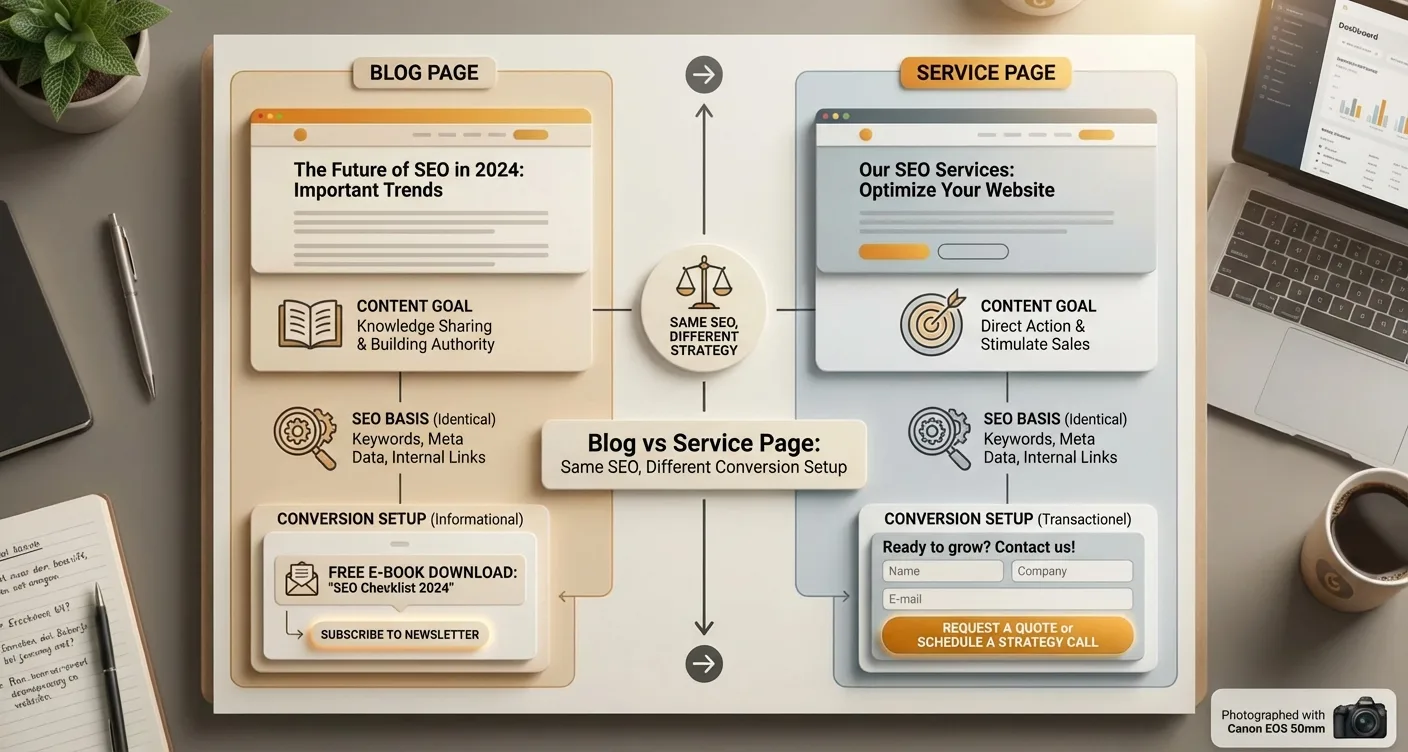
Despite their different goals, both page types leverage the same SEO fundamentals. This includes fast loading times, mobile-friendliness, and a logical heading structure. However, the way we craft content within the framework of Blog vs. Service Page: Identical SEO, Distinct Conversion Setups varies significantly. A blog often employs a narrative tone, while a service page is more direct and results-oriented. It's essential to understand that different conversion strategies for blogs and services determine the ultimate return on your organic traffic. For optimal implementation, consider specialized WordPress SEO services to perfect this balance.
"SEO brings people to the front door, but the conversion setup determines whether they come in and stay for a conversation or leave immediately."
- Search Intent: Blogs answer 'how' and 'why' questions; service pages answer 'who' and 'what does it cost'.
- Call-to-Action (CTA): On blogs, these are often informative (soft-sell), on service pages, they are transactional (hard-sell).
- Content Depth: Blogs are often longer and exploratory, while service pages must be concise and persuasive.
- Internal Link Structure: Blogs often link to deeper knowledge or services, while service pages are the final destination in a funnel.
Successfully applying the Blog vs. Service Page: Identical SEO, Distinct Conversion Setups strategy requires constant analysis of user behavior. By testing which buttons and texts work best on each page type, you optimize not just for search engines, but primarily for the human visitor. For more in-depth information on search intent, consult the guidelines of Google Search Central. Ultimately, the right Blog vs. Service Page: Identical SEO, Distinct Conversion Setups strategy ensures your website transforms from a digital business card into an active lead machine that adds value at every funnel stage.
Understanding Search Intent: Informational Versus Commercial
Understanding the psychology behind a search query is the cornerstone of every successful digital strategy. When a user enters a term into a search engine, that person has a specific goal in mind: gathering information or purchasing a solution. This distinction entirely dictates how you structure your content. When weighing the options of Blog vs. Service Page: Identical SEO, Distinct Conversion Setups, you'll find that technical optimization often aligns, but the psychological approach to the visitor fundamentally differs. A blog post typically answers a 'how' or 'why' question, while a service page addresses the immediate need for professional execution or a product.
The essence of Blog vs. Service Page: Identical SEO, Distinct Conversion Setups strategies lies in recognizing the stage of the marketing funnel the potential customer is in.
The Informational Needs of the Blog Visitor
Visitors landing on a blog are often in the research phase. They are looking for educational content, guides, or comparisons to better understand a specific problem. In this context, the Blog vs. Service Page: Identical SEO, Distinct Conversion Setups for knowledge-seeking is essential for building authority. You provide value without directly selling anything, which increases reader trust. While SEO techniques like meta-tags and headers are identical to those of commercial pages, the text here should be flowing and advisory. The goal is not a direct sale, but positioning your brand as a reliable source of expertise within your field.
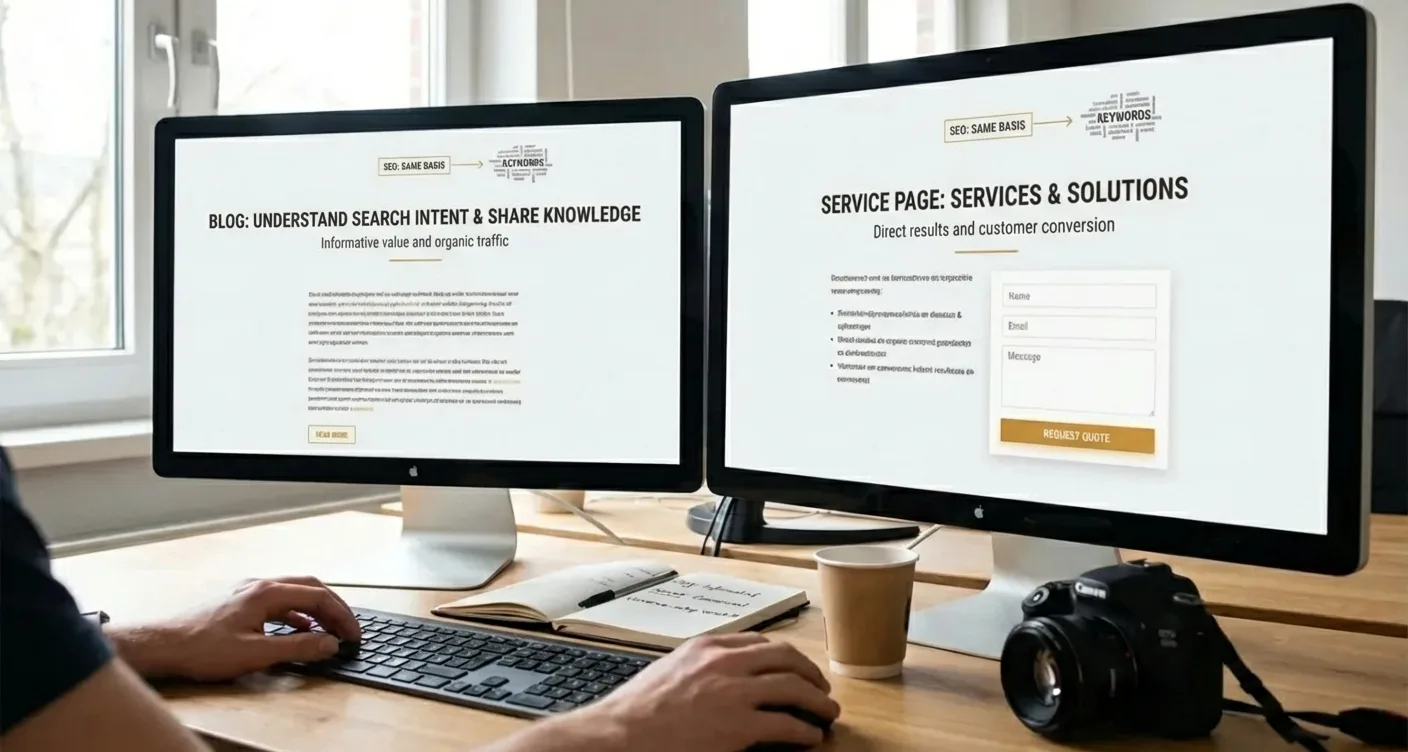
It is crucial that the content aligns with the technical state of your platform; a slow site can, after all, ruin even the best text. For an optimal experience, you can optimize your website's speed to keep the bounce rate low.
Commercial Intent on Service Pages
When we look at the commercial side of Blog vs. Service Page: Identical SEO, Distinct Conversion Setups for conversion optimization, we see that the user is ready to take action. The language on these pages is more direct, results-oriented, and includes clear calls-to-action. Here, it's about removing barriers and proving the added value of your specific service. It's no longer about explaining the 'why,' but about presenting the 'what' and 'how much.' A strong Blog vs. Service Page: Identical SEO, Distinct Conversion Setups approach ensures that commercial pages are optimized for high-buying intent keywords, such as 'rent,' 'buy,' or 'specialist.'
"The success of a page doesn't depend on traffic volume, but on the content's relevance to the user's specific search intent."
- Use informative headings (H2/H3) for blogs to answer questions.
- Focus on benefits and USPs on your commercial service pages.
- Implement different conversion points, such as a newsletter subscription for blogs versus a quote form for services.
- Ensure the internal link structure logically guides the visitor through the funnel.
Ultimately, the Blog vs. Service Page: Identical SEO, Distinct Conversion Setups method is about balance. By strategically deploying both types of content, you capture both the researching seeker and the decisive buyer. This ensures a sustainable flow of relevant traffic that genuinely contributes to your business objectives.
The Role of Keywords in Your Content Strategy
The foundation of every successful online presence rests on a profound understanding of how potential customers search for information. When we examine the dynamics between different page types, we see that the intent behind a search query determines which content format is most effective. The concept of Blog vs. Service Page: Identical SEO, Distinct Conversion Setups perfectly illustrates that while technical optimization often aligns, the psychological approach to the visitor fundamentally differs for each page type within your website architecture.
For a blog post, you often focus on informational keywords, while a service page addresses a commercial or transactional user need.
The way you integrate keywords is closely linked to the stage of the customer journey the reader is in. For an effective strategy, it's essential to understand that Blog vs. Service Page: Identical SEO, Distinct Conversion Setups strategies require you to leverage your blog's authority to drive traffic to your commercial pages. This creates an ecosystem where informative content builds trust, while service pages achieve the final conversion by offering concrete solutions to customer problems.
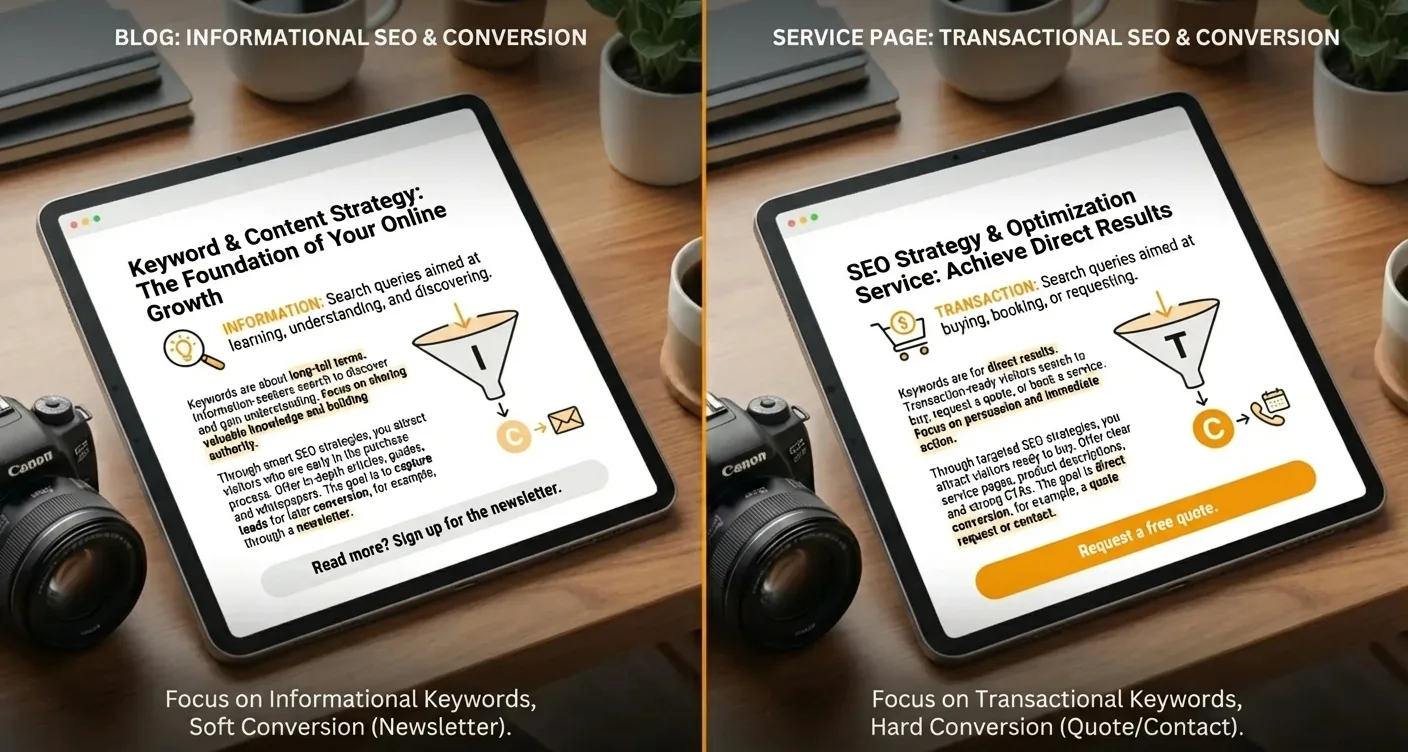
Matching Search Intent to Page Types
Distinguishing between informational and commercial keywords is crucial for a healthy content mix. In practice, a Blog vs. Service Page: Identical SEO, Distinct Conversion Setups approach helps to prevent keyword cannibalization, where different pages compete with each other in search results. By assigning specific long-tail keywords to blogs and shorter, competitive terms to service pages, you build a structured network that helps Google understand your website's relevance for various search queries within your niche.
"Content without the correct keyword intent is like a signpost pointing the wrong way; you attract people, but they never reach their desired destination."
To streamline this process, you can utilize the following steps:
- Identify the primary search intent for each selected keyword.
- Determine whether the content should inform (blog) or persuade (service page).
- Optimize the internal link structure between both page types for maximum authority.
- Adjust the call-to-action based on the anticipated user action.
The success of your strategy hinges on the implementation of the optimal Blog vs. Service Page: Identical SEO, Distinct Conversion Setups for local businesses. For instance, when you look at the complete guide to WordPress SEO, it becomes clear that technical settings are only half the battle. The real gain lies in the nuance of how you apply Blog vs. Service Page: Identical SEO, Distinct Conversion Setups methods to subtly guide the visitor through the funnel without appearing intrusive in the informational phase.
Consistency in your keyword usage ensures strong thematic relevance with search engines like Google.
Finally, it's important to remember that the Blog vs. Service Page: Identical SEO, Distinct Conversion Setups implementation is a continuous process of measurement and adjustment. By using tools like the Keyword Tool, you can discover what questions your target audience is asking, allowing you to adapt your content strategy accordingly. A strong focus on the role of keywords ensures that you are not only discoverable but also that the content found truly aligns with the immediate needs of the user.
Why the SEO Foundation for Both Page Types is Identical
Although a visitor's intent differs significantly between an informational blog post and a commercial landing page, the technical foundation upon which they rest remains unchanged. Search engines like Google apply a universal set of criteria to assess the quality and relevance of a web page, regardless of its specific function within the marketing funnel. For an SEO expert, it's essential to understand that Blog vs. Service Page: Identical SEO, Distinct Conversion Setups is not an opposition but a synergy where both types benefit from strong on-page optimization, fast loading times, and a clear site structure. Without this shared foundation, neither page type will perform optimally in organic search results.
The core of good discoverability lies in how search engines understand and index content.
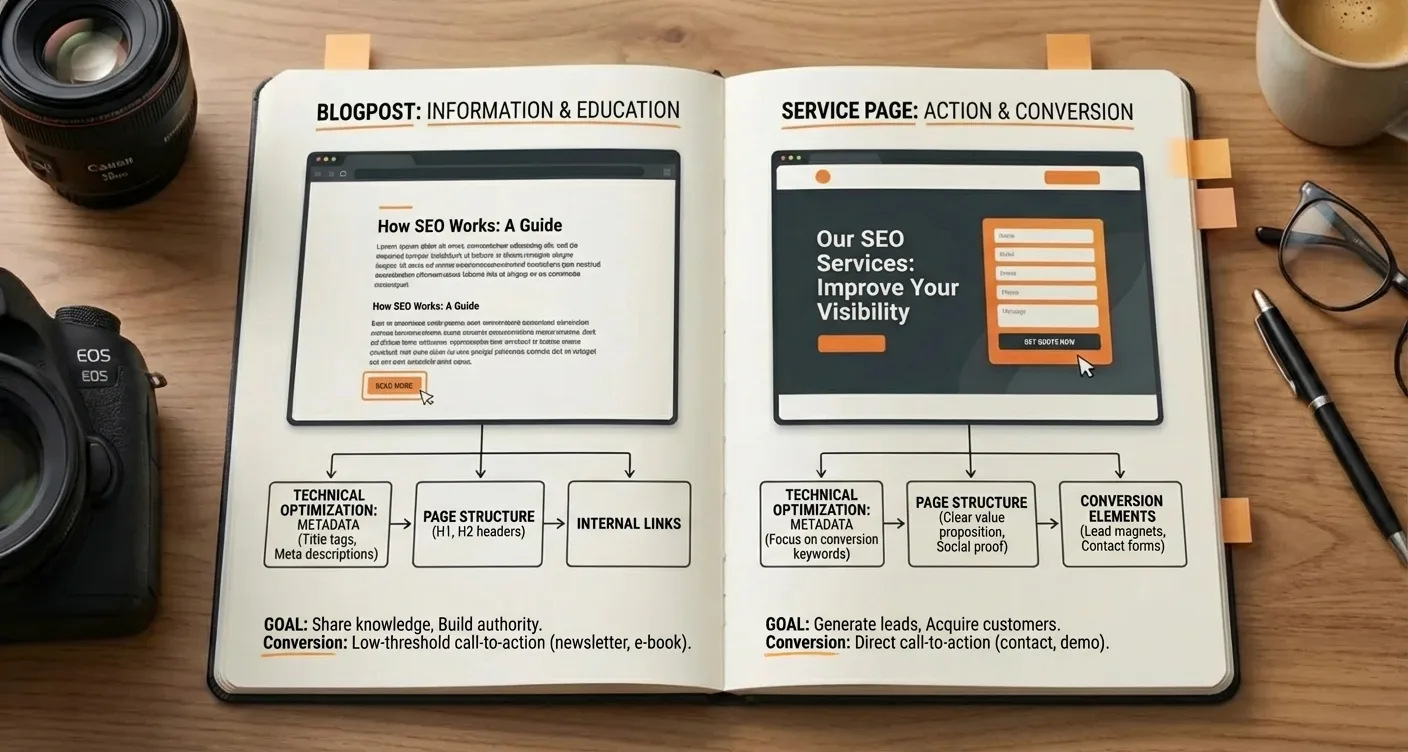
When we look at the technical implementation, both blogs and service pages have the same metadata requirements. A strong title tag, a compelling meta description, and a logical structure of H-tags are crucial. The principle of Blog vs. Service Page: Identical SEO, Distinct Conversion Setups means that in both cases, you must adhere to Google's E-E-A-T guidelines. This implies that the content must exude expertise and be trustworthy for the end-user. Whether you're writing an in-depth article or offering a specific service, the authority of the source remains a decisive factor for your search engine ranking.
Universal Elements of On-Page Optimization
Beyond textual content, visual elements play a significant role in how a page is valued by both algorithms and people. It's therefore wise to pay attention to a well-thought-out visual strategy for imagery that supports the text. In the context of Blog vs. Service Page: Identical SEO, Distinct Conversion Setups, we see that images on both page types must be optimized with relevant alt-texts and correct file formats to avoid negatively impacting loading speed. A slow page, after all, harms the user experience, which directly leads to a lower position in search results, regardless of the quality of the written content.
"The technical SEO standard is the democratic factor of the internet; it presents every page, from blog to service page, with the same challenges regarding crawlability and indexation."
The concept Blog vs. Service Page: Identical SEO, Distinct Conversion Setups emphasizes that the backend of your website must be consistent. This includes, among other things:
- The use of structured data (Schema Markup) to help search engines understand context.
- A mobile-friendly design that functions flawlessly on all devices.
- Fast server response times and efficient code architecture.
- A logical internal link structure that passes authority to important pages.
In practice, we often see businesses neglect their blogs on a technical level while meticulously optimizing their service pages. This is a missed opportunity, as a Blog vs. Service Page: Identical SEO, Distinct Conversion Setups strategy for a holistic approach requires every part of the website to contribute to overall domain authority. According to Google Search Central documentation, consistent application of SEO best practices across the entire site is the best way to achieve sustainable results. By adopting Blog vs. Service Page: Identical SEO, Distinct Conversion Setups as your starting point, you create a solid foundation upon which you can later build specific conversion goals.
Ultimately, it's about the balance between technology and psychology.
Conversion Optimization for Informative Blog Articles
When we examine website dynamics, we often observe that visitors arrive with varying intentions. A crucial aspect of a modern digital strategy is understanding the nuance between Blog vs. Service Page: Identical SEO, Distinct Conversion Setups. While a service page is directly aimed at sales or quote requests, a blog article primarily serves to build authority and answer questions. However, this doesn't mean a blog cannot generate conversions; the method of doing so simply needs to be more subtle and education-focused. By finding the right balance between valuable information and strategic guidance, you transform a passive reader into an active lead without appearing intrusive in the textual presentation.
This revolves around the psychology of the visitor who lands on your platform via a search engine.
The Subtle Art of Soft Conversions
In the context of Blog vs. Service Page: Identical SEO, Distinct Conversion Setups, it's essential to work with 'soft conversions.' Where a service page prompts a direct purchase, a blog article often requests a newsletter subscription or a whitepaper download. This aligns with the reader's informational needs. It's important to weave these conversion points organically into the text so that the reading experience isn't interrupted by aggressive pop-ups or irrelevant buttons that detract from the content's focus. Blog vs. Service Page: Identical SEO, Distinct Conversion Setups for an improved user experience requires thoughtful placement of calls-to-action that align with the specific stage of the customer journey the reader is currently in.

An effective strategy within the comparison of Blog vs. Service Page: Identical SEO, Distinct Conversion Setups tactics is the use of relevant internal links. For example, you can redirect readers to a confirmation page for sign-ups to capitalize on their interest. Additionally, employing visual elements that draw attention to the next step in the process can be helpful.
"Conversion in a blog isn't about the hard sell, but about earning the reader's trust through expertise and relevance."
Structure and Elements for Maximum Impact
To ensure the effectiveness of your content, your article's structure must naturally guide the reader towards an action point. This requires a different approach than a static sales page. In the consideration of Blog vs. Service Page: Identical SEO, Distinct Conversion Setups, it's often observed that blogs perform better with text links embedded within paragraphs, whereas service pages benefit from large, prominent buttons at the bottom of sections. Adding social proof, such as short testimonials or references to past successes within the blog text, can significantly increase credibility. According to experts at Frankwatching, the relevance of the call-to-action to the blog's topic is the primary predictor of success for Blog vs. Service Page: Identical SEO, Distinct Conversion Setups strategies.
Consider implementing the following elements for an optimally results-oriented blog post:
- In-line text links to in-depth content or relevant services.
- A clear conclusion that invites the reader to interact or read further.
- Content upgrades like checklists or templates directly related to the topic.
- Visual cues that guide the reader through the text to the key conclusions.
Ultimately, the goal of Blog vs. Service Page: Identical SEO, Distinct Conversion Setups implementation is to create an ecosystem where information and commerce reinforce each other. By first helping the reader with their problem, you create a goodwill factor that later in the process becomes crucial for the ultimate conversion on your main pages.
The Ideal Conversion Setup for a Converting Service Page
When we look at the dynamic between different types of content, one thing immediately stands out: the visitor's intent determines the page's design. While technical optimization often aligns, the psychological approach is entirely different. In Blog vs. Service Page: Identical SEO, Distinct Conversion Setups, the point is that a blog informs, while a service page must persuade and prompt action. A visitor on a service page is usually lower in the marketing funnel and actively seeking a solution to a specific problem. Therefore, the structure of this page must immediately convey trust and lower the barrier to contact as much as possible, without losing sight of SEO value. The success of a service page depends on the balance between authority and user-friendliness within the broader digital strategy.
An effective service page begins with a clear value proposition above the fold. The visitor must understand what you offer and why you are the best choice within seconds. It's essential to use visual elements that support the text. Consider icons highlighting benefits or a clear 'Call to Action' (CTA) button that stands out with its color scheme. Where a blog often ends with a suggestion for further reading, a service page must guide the visitor to a quote form or contact page. Removing doubt through social proof, such as customer reviews or partner logos, significantly boosts conversion power. Integrating specific services, like WordPress repairs, requires a direct approach where the problem and solution are central.
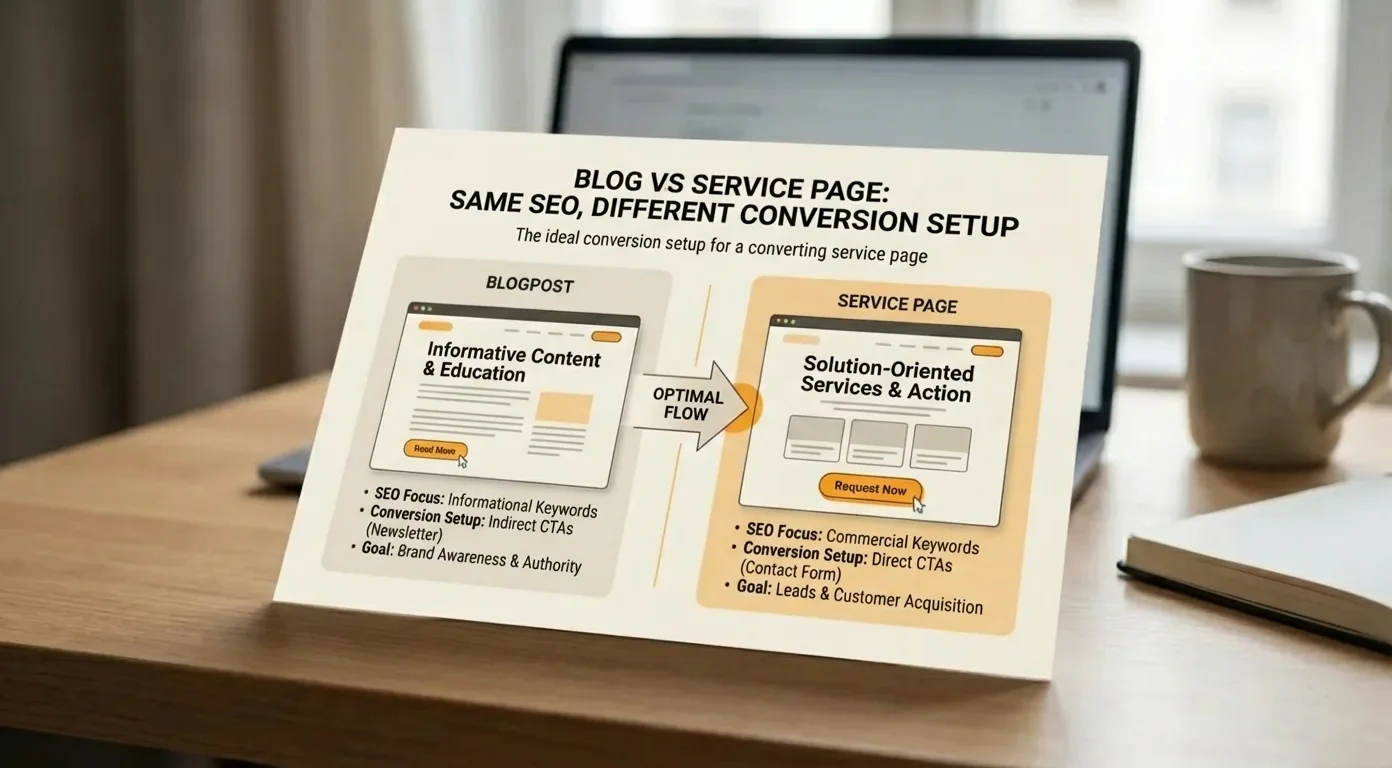
The navigation structure on a service page must be linear. While a blog visitor enjoys exploring related articles, you want to keep the service page visitor on a set path. This is a crucial part of the optimal methodology for business websites. Too many distractions can lead to decision paralysis, causing the potential customer to leave the page without taking action. The use of white space, clear headings, and a logical progression from general information to specific details helps visitors quickly scan the information and grasp the value of your offer. A converting service page is not a final destination, but a starting point for a sustainable customer relationship through relevant information and direct interaction opportunities.
To enhance your page's authority, it's advisable to link to external sources that support your expertise. For example, you can learn more about conversion optimization on the Nielsen Norman Group's website, an authority in user experience. By combining this external validation with a strong internal structure, you create a page that not only ranks well in search engines but also genuinely delivers results. Understanding the nuance in tactics ensures that every visitor receives the right impulse at the right moment. Use clear, action-oriented headings that emphasize benefits and place contact forms in strategic locations, not just at the bottom of the page. Additionally, ensure fast loading times to prevent bounce-offs and implement visual hierarchy to direct attention to the CTA. Ultimately, the comparison boils down to relevance; a blog answers a question, a service page fulfills a need.
Improving Internal Link Structure Between Blogs and Services
A well-thought-out internal link structure forms the backbone of a successful SEO strategy, with the synergy between informative articles and commercial pages at its core. It's essential to understand that visitors reading a blog post are often in a different stage of the customer journey than those landing directly on an offer page. In the consideration of Blog vs. Service Page: Identical SEO, Distinct Conversion Setups, we see that blogs serve as the ideal entry point for broad search terms, while service pages must facilitate the final transaction. By cleverly connecting these two types through relevant hyperlinks, you not only strengthen your domain's authority but also naturally guide the user toward a purchase or inquiry.
Strategically placing links ensures a better distribution of what's known as link juice across your entire website.
Bridging the Gap from Information to Action
When you create content, the focus must be on making the transition from an informative article to a specific service relevant. In the context of Blog vs. Service Page: Identical SEO, Distinct Conversion Setups, this means a blog about web design trends should link directly to a page for professional web design to capitalize on the reader's interest. It's crucial that anchor texts are descriptive and meet visitor expectations. An incoherent link structure can lead to a higher bounce rate, which is detrimental to your Google search rankings.
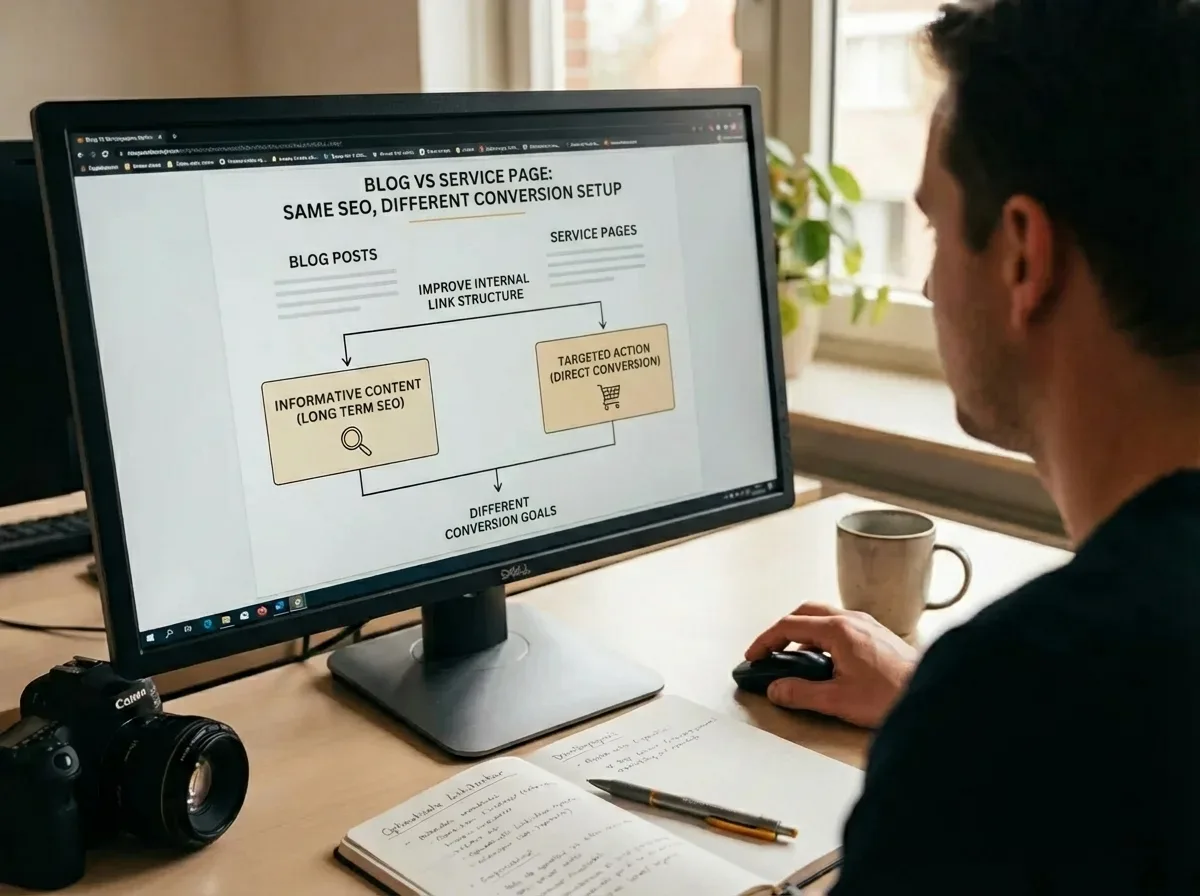
Optimizing these connections requires a keen eye for the searcher's intent. Users looking for solutions for a slow site can be redirected via a blog post to a WordPress speed optimization service. Here, the principle of Blog vs. Service Page: Identical SEO, Distinct Conversion Setups strategy remains crucial: the blog informs and builds trust, while the service page offers the technical solution with a clear call-to-action. According to Google Search Central guidelines, a logical hierarchy helps search engines better understand the context of your pages.
"A strong internal link structure is not only good for search engines but also acts as a roadmap that effortlessly guides the visitor from a problem to the ultimate solution."
Consistency in your linking strategy is the key to long-term success in organic search results.
Practical Tips for an Optimal Hierarchy
To optimally leverage the relationship between Blog vs. Service Page: Identical SEO, Distinct Conversion Setups, you can take the following steps for your internal links:
- Link from popular blogs to relevant services to drive direct conversions.
- Use variations in anchor texts to build a natural link profile within your own domain.
- Ensure that every service page receives at least one link from a high-quality informative article.
- Regularly check for broken links to ensure user experience and crawlability.
By applying this methodology, you create an ecosystem where content and commerce reinforce each other. Understanding the optimal Blog vs. Service Page: Identical SEO, Distinct Conversion Setups method for businesses enables you to build authority on specific topics. Don't forget that the Blog vs. Service Page: Identical SEO, Distinct Conversion Setups approach also means you can sometimes link back from your service pages to in-depth blogs for additional evidence or explanation. Ultimately, it's about providing the most complete experience for the end-user, regardless of the page where they began their journey on your website.
Measuring Success: KPIs for Blogs and Service Pages
Evaluating your digital performance requires a nuanced look at data, as objectives vary significantly by page type. In analyzing Blog vs. Service Page: Identical SEO, Distinct Conversion Setups, it's notable that success for a blog is often measured by engagement and brand awareness, while service pages are directly focused on commercial actions. It's essential to understand that a high bounce rate on an informative blog post isn't necessarily negative, provided the reader found the answer they were seeking. For a service page, however, a quick exit often indicates a mismatch between search intent and the site's offering.
Quantitative Versus Qualitative Metrics
In practice, marketers look at specific indicators such as average session duration and pages viewed per session to determine the effectiveness of their content strategy.
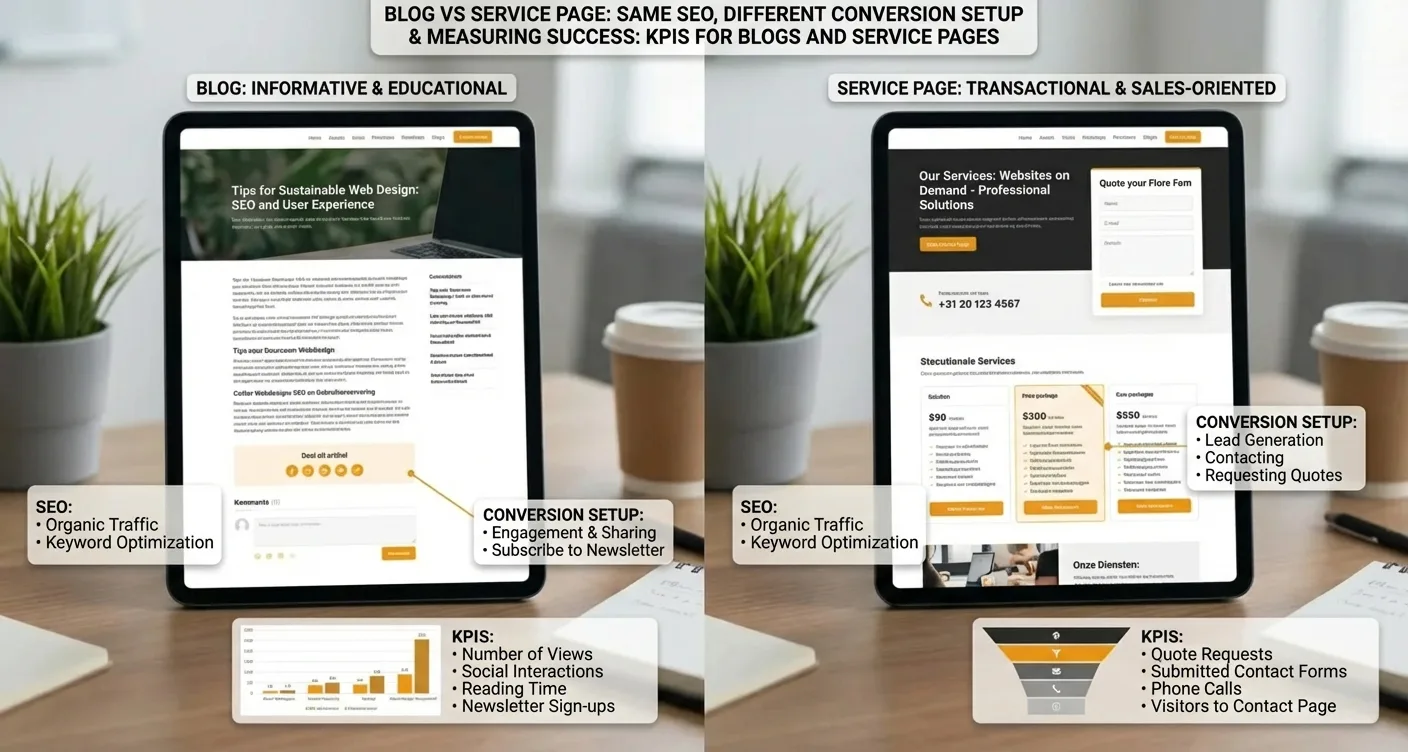
When we look at the dynamics of Blog vs. Service Page: Identical SEO, Distinct Conversion Setups, we see that the conversion rate remains the most important anchor point for services. For a pro webshop package, you measure success via quote requests or direct sales, while a blog post is successful if it leads to a newsletter subscription or a click-through to a commercial page. It's about balancing informing and converting throughout the entire customer journey.
The Role of Conversion Paths
Mapping the route a visitor takes helps optimize the Blog vs. Service Page: Identical SEO, Distinct Conversion Setups strategy for businesses aiming for online growth. By utilizing tools like Google Analytics, you can pinpoint exactly where visitors drop off. Use the following list to determine your focus areas:
- Unique visitors and organic growth for blogs.
- Click-through rate (CTR) on call-to-action buttons for service pages.
- Assisted conversions where a blog was the first point of contact.
- The quality of leads generated through specific landing pages.
"Measuring the right variables in a Blog vs. Service Page: Identical SEO, Distinct Conversion Setups context prevents you from drawing incorrect conclusions about your content's ROI."
Ultimately, the Blog vs. Service Page: Identical SEO, Distinct Conversion Setups is truly successful only when both elements reinforce each other in search results and the sales funnel.
Conclusion: The Synergy Between Knowledge and Sales
Understanding the dynamic between informative content and commercial landing pages is essential for any modern digital strategy. While both types aim for maximum visibility in search engines, the true power lies in the nuance of user intent. In considering Blog vs. Service Page: Identical SEO, Distinct Conversion Setups, we see that a blog acts as the educational engine that builds trust, while the service page facilitates the final transaction. Without a good balance between these two elements, your online presence often gets stuck in a one-sided approach that feels either too commercial or too non-committal for the average visitor.
In practice, this means you must optimize the Blog vs. Service Page: Identical SEO, Distinct Conversion Setups based on the specific stage of the customer journey. When we examine the technical implementation, it's clear that the Blog vs. Service Page: Identical SEO, Distinct Conversion Setups requires the internal link structure to seamlessly align with user needs. A visitor entering via a blog is often seeking answers, while someone on a service page wants immediate help with a specific problem or purchase. By cleverly intersecting these paths, you create an ecosystem where knowledge directly leads to action. It is, therefore, crucial to understand that the Blog vs. Service Page: Identical SEO, Distinct Conversion Setups for local entrepreneurs is a powerful tool to claim authority within your niche.
To achieve this synergy, you can take the following steps:
- Identify which informational search terms lead to your commercial services.
- Implement clear calls-to-action that facilitate the transition from blog to service page.
- Monitor user behavior to identify where the Blog vs. Service Page: Identical SEO, Distinct Conversion Setups still needs improvement.
- Ensure a consistent visual style that enhances the reliability of both page types.
Ultimately, the Blog vs. Service Page: Identical SEO, Distinct Conversion Setups is about relevance. For professional execution of your online strategy, you can look into WordPress website design. By consistently applying the Blog vs. Service Page: Identical SEO, Distinct Conversion Setups method, you build sustainable growth. For more in-depth information on search engine optimization, you can consult the Google Search Central documentation. A strong online foundation begins with the right choices in content structure.
The distinction between a Blog vs. Service Page: Identical SEO, Distinct Conversion Setups is crucial for online success.
While both page types build authority through search engines, the visitor's intent fundamentally differs. A blog informs the reader, while a service page directly prompts a commercial action or purchase.
By finding the right balance between informative value and a strong sales-oriented structure, you maximize the return from your organic traffic. Do you want to immediately improve your online results by optimizing your website's conversion setup for both information seekers and buyers? Contact our specialists today for a no-obligation analysis of your current content strategy and discover how to effectively guide every visitor through the marketing funnel to a definitive conversion on your platform.
Frequently Asked Questions
What is the main difference between a blog and a service page?
A blog primarily focuses on informing the reader, while a service page is directly aimed at selling a service. Although the approach differs, the comparison 'Blog vs. Service Page: Identical SEO, Distinct Conversion Setups' is essential to understand that both page types must technically meet the same SEO requirements.
How do you optimize the conversion setup for a blog post?
For a blog post, you often use soft conversions, such as a newsletter subscription or downloading a whitepaper. Because the intent is informational, a subtle conversion setup works better than the direct sales buttons you find on a service page.
Why is the SEO strategy often identical for both page types?
The basics of search engine optimization, such as loading speed, mobile-friendliness, and keyword usage, remain the same regardless of the page type. In the discussion 'Blog vs. Service Page: Identical SEO, Distinct Conversion Setups,' we see that the authority you build with blogs also strengthens the discoverability of your commercial service pages.
When should you choose a service page instead of a blog?
You choose a service page when the user has a specific purchase intent and is directly looking for a solution or service. A blog, on the other hand, is more suitable for the research phase, where you attract the visitor to your ecosystem through valuable content.
How SEO Supercharged helps you here
SEO Supercharged is fully online (service area: online, worldwide), so you can use it from anywhere.
The platform is built for Self-employed entrepreneurs (freelancers) who manage their own website, Marketing managers at SME companies, SEO specialists and content strategists at marketing agencies, E-commerce owners who want to convert organic traffic, Freelance copywriters with a focus on conversion optimization, B2B service providers who generate leads through knowledge sharing, Start-up founders who want to scale their online visibility and conversions, Web designers who offer strategic advice on site structure, Digital marketing consultants for international brands.
You can use it for, among other things, Content Strategy Audit: Blog vs. Service Page, CRO Optimization for Service Pages, Intent-based Keyword Research, Internal Link Architecture Optimization, Blog-to-Service Conversion Funnel Design, SEO Content Mapping & Strategy, Conversion-Driven Page Review.
Want to tackle this directly? Create strong content with the Content Generator, or start a free SEO analysis.
Related articles
- AI Content Generator: Create Content That Ranks, Explains, and Converts (with Visuals)
Master our AI Content Generator to create articles & pages that rank high in Google & fuel AI answers. Learn intent, structure, internal links, visuals.
- Internal Links in Content: Where, How Many, and Why They Are Crucial
Master internal linking for SEO success. Learn where to place internal links, how many to use, and why they're crucial for boosting rankings. Read more!
- Multilingual Content: Optimize Your International Website
Master multilingual content for NL/EN/FR/DE. Discover how to avoid duplicate content penalties, boost international SEO, and optimize your global website.
- Editorial Templates: 7 Proven Content Formats That Always Drive Engagement
Discover 7 effective editorial templates and content formats that always work to boost your reach and engagement. Optimize your content strategy with proven.
- Practical E-E-A-T: Building Trust Without Fluff for SEO Success
Learn practical E-E-A-T strategies to build trust & authority for better SEO. Discover actionable tips & immediately improve your website's credibility.