Internal Links in Content: Where, How Many, and Why They Are Crucial
Internal Links in Content: Where, How Many, & Why They Matter
Strategic internal linking in your content—covering where, how many, and why—forms the bedrock of a powerful SEO strategy and a logical site structure. By strategically connecting pages within your own domain, you strengthen the authority of specific pages and help search engines better understand the interconnectedness of your topics. This directly leads to higher organic visibility and improved crawlability for your entire website.
Furthermore, a well-thought-out hierarchy ensures an optimal user experience. Always focus on relevance when optimizing and use descriptive anchor texts that accurately represent the destination page.
- Place links early in the text for maximum SEO value.
- Keep the number of links per page natural and balanced.
- Use relevant keywords in your anchor texts.
- Refer to valuable, related information sources.
This approach significantly increases session duration and lowers bounce rates.
The Crucial Role of Internal Links in Content: Placement, Quantity, and Impact
When discussing search engine optimization, many administrators immediately focus on external factors, but the power of a strong internal structure is often underestimated. Strategically employing internal links is essential for both user experience and search engine indexing. By connecting pages within your own domain, you create a web of relevant information that keeps visitors on your website longer. Understanding where, how many, and why to use internal links in your content forms the basis for a healthy site hierarchy, effectively distributing the value of important pages across your entire site architecture.
Internal links pass authority to deeper pages that would otherwise be difficult for Google to discover.
The optimization process begins with understanding the contextual value of every link you place. A link is not just a clickable piece of text; it's a signpost that confirms the relevance of your topic. In this article, we delve deep into the principles of internal linking in content—where, how many, and why—to discover how to find a balance between user-friendliness and technical SEO. The goal is to help readers find more in-depth information without disrupting the readability of the current text, ultimately leading to a lower bounce rate and higher algorithmic ranking.
The Strategic Value for Search Engines
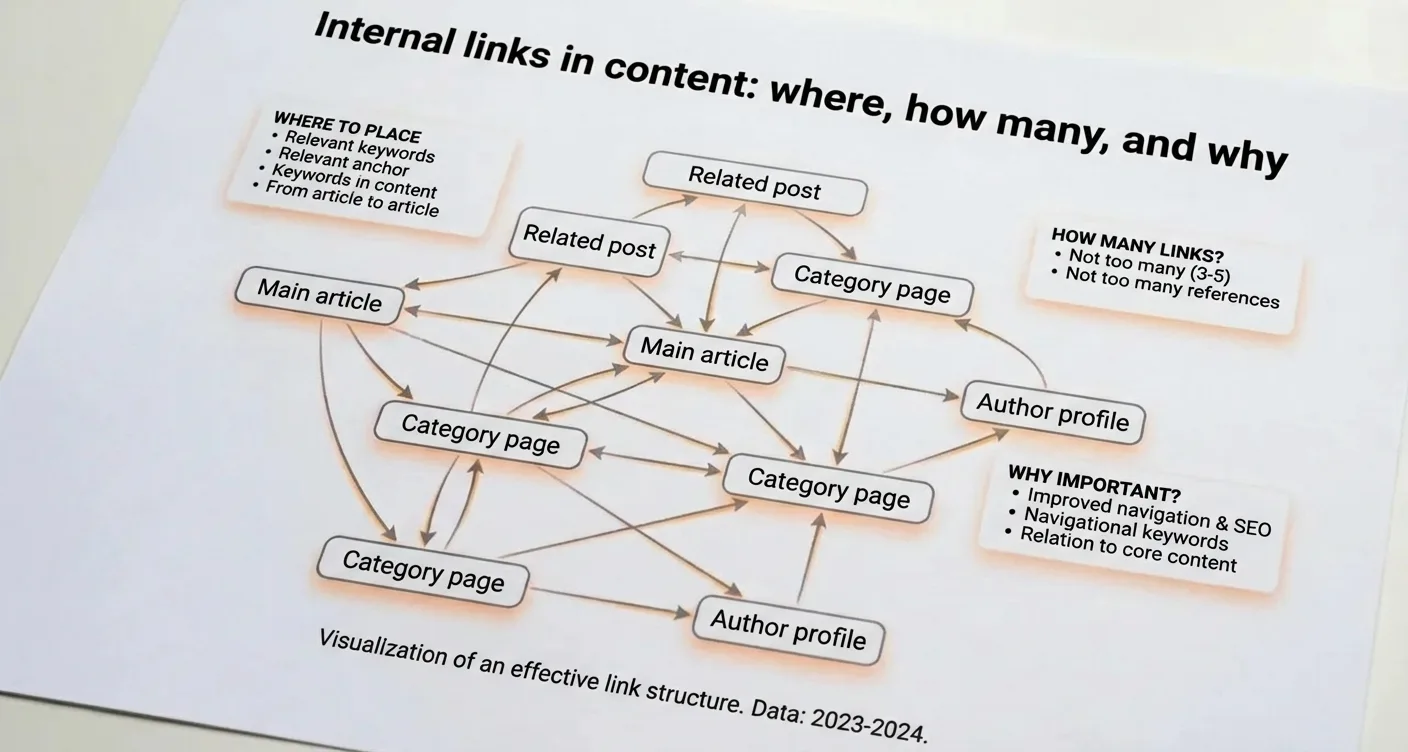
Search engines like Google use crawlers to map the internet, and these bots follow paths formed by links. Without a good strategy for where, how many, and why to use internal links in your content, certain pages can end up as 'orphan pages,' meaning they are undiscoverable. By maintaining a logical structure, you explicitly indicate which pages on your website have the most priority. This not only aids indexing but also helps in understanding the semantic relationship between different articles and services you offer on your platform.
A sound internal linking strategy ensures that 'link juice' flows smoothly through your website to the most important conversion pages.
"Internal link structures are the foundation upon which a website's authority is built, provided they are applied naturally and relevantly within the textual context."
Why Placement and Quantity Are Crucial
When implementing an advanced internal linking strategy within your content, it's essential to consider the placement within the paragraph. Links higher up in the text are often assigned more value than links in the footer or sidebar. However, the number of links must be proportionate to the text's length; too many links can feel spammy, while too few links hinder navigation. For an effective approach to internal links in content, consider the following guidelines:
- Place the most important links in the first few paragraphs for maximum impact.
- Use descriptive anchor texts that accurately reflect the content of the target page.
- Ensure a natural flow; don't force links that don't fit the current sentence.
- Link to related topics, such as affordable search engine optimization for your website, to increase relevance.
Ultimately, internal linking in content is about providing value to the end-user. According to Google Search Central's documentation, a clear link structure helps their systems better understand your site's context. By maintaining a consistent approach, you build an authoritative domain valued by both people and machines.
Optimizing Internal Link Placement Within Your Content
Strategically placing hyperlinks is an art form that directly impacts both user experience and search engine optimization. When we consider effective internal linking in content, the position of a link determines how valuable it is perceived by search engine algorithms like Google's. A link prominently placed at the top of the first paragraph generally carries more authority than one tucked away in the footer or a sidebar. This is because readers are more likely to click on early references that offer immediate relevance to the topic they've just started reading.
The context surrounding your internal links in content determines whether a visitor actually clicks through to another page on your website.
When deciding on the right placement, you must consider your visitor's natural reading flow. It's essential that the link doesn't disrupt but rather enriches the information being consumed. In practice, links woven into informative sentences are clicked more often than standalone links acting as a navigation menu. By textually integrating the link, you maintain reader attention while simultaneously strengthening the authority of your deeper pages within your website's hierarchy.
The Power of Early Placement and Relevant Anchor Text
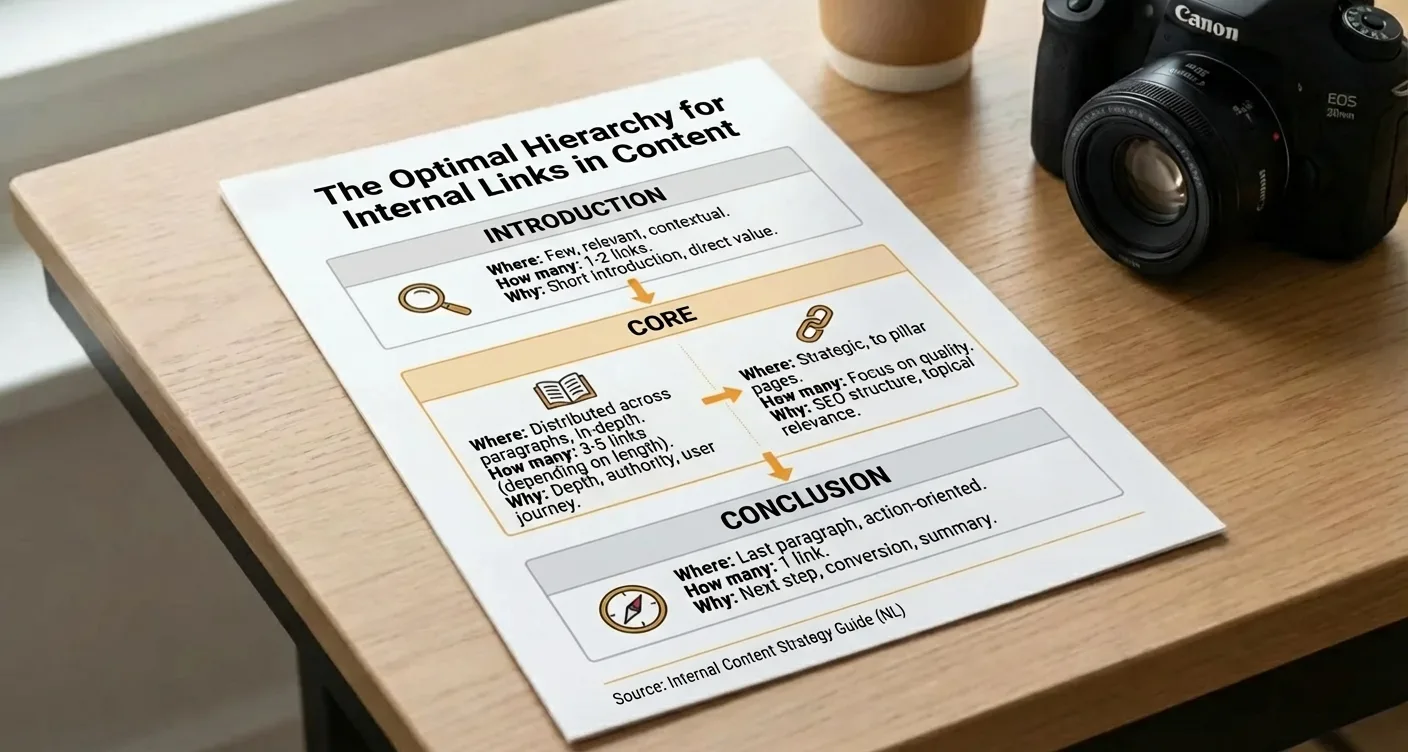
Placing internal links strategically in your content's introduction helps search engines immediately grasp the relationship between different pages. This leads to faster indexing of new content. Moreover, it helps reduce the bounce rate by offering visitors a direct path to more in-depth information. It's crucial that the anchor text is descriptive and accurately conveys what the visitor can expect on the next page, contributing to a transparent and user-friendly navigation structure across your entire domain.
Remember that optimizing internal links in content for a better user experience is essential for a healthy site structure.
"A well-placed internal link acts as a signpost, helping visitors effortlessly find desired information within a complex website architecture."
Besides position, spread throughout the text is crucial for a natural profile. If you cram too many links into one spot, it can feel spammy to both readers and search engines. A balanced approach, focusing on optimizing internal links in content, ensures the text remains readable. For instance, consider linking to a mobile-friendly WordPress website when discussing technical optimization. This type of relevant referral significantly increases the time a user spends on your site.
- Place the most important link in the first two paragraphs for maximum value.
- Vary the position: beginning, middle, and end of sections.
- Ensure links are always surrounded by relevant text (context).
- Avoid linking general terms like "click here" or "read more."
Finally, it's advisable to consult external resources for a broader perspective on link building. For example, you can find more information on the basic principles of SEO to deepen your knowledge. By consistently applying the principles of implementing internal links in content, you build a strong foundation for your online visibility and authority.
How Many Internal Links Per Page Are Optimal for SEO?
Determining the ideal number of internal links on a single page is one of the most debated topics in search engine optimization. There's no magic number that applies universally to every website, as the context of the text and the article's length play a crucial role. When considering internal links in content—where, how many, and why—the focus should be on user experience rather than a rigid mathematical formula. A two-thousand-word page can easily contain fifteen links, while a short three-hundred-word blog post might look cluttered with just five.
Excessive linking harms your page's authority because the so-called 'link juice' is diluted across too many different destinations.
In practice, search engines like Google often have a limit on the number of links they crawl per page, typically around one hundred to two hundred links, including navigation menus. For the main body text itself, it's essential to apply internal linking strategies that prioritize relevance. Too many links can distract the reader from the core message, leading to a higher bounce rate. It's therefore wise to only link when it genuinely adds value to the visitor's information needs at that specific point in their customer journey.
Balancing Authority and User Experience

The concept of optimal internal links in content for maximum authority revolves around maintaining a natural flow. A good rule of thumb is to include about two to three relevant links per three hundred words. This ensures the text breathes and the links stand out without causing irritation. According to Google Search Central's guidelines, it's more important for anchor texts to be descriptive than to aim for a specific number. Quality always triumphs over quantity, especially when working on a helpful content strategy that puts the user first.
Always critically evaluate the necessity of every link you add to your article.
"An abundance of links on a page dilutes the value of each individual link, causing search engines to assign less weight to the most important destination pages within your site structure."
Practical Guidelines for Link Density
To maintain a clear website structure, you can use several practical guidelines when implementing internal linking tactics in your content. It's often more effective to deep link to specific subpages rather than just to the homepage or main categories. This helps the search engine better understand and index your site's hierarchy. When placing internal links in content, pay attention to the following points:
- Only link to pages that further elaborate on or clarify the current topic.
- Vary anchor texts to maintain a natural profile for search engines.
- Preferably place the most important links higher in the text for greater attention value.
- Regularly check for broken links to avoid harming the user experience.
By following these rules, you create a web of information that is both logical and powerful for your SEO position. Ultimately, it's about guiding visitors to the next logical step in their quest for knowledge.
Why a Strong Internal Link Structure Is Essential for Google
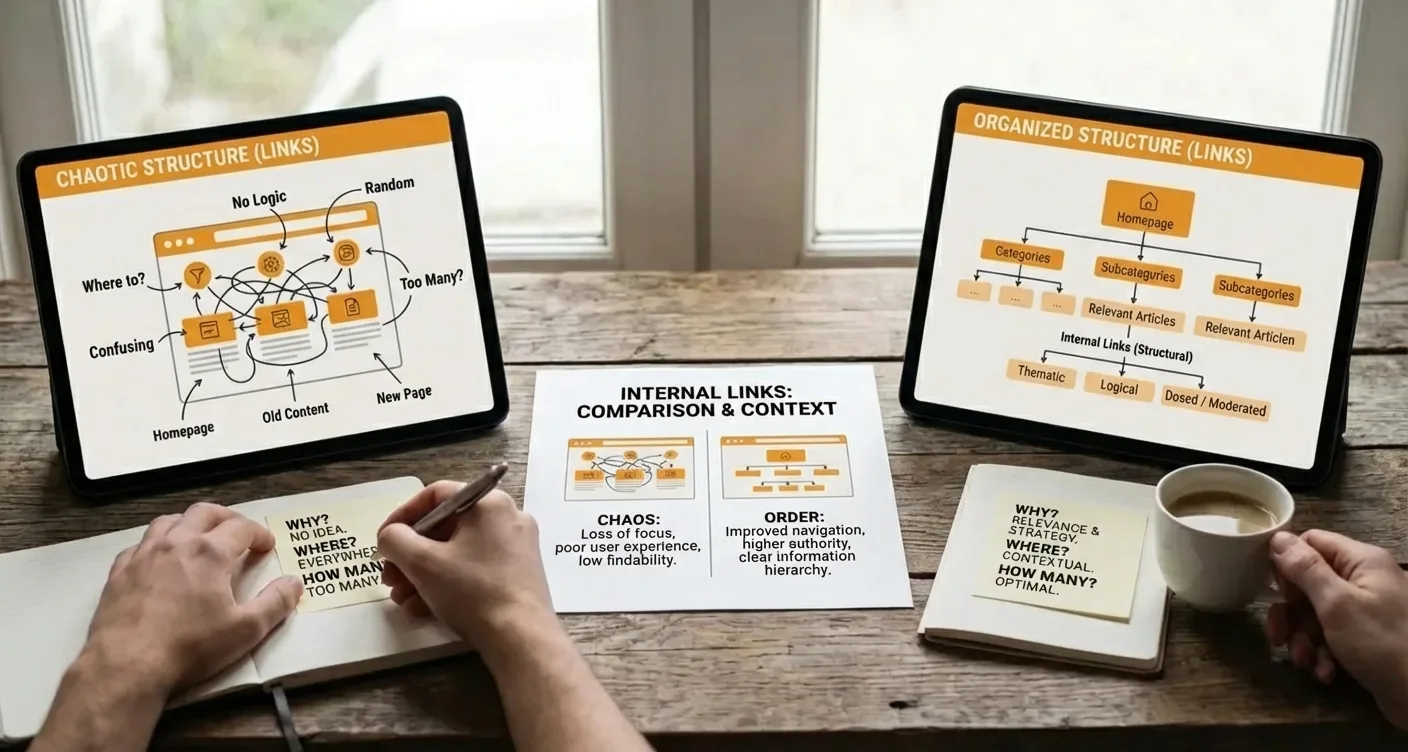
A well-thought-out internal link structure acts as the essential roadmap for search engine crawlers visiting your website. When Google scans a specific page, its algorithm follows the existing connections to understand the context, relevance, and hierarchy of the information. Without a logical system, valuable pages often remain hidden deep within your site architecture. Strategically implementing internal links in content—knowing where, how many, and why—ensures that the authority of your homepage is effectively passed to deeper subpages. This process, also known as 'link juice,' is crucial for improving the discoverability of specific topics that would otherwise be overlooked in organic search results.
The Role of Relevance and Authority
Google uses these internal connections to determine which pages are most relevant for specific user search queries. By consistently using optimized techniques, you help algorithms validate the interconnectedness between different articles. This not only strengthens the SEO value of individual pages but also increases the overall credibility of your domain within a specific field. It's therefore wise to consider a website development from concept to online success where the structure is correctly built from the ground up.
Optimizing User Experience
In addition to technical benefits, these strategies significantly improve the user experience by keeping visitors on the site longer. A natural flow in the text encourages further reading, which lowers the bounce rate and increases engagement. According to Google Search Central's guidelines, understandable navigation is essential for both humans and machines. However, it requires a balance between quantity and quality to prevent over-optimization.
"A website without internal links is like a city without roads; the destinations exist, but no one can reach them."
When implementing these methods, pay attention to the following points:
- Use descriptive anchor texts that accurately reflect the content of the target page.
- Always link to relevant, related content to strengthen context.
- Ensure that the most important pages are reachable within a maximum of three clicks.
- Avoid linking to dead ends or non-existent pages.
Correctly applying these principles is a continuous process of adjustment and improvement for optimal online results.
Best Practices for Anchor Text and Link Relevance
Optimizing anchor text is a fundamental part of a strong SEO strategy. When you start working with internal links in content—where, how many, and why—it's essential that the clickable text fully covers the content of the destination page. Use descriptive words that tell both search engines and users what to expect after clicking. Avoid vague terms like "click here" or "read more," as these provide no contextual value to Google's crawlers. By including relevant keywords in your anchor text, you strengthen the authority of the underlying page for those specific terms within your own website structure.
The Power of Contextual Relevance
The effectiveness of internal links in content strongly correlates with the surrounding text and the logical coherence between the source and the target.
When building an authoritative website, the hierarchy of your information is crucial. A good strategy for internal links in content for better discoverability ensures that the value of your best-performing pages flows through to new articles. Here, you should consider the following points:
- Use variations of your main keywords in anchor texts.
- Ensure the link feels natural within the reading flow of the paragraph.
- Link to deeper pages, such as a custom WordPress website, for maximum relevance.
- Always prioritize user experience over purely technical optimization.
"A well-thought-out link structure functions as a roadmap for search engines, with the anchor text being the signpost that points the way to valuable information."
Quantity Versus Quality in Your Internal Linking Strategy
While it's tempting to link frequently, balance is essential for success with internal linking strategies in content. Too many links can distract the reader and dilute the value of individual links, while too few links hinder discoverability. For more in-depth information on how search engines interpret these structures, you can consult the official Google SEO Starter Guide. Ultimately, it's about providing additional value to visitors who want to learn more about internal links in content—where, how many, and why.
Remember that a natural distribution of internal links in content for SEO yields the best long-term results.
Strategically implementing internal links is essential for strong SEO value and a well-organized website structure.
By finding the right balance between relevance and quantity, you help both search engines and visitors discover your valuable content faster. Remember that natural integration always takes priority over excessive optimization for maximum results.
In this article, we've covered the core aspects of internal links in content: where to place them, how many to use, and why this technique boosts your authority. Do you want to immediately improve your organic visibility and elevate the user experience? Start optimizing your internal link structure today for sustainable growth in search results. Check out our other guides for more in-depth tips on search engine optimization.
Frequently Asked Questions
Why are internal links crucial in content: placement, quantity, and impact?
Internal links help search engines better understand your website's structure and distribute authority across different pages. Additionally, they improve the user experience by guiding visitors to relevant supplementary information.
Where is the best place to put internal links within an article?
It is most effective to organically embed links within the flowing text, preferably early in the article. By placing links on relevant anchor texts, both readers and Google immediately understand what the target page is about.
How many internal links should you typically use per page?
There is no exact number, but a good guideline is to aim for 3 to 5 links per 1000 words. When determining the number of internal links in content, the relevance to the reader is always central.
When is an internal link not effective for your SEO?
A link is less effective if its context doesn't match the target page or if you cram too many links together. Excessive linking can disrupt readability and dilute the value of individual links.
How SEO Supercharged helps you here
SEO Supercharged is fully online (service area: online, worldwide), so you can use it from anywhere.
The platform is built for SEO Specialists, Content Marketers, Bloggers and Niche Site Owners, E-commerce Entrepreneurs, Marketing Managers for SMEs, Freelance Copywriters and Content Writers, Web Developers and Technical SEO Consultants, Digital Marketing Agencies, Inbound Marketing Strategists.
You can use it for, among other things, Internal Link Audit, Strategic Internal Linking Plan,.
Want to tackle this directly? Create strong content with the Content Generator, or start a free SEO analysis.
Related articles
- AI Content Generator: Create Content That Ranks, Explains, and Converts (with Visuals)
Master our AI Content Generator to create articles & pages that rank high in Google & fuel AI answers. Learn intent, structure, internal links, visuals.
- Blog vs. Service Page: SEO and Conversion Differences
Blog posts vs. service pages: Learn why their SEO is similar but conversion strategies differ. Optimize your website for better results with expert tips!
- Multilingual Content: Optimize Your International Website
Master multilingual content for NL/EN/FR/DE. Discover how to avoid duplicate content penalties, boost international SEO, and optimize your global website.
- Editorial Templates: 7 Proven Content Formats That Always Drive Engagement
Discover 7 effective editorial templates and content formats that always work to boost your reach and engagement. Optimize your content strategy with proven.
- Practical E-E-A-T: Building Trust Without Fluff for SEO Success
Learn practical E-E-A-T strategies to build trust & authority for better SEO. Discover actionable tips & immediately improve your website's credibility.