Multilingual Content: Optimize Your International Website
Multilingual Content: Prevent Duplication & Boost SEO | Guide
Successfully managing **multilingual content across Dutch, English, French, and German (NL/EN/FR/DE) without duplication** requires a smart technical setup that prioritizes hreflang tags and unique content. By adopting this specific approach, you ensure that Google indexes each language version as valuable, standalone content. This process demands precise alignment between translation and localization, where the target audience's context is more crucial than a literal translation. For optimal international growth, you must consider regional search terms that vary by country.
An effective multilingual communication strategy strengthens your authority without diluting SEO value.
- Use hreflang attributes for correct language recognition.
- Write unique metadata for each language region.
- Avoid automatic translations without human review.
- Centralize the management of your international content.
Implementing this strategy is the best way to generate organic traffic worldwide.
The Foundation of Multilingual Content: NL/EN/FR/DE Without Duplication
Setting up an international website requires a well-thought-out strategy to prevent search engines from getting confused by different language versions. When you're managing **multilingual content across Dutch, English, French, and German (NL/EN/FR/DE) to prevent duplication**, it's essential to understand that simply translating isn't enough for optimal visibility. Search engines like Google always try to show the most relevant version of a page to the user based on their location and language settings. Without the right technical foundation, however, confusion can arise about which page should take precedence, which can fragment your domain's authority across different languages.
Multilingual content (NL/EN/FR/DE) without duplication is the cornerstone of a healthy international SEO strategy that enables growth in diverse markets.
The Importance of Technical Structure for Language Versions
A common mistake when managing websites in Dutch, English, French, and German is creating overlapping content that algorithms might perceive as duplicate. To avoid this, each language version must have a unique URL structure, such as subfolders or country-specific extensions. Using strategies for **multilingual content (NL/EN/FR/DE) without duplication for European businesses** helps clearly delineate these sections. This ensures the index understands exactly which text is intended for a French-speaking visitor and which for a German-speaking one, even if the products or services are described almost identically in the source text.

Implementing hreflang tags is indispensable here. These tags tell search engines that the different pages are translations of each other and not attempts at spam. By correctly setting up these signals, you significantly strengthen the relevance of your international website structure. This ensures that the right target audience always lands on the correct page, which benefits user experience and conversion.
"Effective multilingual SEO is not just about language; it's about creating a logical hierarchy where each language version retains its own value without cannibalizing the others."
Best Practices for Unique Content Creation
While the temptation to literally translate texts is strong, localization is a much more powerful method. This means adapting the content to the cultural context and specific search terms of each country. When rolling out a **multilingual content (NL/EN/FR/DE) without duplication implementation**, it's wise to consider the following points:
- Use unique meta titles and descriptions for each language region.
- Adapt currency, units of measurement, and local date formats.
- Avoid automatic translation tools without human review to ensure quality.
- Link internally to relevant pages within the same language section.
By following these steps, you build an authoritative position in every market. For more information on improving your online presence, you can look into affordable search engine optimization for your projects. The success of **multilingual content (NL/EN/FR/DE) without duplication** depends on the consistency with which you apply these rules at every language level. According to Google Search Central's guidelines, it's crucial that user navigation remains intuitive. The ultimate goal is a seamless experience where **multilingual content (NL/EN/FR/DE) without duplication** feels natural for every visitor, regardless of their origin or language preference.
Effective multilingual communication requires constant monitoring of search results per region.
The Importance of Hreflang Tags for International SEO
When you decide to broaden your digital horizon, it's essential to understand how search engines interpret your various language versions. Hreflang tags act as a roadmap for Google and Bing, indicating which specific page is intended for a particular region or language. Without these technical signals, you risk search engines getting confused by the similarity between your pages. Correctly implementing these tags ensures that users in France see the French version, while visitors from Germany land directly on the correct German-language page. This process is the backbone of a successful strategy for **multilingual content (NL/EN/FR/DE) without duplication**, where relevance for the end-user is always central to the algorithm.
**Multilingual content (NL/EN/FR/DE) without duplication** requires precise technical alignment to prevent cannibalization in search results.
Prevent Duplicate Content with the Right Signals
One of the biggest challenges in international expansion is avoiding penalties for duplicate content. While Google officially doesn't issue a 'penalty' for duplication, it can lead to lower rankings because the search engine doesn't know which version to prioritize. By using hreflang attributes, you explicitly tell search engines that the pages are not copies of each other, but deliberate translations or localizations. This is crucial for **multilingual content (NL/EN/FR/DE) without duplication strategies** where the textual structure often matches. It allows you to offer the same products or services in different markets without diluting your main domain's authority due to internal competition between language paths.
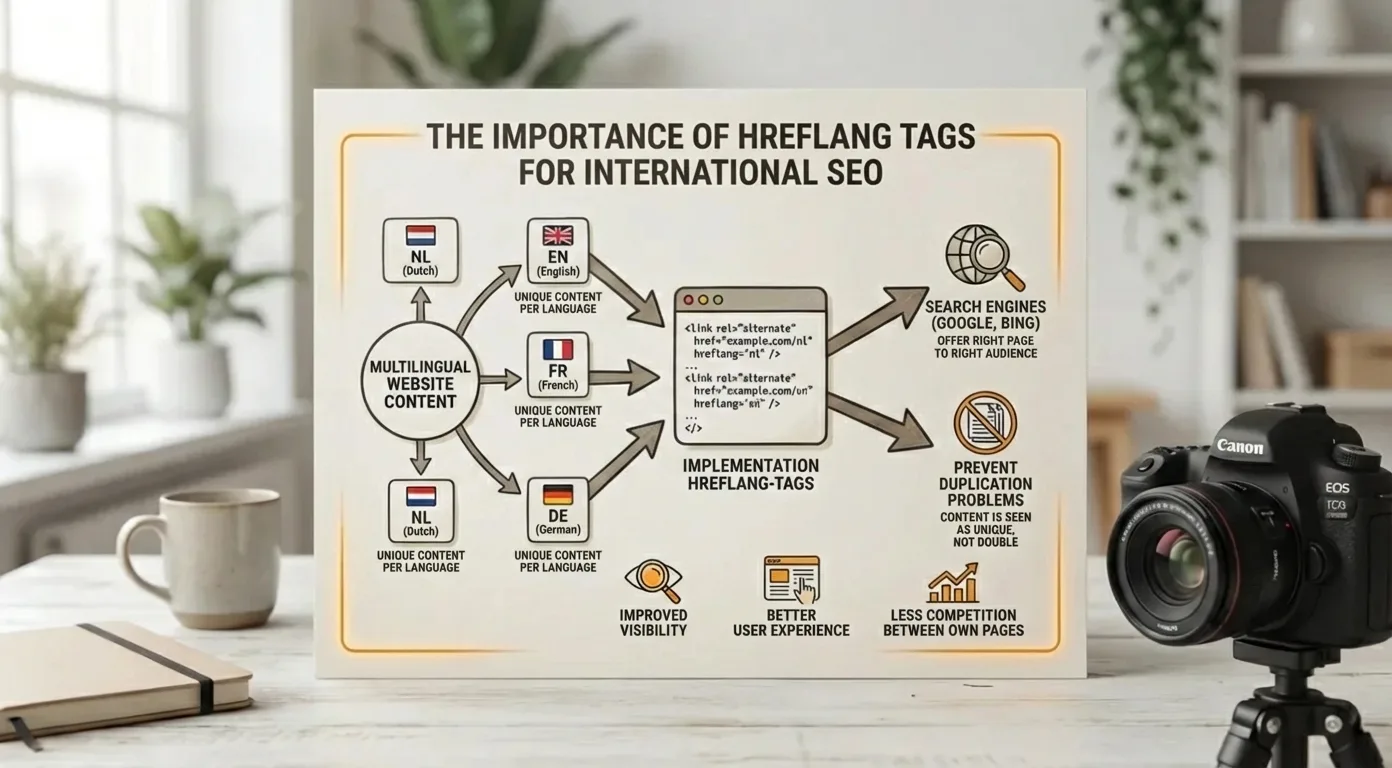
These tags can be implemented via the HTML head, HTTP header, or an XML sitemap. Many administrators choose the sitemap method because it keeps the page's source code organized and is less error-prone for large websites. For an optimal structure, you can also consider a custom WordPress configuration to automate these processes. Remember that each page must reference itself and all other language variants, known as 'return tags'. If this circle is not complete, Google completely ignores the instructions, directly harming your international visibility.
"Hreflang is not just a technical trick; it's the language you speak with search engines to offer your global audience the best possible experience without confusion."
Manually managing these tags for **multilingual content (NL/EN/FR/DE) without duplication** for advanced webmasters can become complex as the number of languages grows.
The Impact on User Experience and Conversion
In addition to the technical benefits for SEO, hreflang tags have a direct impact on user experience. Nothing is more frustrating for a visitor than landing on a page in the wrong language. When a user is directly presented with the correct language version, the bounce rate decreases significantly. This is an indirect but powerful signal to search engines that your website is valuable. Good implementation of **multilingual content (NL/EN/FR/DE) without duplication techniques** ensures that the conversion rate increases, simply because the barrier for the visitor is lower. For more in-depth information on international standards, you can consult the official documentation on Google Search Central.
- Use the correct ISO 639-1 language codes for accurate recognition.
- Always add an x-default tag for users outside the defined regions.
- Regularly check for errors in Search Console to prevent indexing issues.
- Ensure the internal linking structure remains consistent across all language versions.
Consistency is the keyword when scaling your platform. Each language version must project the same authority as the original. By taking **multilingual content (NL/EN/FR/DE) without duplication management** seriously, you build a sustainable international brand. Correctly setting these parameters is just as important as the quality of the translations themselves, as it directly influences visibility in local search engines like Google.fr or Google.de.
Strategies to Avoid Duplicate Content in Translations
Managing a website that targets different markets requires a watertight approach to show search engines that each page offers unique value. When you're working with **multilingual content (NL/EN/FR/DE) without duplication**, it's essential to understand that a direct, word-for-word translation can sometimes be considered low quality by algorithms. To prevent this, the focus should be on localization rather than mere translation. This means adapting the text to the cultural nuances and specific search terms of the target region, which significantly increases relevance for the local user and reduces the chance of indexing issues.
A strong foundation begins with a robust structure. Ensure your technical groundwork, such as an SEO audit and action plan, takes language variants into account.
Technical Signals and Hreflang Implementation
The most effective method for instructing search engines about the relationship between your different language versions is the correct use of hreflang tags. These tags tell Google exactly which version of a page is intended for a specific language or region. Without these technical signposts, a search engine can become confused by the similarity in structure, especially for product pages. Implementing **multilingual content (NL/EN/FR/DE) without duplication strategies** ensures that the right user lands on the correct URL, directly benefiting user experience and your position in search results.

In addition to technical aspects, content quality plays a crucial role. It's tempting to use the same texts everywhere, but unique headings and meta descriptions per language are necessary. By investing in practical **multilingual content (NL/EN/FR/DE) without duplication** methods for international growth, you prevent pages from competing with each other in search results. This content creation process requires a human touch, where the tone of voice is tailored to the local target audience, which is essential for building authority in diverse markets.
"Simply copying a page structure to another language without considering local search intent is a common mistake that can erode a domain's SEO value."
Localization as a Weapon Against Duplication
Localization goes beyond language; it encompasses currency, units of measurement, and local references. When you apply **multilingual content (NL/EN/FR/DE) without duplication optimization**, you are effectively creating new, unique assets for your business. This prevents search engines from thinking you are simply 'spinning' pages to occupy more space. For more information on writing content that appeals to both people and search engines, you can look at helpful content principles. A well-thought-out approach to **multilingual content (NL/EN/FR/DE) without duplication management** requires discipline in tracking changes across all language versions.
- Use unique images or adapt alt-texts per language region.
- Avoid automatic translations without manual review and revision.
- Ensure a consistent internal linking structure within the same language section.
- Monitor your performance via Google Search Console to detect any overlap in a timely manner.
Finally, it is advisable to consult external resources for the latest search engine guidelines. For example, follow the official documentation of Google Search Central to keep your knowledge of international SEO up-to-date. By combining these technical and content-focused steps, you build a sustainable presence where **multilingual content (NL/EN/FR/DE) without duplication results** lead to higher conversion and better visibility in every country where you operate.
Technical Structure: Subfolders versus Subdomains for Languages
When setting up an international website, the choice between subfolders and subdomains is crucial for your domain's authority. For most businesses, using subfolders, such as domain.be/en/ or domain.be/fr/, is the most effective method. This is because the accumulated SEO value of the main domain directly benefits all language versions. When you aim for **multilingual content (NL/EN/FR/DE) without duplication**, a subfolder structure ensures that search engines view your site as one powerful entity, which significantly speeds up and simplifies the indexing of different languages.
The Advantages of Subfolders for SEO Value
Subfolders are easier to maintain and require less technical configuration than subdomains, allowing the focus to remain entirely on content quality. Implementing **multilingual content (NL/EN/FR/DE) without duplication strategies** requires a clear hierarchy. By choosing subfolders, you maintain a centralized link-building strategy. Every external link to your main domain indirectly strengthens the positions of your French or German pages. This is often more efficient than managing multiple separate subdomains, each needing to build its own authority with Google. For a professional approach, you can have a website built that is directly optimized according to these technical standards.
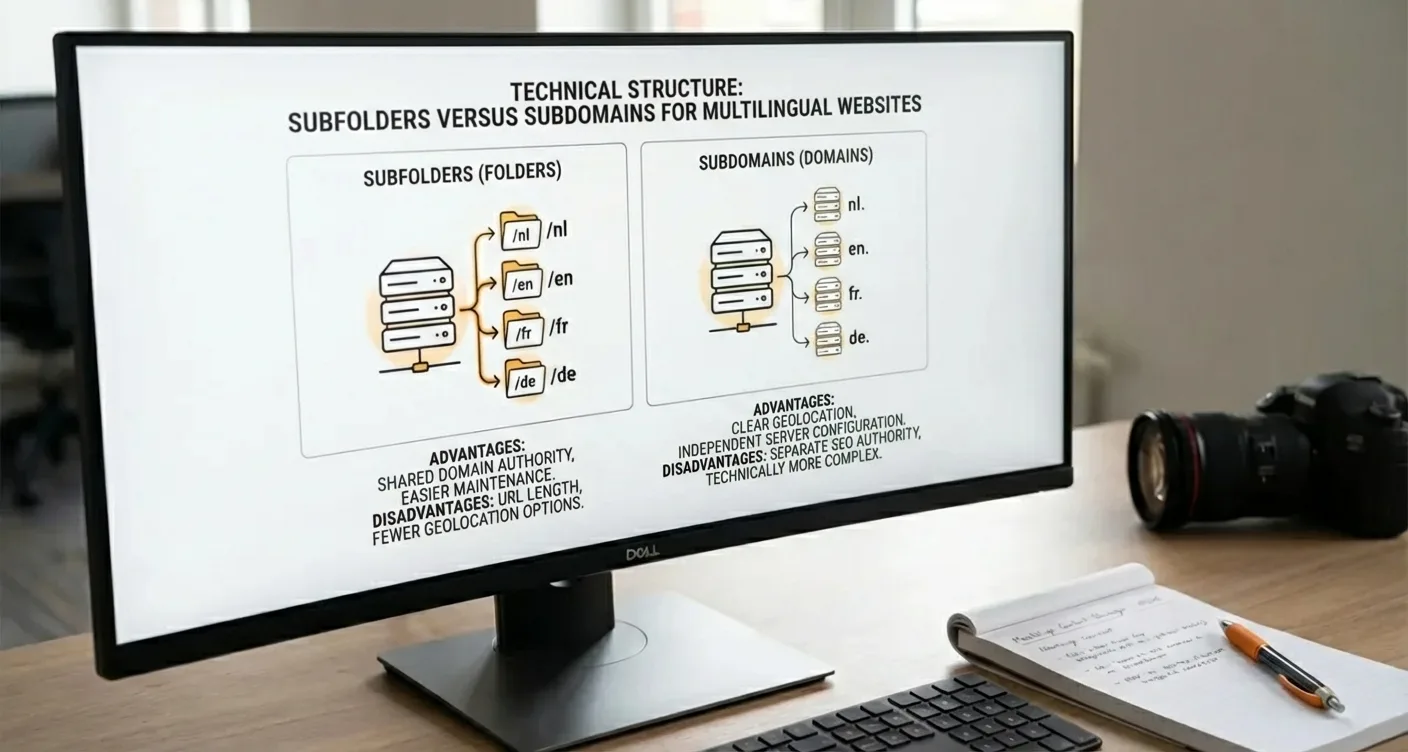
A subdomain, such as fr.domain.be, is often treated as a separate entity by search engines. This can be useful if you maintain a completely different brand identity per country, but for multilingual projects within a single brand, it is usually counterproductive. It fragments your SEO power and makes it harder to maintain consistency in your technical optimization across all language versions. To be successful with international SEO, you must consider the following technical aspects:
- Use hreflang tags to indicate the relationship between language versions.
- Ensure a logical URL structure that includes the language code.
- Avoid automatic redirects based on IP address for search engines.
- Keep the sitemap up-to-date with all translated URLs.
"The choice of the right URL structure is the foundation upon which your international visibility rests; a faulty start can cost years of SEO efforts."
Don't forget that the technical structure also affects user experience and loading speed. A well-structured site with **multilingual content (NL/EN/FR/DE) without duplication management** often performs better in diverse regions. For more in-depth information on international standards, you can consult the official documentation of Google Search Central. Correctly configuring this folder structure is essential for long-term international success.
Best Practices for Managing a Four-Language Website
Successfully managing a platform with four languages requires an ironclad technical foundation and a clear editorial workflow. When you're working with **multilingual content across Dutch, English, French, and German (NL/EN/FR/DE) without duplication**, it's essential that search engines understand which page is intended for which region. This prevents Google from seeing your translations as copied text, which would be detrimental to your rankings. By using hreflang tags and a logical URL structure, you ensure that the correct language version always reaches the right visitor, regardless of their location or browser settings.
Technical Optimization and Structure
Good structure is half the battle when publishing **multilingual content (NL/EN/FR/DE) without duplication** on your domain.
For a seamless experience, it is advisable to invest in WordPress customization. This allows you to set up specific fields and taxonomies that remain consistent across all language versions. Manually maintaining four different languages can quickly lead to errors in navigation or missing links. A central database where **multilingual content (NL/EN/FR/DE) without duplication** for international companies is stored helps you maintain an overview and keep your website's loading speed optimal for every user.
Consistency and Quality Control
Beyond the technical aspect, the editorial quality of **multilingual content (NL/EN/FR/DE) without duplication** is decisive for your online authority. It is tempting to rely on automatic translations, but in practice, human review proves indispensable to ensure the correct tone and context. Therefore, always use a fixed checklist for your publications:
- Check that all internal links refer to the correct language version.
- Ensure meta-descriptions are unique for each language.
- Validate hreflang attributes in the source code.
- Update all language versions simultaneously for major changes.
"Effective management of **multilingual content (NL/EN/FR/DE) without duplication** begins with strong synergy between technology and linguistic sensitivity."
Remember that regular periodic maintenance is necessary to keep the database clean of unnecessary revisions. This ensures that your **multilingual content (NL/EN/FR/DE) without duplication** is always loaded quickly by search engines. For more in-depth information on SEO standards, you can consult the official documentation of Google Search Central. A well-structured website is, after all, the key to international success.
Correctly managing **multilingual content (NL/EN/FR/DE) without duplication** is essential for a strong international SEO position and an optimal user experience.
By implementing smart technical solutions such as hreflang tags and unique URL structures, you prevent search engines from considering your translated pages as duplicate content. This ensures that your website reaches the right target audience in every country without your authority being diluted by internal competition between different language versions.
Do you want to maximize the visibility of your international website and definitively eliminate technical errors? Start today by optimizing your **multilingual content (NL/EN/FR/DE) without duplication** by conducting a thorough audit of your current site structure and hreflang settings. A consistent approach in Dutch, English, French, and German not only strengthens your findability but also builds direct trust with your global customer base. Contact our specialists now for a no-obligation consultation about your worldwide growth opportunities and SEO strategy.
Frequently Asked Questions
What is the importance of the hreflang tag for multilingual content?
The hreflang tag is essential for letting search engines know which language version is intended for which region. By implementing it correctly, you prevent **multilingual content (NL/EN/FR/DE) without duplication** from being considered 'duplicate content,' because Google understands that these are different translations.
How do you prevent duplicate content on a website in four languages?
You prevent this by giving each language version a unique URL, for example, via subfolders or subdomains. Consistently applying canonical tags and hreflang attributes ensures a healthy structure for your **multilingual content (NL/EN/FR/DE) without duplication**.
Why is automatic translation often insufficient for SEO?
Automatic translations often lack the cultural nuance and specific keywords that local users employ. For an optimal user experience and visibility, manually localizing texts is necessary to ensure quality content in Dutch, English, French, and German.
When should you choose a separate domain structure per language?
A separate domain structure (such as .nl, .de, .fr) is ideal when you want to build strong local authority in specific countries. This is especially effective if you have the resources to maintain and optimize each domain separately for the local market.
How SEO Supercharged helps you here
SEO Supercharged is fully online, so you can use it from anywhere.
The platform is built for International e-commerce entrepreneurs, Marketing managers at European multinationals, Content strategists and SEO specialists, SaaS companies with international growth ambitions, Tourism and hospitality businesses, Digital marketing and communication agencies, Exporters and manufacturing companies in the DACH and Benelux regions, E-learning platforms and online education providers, Technical project leaders and CMS administrators.
You can use it for, among other things, Hreflang configuration audit, Multilingual keyword research, Local content localization, Cross-border content strategy, Duplicate content prevention scan, Native copywriting (NL/EN/FR/DE), International SEO architecture.
Want to tackle this directly? Create strong content with the Content Generator, or start a free SEO analysis.
Related articles
- AI Content Generator: Create Content That Ranks, Explains, and Converts (with Visuals)
Master our AI Content Generator to create articles & pages that rank high in Google & fuel AI answers. Learn intent, structure, internal links, visuals.
- Blog vs. Service Page: SEO and Conversion Differences
Blog posts vs. service pages: Learn why their SEO is similar but conversion strategies differ. Optimize your website for better results with expert tips!
- Internal Links in Content: Where, How Many, and Why They Are Crucial
Master internal linking for SEO success. Learn where to place internal links, how many to use, and why they're crucial for boosting rankings. Read more!
- Editorial Templates: 7 Proven Content Formats That Always Drive Engagement
Discover 7 effective editorial templates and content formats that always work to boost your reach and engagement. Optimize your content strategy with proven.
- Practical E-E-A-T: Building Trust Without Fluff for SEO Success
Learn practical E-E-A-T strategies to build trust & authority for better SEO. Discover actionable tips & immediately improve your website's credibility.