SERP Testing: Boost Your Click-Through Rate with A/B Tests
Master SERP A/B Testing: Boost CTR, Avoid Chaos | SEO Guide

With SERP testing, you optimize your click-through rate (CTR) by systematically varying metadata without jeopardizing organic search rankings. This SERP testing methodology allows SEO specialists to make data-driven decisions about titles and descriptions, replacing guesswork with measurable results in Google. In practice, a structured approach is crucial to prevent contamination of test data.
Successful SERP A/B testing hinges on isolating variables.
By focusing on effective SERP A/B testing methods, you maintain clarity and control. The process of practical SERP A/B testing requires patience and precise monitoring of Search Console data.

The Fundamentals of Practical SERP A/B Testing
Optimizing organic impressions starts with a structured approach. Many marketers haphazardly adjust titles, but sustainable growth requires practical SERP A/B testing to understand what truly motivates searchers. By isolating variables in your metadata, you can measure which adjustments lead to a higher click-through rate without jeopardizing your rankings with ill-considered changes.
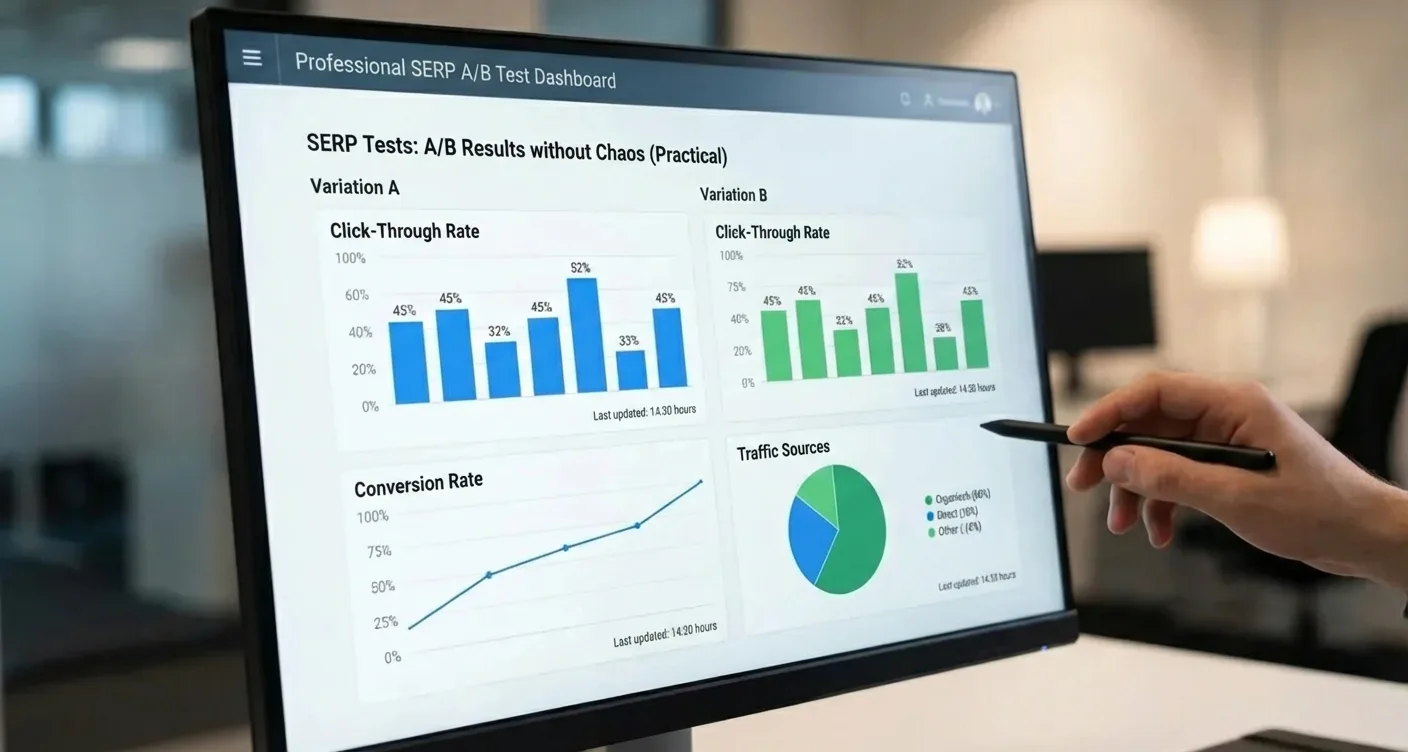
Effective strategies revolve around precision. Before you begin, determine which element you'll test. Is it action-oriented language in the meta description or a year in the page title? When testing, it's crucial to change only one element at a time. This ensures that any increase in traffic can be directly attributed to that specific adjustment and not to external factors.
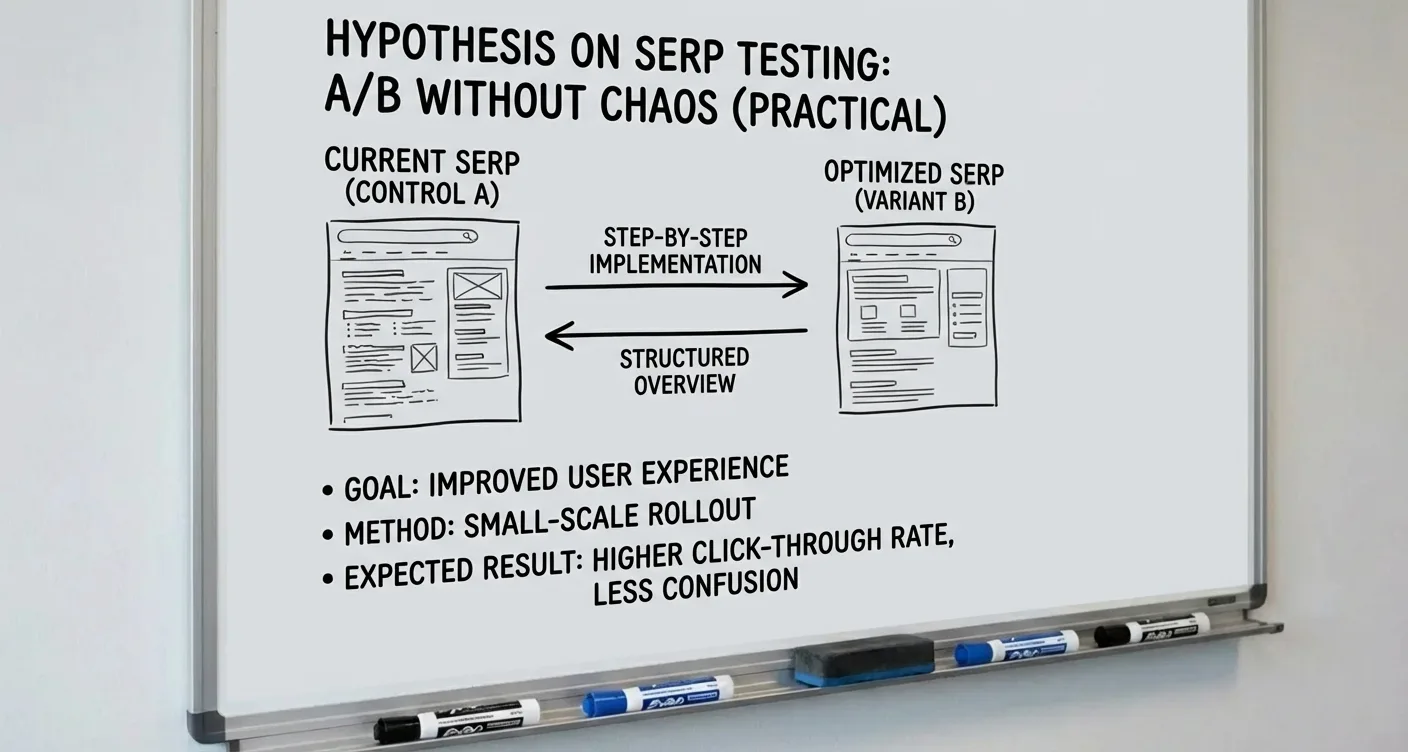
"Successful SEO isn't the result of guessing, but of consistently validating data through controlled experiments."
Implement a clear step-by-step plan for your testing phase:
- Select pages with sufficient stable traffic.
- Document current performance in Google Search Console.
- Implement the change and monitor results for at least two weeks.
- Analyze whether the practical method has had a positive effect.
For sustainable growth, affordable search engine optimization is crucial. Consult external resources like Search Engine Journal for trends. Implementing this testing method ensures a predictable stream of relevant visitors to your website.
Step-by-Step Plan for Measuring Metadata Performance
Optimizing click-through rates begins with a data-driven approach guiding every adjustment to titles and descriptions. To achieve results, it's essential to first conduct a baseline measurement in Google Search Console. By focusing on pages with high impression value but a low CTR, you immediately identify opportunities for improvement. The process of conducting SERP A/B tests without chaos requires you to adjust only one variable at a time to accurately measure its impact.
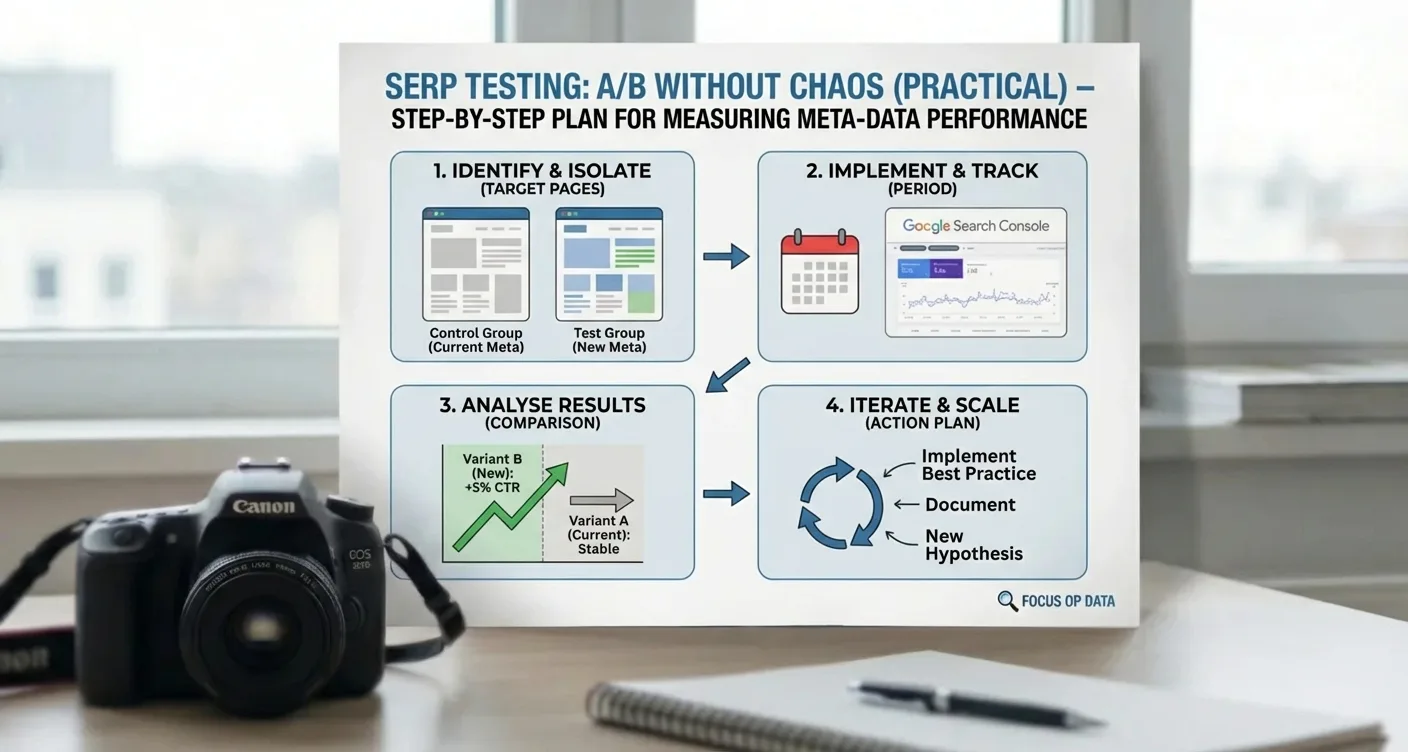
Consistency is key to noise-free data analysis. When running tests, it's crucial to define a control group and a test group. For instance, you could adjust the meta titles of a specific product category while leaving a similar category unchanged to serve as a reference point for natural fluctuations. Don't forget to subtly incorporate your visual brand identity into the new metadata to enhance recognition.
"Effective SEO experiments rely on the discipline of patiently waiting until sufficient statistical relevance is achieved in search results."
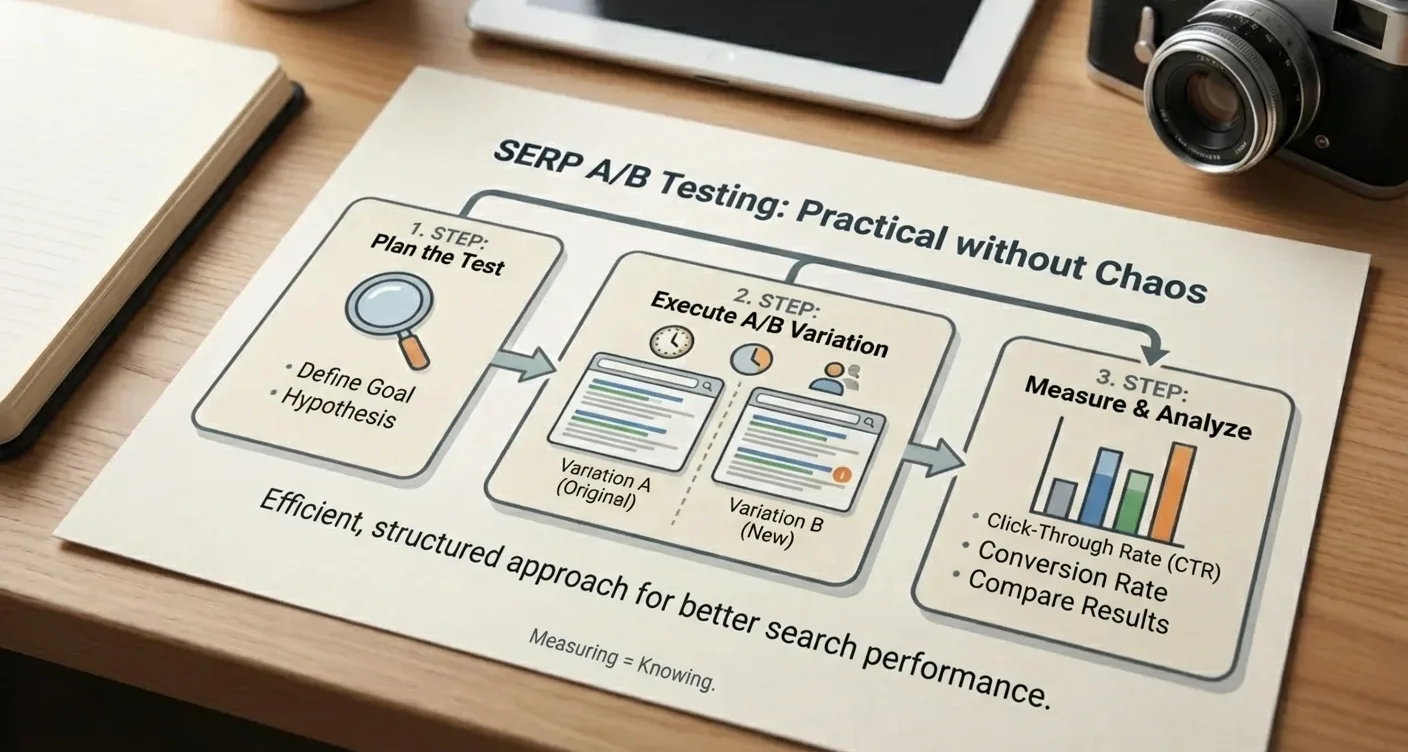
Monitor changes for a minimum of two to four weeks for a reliable picture. Be aware of external factors such as seasonal trends or algorithm updates to avoid drawing incorrect conclusions. Use tools like Google Search Console to track shifts in position and click frequency. A solid methodology helps you recognize patterns that would otherwise remain invisible. This process is about continuously refining your message based on actual user behavior.
Avoiding Common Mistakes in Search Engine Results Testing
When optimizing metadata, marketers often make the mistake of changing too many variables simultaneously. When you adjust titles, descriptions, and URL structures at the same time, it becomes impossible to determine which change is responsible for a shift in the click-through rate. For successful practical SERP A/B testing, isolating elements is essential to gather reliable data on searcher behavior. Therefore, always focus on one hypothesis per test cycle to minimize statistical noise.
Data Interpretation and Seasonal Influences

Another pitfall is ignoring external factors like holidays or algorithm updates. Without a control group or historical context, a traffic increase could be incorrectly attributed to your new meta description. The SERP testing process requires a critical look at the timeline. Use tools like Google Search Console to monitor trends. Consistency in test duration is the absolute key to valid SEO insights.
Prematurely ending experiments often leads to incorrect conclusions. Give search engines time to index changes and users a chance to react. For an effective method, you should consider the following points:
- Test only one element, such as the Title Tag, at a time.
- Account for loading speed through speed optimization.
- Accurately document every adjustment in a logbook.
- Compare results only with comparable periods from the past.
Ultimately, a SERP A/B test is about patience and precision. By working systematically and avoiding common mistakes, you build a sustainable strategy that structurally improves your visibility without unnecessary risks.
Ready for more clicks?
With the right approach, **SERP testing becomes actionable** for every **SEO specialist** who wants to make **data-driven decisions without risking rankings**. By systematically optimizing titles and meta descriptions, you discover exactly which message resonates with your target audience. Focus on small adjustments, accurately monitor results in Google Search Console, and implement only the winning variants for sustained growth. Start your first test today and watch your organic CTR increase immediately.
Frequently Asked Questions
What exactly is an A/B SERP test?
It's a method to test different versions of your meta titles and descriptions in search results without harming SEO performance. By employing a structured approach to practical SERP A/B testing, you accurately measure which variant yields the highest click-through rate (CTR).
How do you perform an effective A/B test on your metadata?
You start by selecting comparable pages and applying a specific change to half of them, such as a different call-to-action. By using tools like Google Search Console, you can analyze the results of this practical SERP A/B testing and determine which adjustment works best.
Why is an organized approach essential for search engine testing?
Without a clear plan, external factors like seasonal trends can contaminate your data. A practical approach ensures that you only test variables that genuinely influence user behavior in the search engine.
When is the ideal time to stop a test?
A test should run long enough to achieve statistical significance, typically between two and four weeks. As soon as a clear difference in click behavior is visible between the control and test groups, you can permanently implement the winning variant.
How SEO Supercharged helps you here
SEO Supercharged is fully online (service area: online, worldwide), so you can use it from anywhere.
The platform is built for SMEs with growth ambitions, Marketing Managers at medium-sized organizations, E-commerce operators and webshop owners, SaaS companies and tech startups, B2B service providers and business consultants, Content and communication specialists, International exporters and global brands, Local entrepreneurs with a digital focus, Digital marketing agencies and agency owners.
You can use it for, among other things, GEO-Strategy & AI Audit, Hybrid SEO & GEO Content Creation, LLM Visibility Analysis, Structured Data & Schema Optimization, Brand Authority & Citation Building, E-E-A-T Content Optimization.
Want to tackle this directly? Optimize your SERP snippet with the SERP Optimizer, or start a free SEO analysis.
Related articles
- From Keyword to Winning SEO Page: Generator + SERP Optimizer
Discover a practical workflow to build winning SEO pages: from keyword research and intent mapping to content generation and SERP snippet optimization. Boost.
- Meta Descriptions: Boost Clicks Without Clickbait
Discover how to boost your CTR with meta descriptions without clickbait. Improve organic search results today with practical tips for effective snippets.
- Clickable Title Tags: Patterns & Sector-Specific Examples
Master clickable title tags with proven patterns & sector-specific examples. Learn to boost your CTR, drive more organic traffic, and optimize your website now!
- The On-page SEO Checklist (Scoring Model): What's 'Good Enough' for Google?
Master On-page SEO with our checklist & scoring model. Discover what's 'good enough' to rank on Google, optimize your content, and boost visibility today!
- The Fundamentals of Structured Data for Rich Results
Learn all about structured data for rich results: the dos and don'ts. Optimize your website and boost your CTR immediately. Read our expert tips now!