Core Web Vitals for Speed, Conversion & SEO
Core Web Vitals for Content Sites: Boost Speed & SEO

Optimizing Core Web Vitals for content sites is essential for a superior user experience and higher search engine rankings. By focusing on these metrics, publishers can significantly improve page load times and visual stability. This process requires a thorough analysis of technical aspects like Largest Contentful Paint (LCP) and Cumulative Layout Shift (CLS) to maximize visitor interaction.
Implementing a sustainable approach ensures that heavy media files and intrusive advertisements no longer hinder readability. Successful publishers understand that technical optimization forms the foundation for digital growth and authority. It's about removing barriers that negatively impact reader retention.

Pay attention to the following key points for improved performance:
- Faster display of core content.
- Preventing unexpected shifts during scrolling.
- Improved responsiveness during interactions.
- Higher evaluation by search engine algorithms.
What Are the Key Core Web Vitals for Content Sites?
For owners of informative websites, understanding the user experience is crucial for remaining relevant in search engines. Core Web Vitals are a set of specific factors Google uses to objectively measure a webpage's overall user experience. For publishers and bloggers, optimizing Core Web Vitals for content sites – focusing on impactful speed gains – has become an absolute necessity, not just an option. These metrics look beyond simple load times; they assess how stable and interactive a page feels while a visitor reads an article or navigates a photo gallery. When a page responds slowly or visually shifts during loading, readers often abandon the site prematurely, which directly harms the website's authority and conversion rates.
Structurally improving these technical aspects ensures a smooth reading experience that keeps visitors on your platform longer. The core of this assessment consists of three specific components: Largest Contentful Paint (LCP), Interaction to Next Paint (INP), and Cumulative Layout Shift (CLS). LCP measures how quickly the largest visible element on the screen, such as a hero image or a prominent heading, becomes visible to the end-user. For content sites, this is crucial because readers want to immediately see what an article is about. INP replaces the older FID metric and examines the page's overall responsiveness throughout the entire visit. Finally, CLS focuses on visual stability, preventing text from suddenly shifting when ads or images load. Mastering these factors is a fundamental skill for modern webmasters and editors.
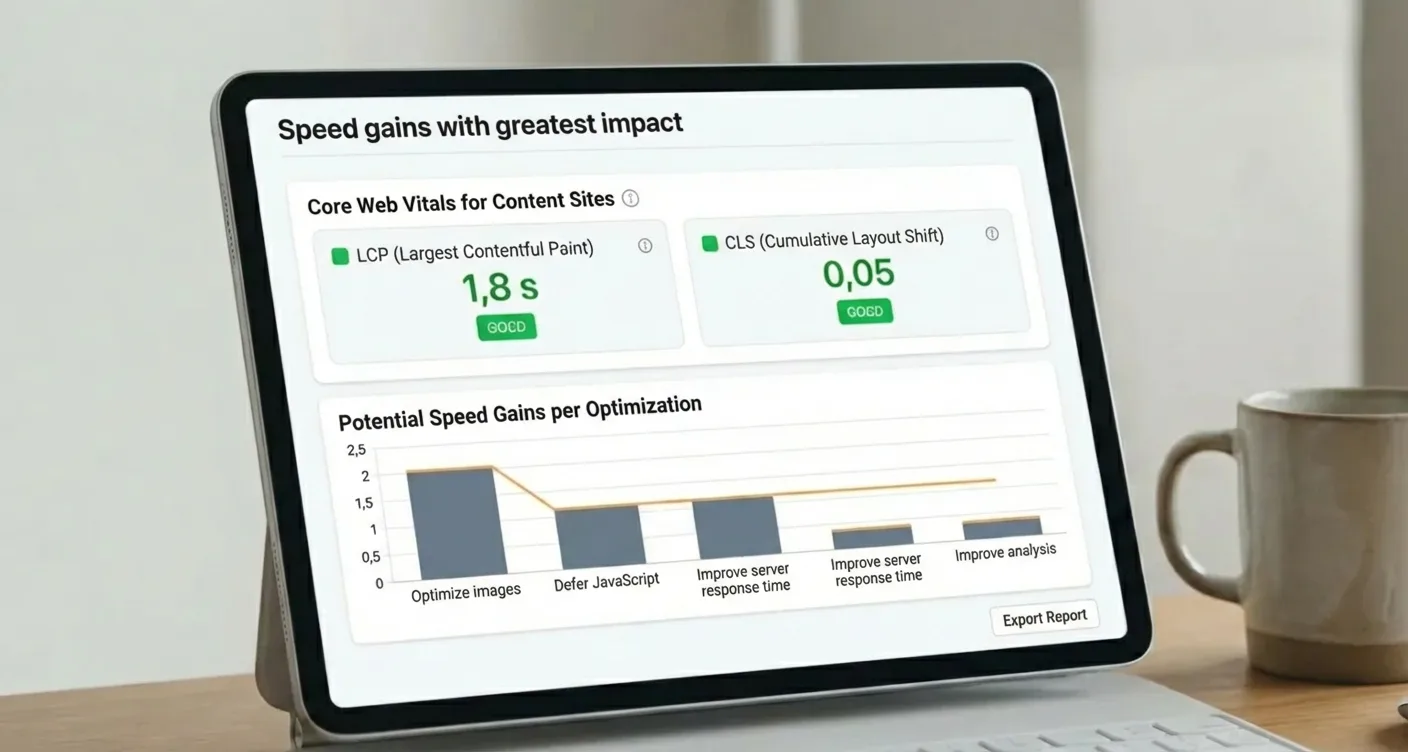
A good score on these metrics directly translates into a higher evaluation by algorithms, provided the content remains high-quality. Implementing smart strategies helps reduce the bounce rate. A technically perfect website creates an invisible bridge between the author's message and the reader's needs, without frustrating delays. To effectively monitor performance, you can use various tools such as Google Search Console and PageSpeed Insights. Here are the most important aspects to pay immediate attention to:
- Optimize images by using modern formats like WebP or AVIF for faster loading times.
- Limit the impact of third-party scripts, such as heavy ad networks and unnecessary tracking pixels.
- Ensure reserved space for ad blocks to minimize annoying layout shifts.
- Utilize advanced server-side caching to significantly reduce server response time.
Consistently applying this method results in a more stable position within the organic search results. For more technical details on the measurement methods, you can consult the official documentation on Web.dev. By focusing on these technical fundamentals, you lay a strong foundation for any SEO campaign. Ultimately, these optimizations are about respecting your audience's valuable time and attention.
Why Core Web Vitals for Content Sites are Essential for Maximum Speed and Impact
For publishers and bloggers, user experience is the cornerstone of their digital success, with technical performance directly linked to search engine visibility. Optimizing Core Web Vitals for content sites, focusing on achieving the greatest speed gains and impact, ensures that visitors don't abandon pages prematurely due to slow load times or shifting text. When a page responds instantly to interactions, it builds trust with the reader, which is crucial for website authority. Google uses these metrics as a formal ranking factor, meaning technical refinement directly contributes to a better position in search results.
Understanding how to improve Core Web Vitals for content sites for better SEO performance and maximum impact on speed is essential for every webmaster.
The Direct Link Between Technical Performance and Reader Retention
Content sites rely heavily on advertising revenue and affiliate marketing, where every second of delay can lead to a drop in income. By focusing on a strong Core Web Vitals strategy for content sites to maximize speed and impact, you minimize the chance of advertisements negatively affecting the reading experience through unexpected layout shifts. This creates a stable environment where text takes center stage, and technology functions seamlessly in the background.
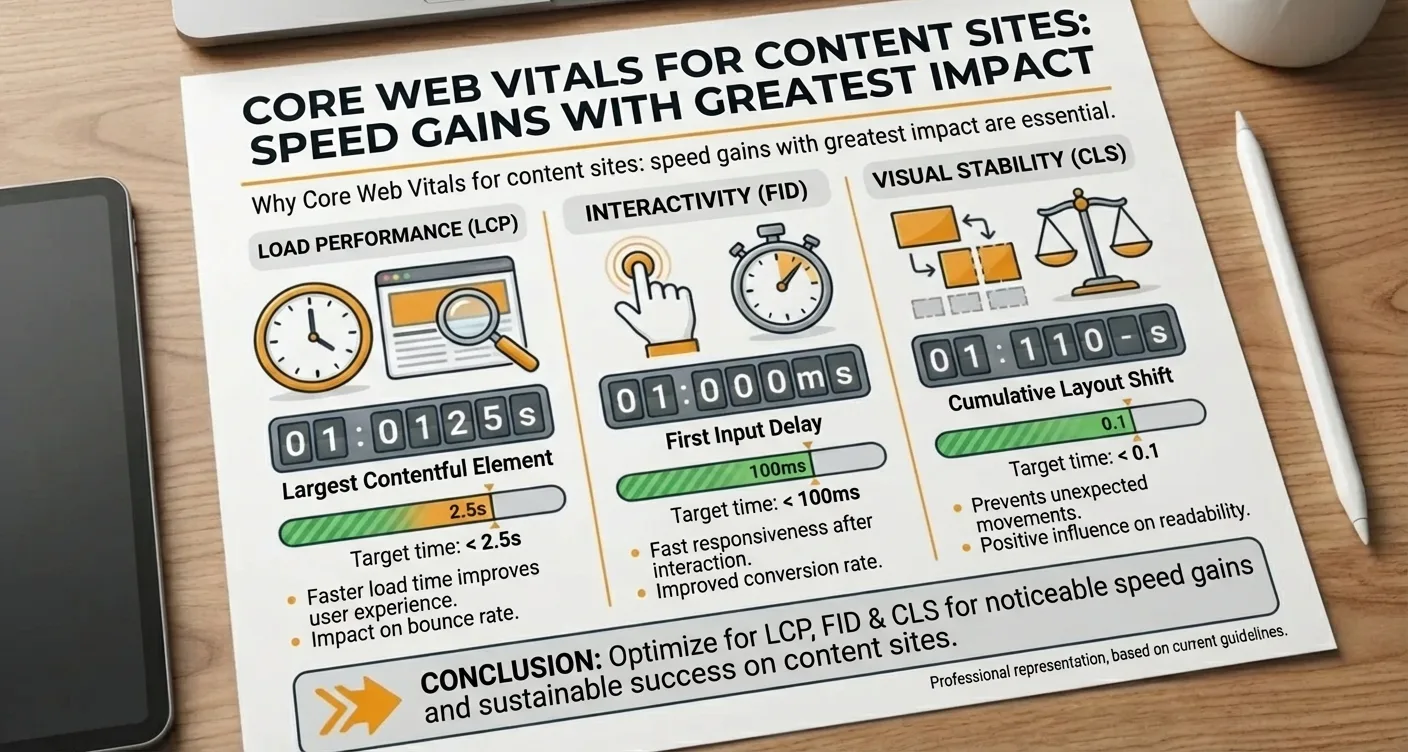
A fast website ensures that users stay longer and view more pages, significantly increasing overall engagement. In practice, we see that sites that seriously address these technical barriers often report a lower bounce rate.
"Focusing on Core Web Vitals for content sites to achieve maximum speed and impact is no longer a luxury, but a necessity for survival in a competitive digital landscape where user attention spans are shorter than ever."
Why Prioritize These Metrics?
Prioritizing Core Web Vitals optimization for content sites to maximize speed and impact offers a competitive advantage over slower rivals who neglect their infrastructure. Because search engines strive for the best user experience, websites that perform technically excellently are often rewarded with higher visibility. This is especially true for mobile users, who often rely on less stable connections and thus benefit most from an efficiently loaded page.
- Improved indexing through more efficient use of search engine crawl budget.
- Higher satisfaction for returning visitors due to consistent Core Web Vitals performance for content sites, leading to significant speed gains and impact.
- Better performance of interactive elements such as forms and navigation menus.
- A strong foundation for future Google algorithm updates.
You can read more about the technical specifications in the official Web.dev documentation for in-depth insights. Implementing the right Core Web Vitals approach for content sites, focused on maximum speed and impact, is an investment that pays off in organic growth.
Ultimately, it's about balancing rich media with speed.
Optimizing LCP: Improving the Load Speed of Your Most Important Content
Largest Contentful Paint (LCP) is a crucial metric for user experience, as it precisely measures how quickly the largest visible element on the screen is fully loaded. For publishers and bloggers, this is often a hero image, a prominent heading, or a video thumbnail designed to immediately capture visitor attention. When we examine Core Web Vitals for content sites, focusing on maximum speed and impact, it's clear that a slow LCP is often caused by sluggish server response times or heavy media files that are not optimally configured for mobile devices. Improving this specific metric ensures that visitors can interact with your articles faster, significantly reducing the likelihood of early abandonment.
A fast load time for the main element is essential for retaining your readership and search engine rankings. Image optimization is often the most effective method for making gains within the context of Core Web Vitals for content sites. By using modern file formats such as WebP or AVIF, you can drastically reduce file sizes without noticeable quality loss. Additionally, implementing 'fetchpriority="high"' on your main hero image is a smart move, as it tells the browser to prioritize this specific element during rendering. Don't forget to provide explicit dimensions for your images to prevent unnecessary browser calculations during the loading process.

Beyond technical image optimization, server infrastructure plays a key role in achieving a good Core Web Vitals score. Using a Content Delivery Network (CDN) ensures that your heavy media files are served from a location physically close to the visitor. This reduces latency and speeds up data transfer, directly resulting in a lower LCP value. Minimizing render-blocking JavaScript and CSS in the 'above-the-fold' section is also necessary to allow the browser to display the main element immediately to the end-user. Efficient server response forms the backbone of any successful optimization strategy for modern websites.
"User perception of speed is largely determined by how quickly the visual core of a page appears, underscoring the importance of LCP within Core Web Vitals for content sites to achieve maximum speed and impact."
To structurally enhance your platform's performance, consider the following actions within your optimization strategy: compress all hero images and use responsive images via the 'srcset' attribute. Remove unnecessary widgets or scripts that delay the loading of primary content. Implement server-side caching to minimize request processing time and prioritize the loading of critical CSS needed for displaying the above-the-fold section of the page.
By consistently focusing on these techniques, you build a foundation that both users and search engines like Google appreciate. It's advisable to regularly perform tests using tools like PageSpeed Insights to see if adjustments yield the desired effect. Ultimately, monitoring is about providing a seamless experience where content is central and technology removes barriers.
FID and INP: Interactivity and User Experience on Your Website
When considering the technical optimization of a platform, element responsiveness is crucial for visitor retention. First Input Delay (FID) measures the time from when a user first interacts with your page until the browser actually begins processing that specific interaction. For administrators striving for optimal Core Web Vitals for content sites, understanding this delay is essential to prevent end-user frustration and achieve significant speed and impact. A slow response to a click or keystroke immediately gives an unprofessional impression of the website's overall stability and reliability. Fast interaction ensures that readers stay on the page longer and click through more often to other relevant articles within your domain.
The Transition from FID to Interaction to Next Paint (INP)
Since March 2024, Interaction to Next Paint (INP) has become the official successor to FID within Google's measurement methodologies. Where FID focused solely on the very first interaction, INP examines the full lifecycle of a page visit by precisely monitoring all interactions. This makes optimization more complex but also much more accurate. The goal now is to ensure that every click, tap, or keyboard action results in a rapid visual change on the screen, significantly improving the overall quality perception for the average visitor. This process is a fundamental component of a modern SEO strategy focused on technical excellence.

To improve interactivity and meet INP's stricter requirements, webmasters can take several technical steps. Minimizing JavaScript execution time is often the most critical factor here. When the browser's 'Main Thread' is busy with heavy scripts, it cannot respond immediately to user input. Breaking long tasks into smaller chunks is a proven method to ensure responsiveness. This allows the browser more frequent opportunities to process interactions in between without noticeable delays for the user.
"The shift to INP compels developers to look beyond just the first impression and consider the entire user experience throughout the session."
Implementing advanced techniques helps identify specific bottlenecks in the code. Consider the following actions for a better interactivity score:
- Remove unused JavaScript files that unnecessarily burden the browser during loading.
- Use web workers to perform heavy computations off the main thread.
- Optimize script order so that critical interactive elements load first.
- Monitor results via Google Search Console for continuous performance improvement.
Good interactivity is inextricably linked to your site's authority. For more in-depth information on how Google uses these metrics, you can consult the official Web.dev documentation on INP. By consistently working on improvements, you build a sustainable digital foundation that both search engines and users will appreciate. Ultimately, interactivity is about trust and seamless navigation through your valuable content.
Preventing CLS: Maintaining Visual Stability During Loading
Cumulative Layout Shift (CLS) is a crucial factor within Core Web Vitals for content sites, leading to significant speed gains and impact, as it directly influences user frustration. When elements on a page unexpectedly shift while a visitor is reading, it leads to a poor user experience and lower conversions. For publishers, it's essential to understand that advertisements, images without dimensions, and dynamically injected content are the biggest culprits in causing instability. Optimizing Core Web Vitals for content sites to achieve maximum speed and impact requires a proactive approach where the browser knows in advance how much space each element will occupy.
By assigning fixed dimensions to media and using placeholders for ad blocks, you prevent text from suddenly shifting downwards when a banner finally loads.
Technical Solutions for Layout Shifts
To guarantee stable rendering within Core Web Vitals for content sites, driving maximum speed and impact, developers must add explicit width and height attributes to all image and video elements. This allows the browser to calculate the correct aspect ratio before the actual source files are downloaded. Furthermore, it's wise to optimize web fonts with font-display: swap, so that text is immediately visible and doesn't shift once the custom font has fully loaded. Consistently applying these techniques is a fundamental part of improving Core Web Vitals for content sites for mobile users, ensuring significant speed gains and impact.
Monitoring Core Web Vitals for content sites to achieve maximum speed and impact via tools like PageSpeed Insights helps identify specific elements that cause shifts.
"Visual stability is not a luxury, but a necessity for modern websites striving for high authority and user satisfaction."
Best Practices for Dynamic Content
When working with Core Web Vitals strategies for content sites to maximize speed and impact, it's crucial never to place new content above existing content unless it's in response to a user interaction. Instead, use reserved spaces or 'skeletons' that maintain the page's structure while data is being fetched. This ensures that the most impactful speed gains for Core Web Vitals are genuinely translated into a calm reading experience for the end-user.
- Set fixed heights for ad containers.
- Avoid using embeds without defined dimensions.
- Use CSS aspect-ratio boxes for responsive media.
A stable website simply performs better in Google's search results.
Practical Tools for Measuring and Improving Your Core Web Vitals
To effectively manage your website's performance, it's essential to deploy the right diagnostic tools. Google offers various free tools specifically designed to map out Core Web Vitals for content sites, highlighting areas for maximum speed gains and impact. PageSpeed Insights is the most well-known starting point, as it combines both field data from real users and lab data from a controlled environment. By regularly analyzing this data, you gain a clear picture of how your pages perform in terms of load time, interactivity, and visual stability, which is crucial for a healthy SEO strategy.
Consistently monitoring Core Web Vitals for content sites to achieve significant speed and impact ensures that technical barriers for visitors disappear. In addition to the standard tools, you can use Search Console to discover site-wide patterns. This platform groups pages with similar issues, allowing for more efficient optimization. For developers, the Chrome DevTools environment is indispensable for in-depth inspections. Here, you can pinpoint exactly which scripts are blocking the main thread or which images are causing unexpected layout shifts.
Understanding Core Web Vitals improvements for content sites, which bring maximum speed and impact, requires a precise approach where every millisecond counts for the ultimate user experience. Measuring this experience via standardized metrics is the only way to objectively determine whether technical adjustments genuinely contribute to better visibility and retention. Use the following resources for a deeper dive into the subject:
- Google Search Console for overview reports by URL group.
- Lighthouse for detailed technical audits in the browser.
- Web Vitals Extension for real-time measurements while browsing.
- Web.dev documentation for the most current technical guidelines.
Implementing a Core Web Vitals analysis for publishers, aimed at achieving maximum speed and impact for content sites, helps prioritize tasks. Ultimately, optimizing these scores is about creating a frictionless environment for your readers. When technology seamlessly aligns with the need for speed, your platform's authority will grow organically. Therefore, continue to test, measure, and refine to stay ahead of the competition in search results. A strong focus on this strategy is essential for long-term online success.
Optimizing Core Web Vitals for content sites, focusing on achieving significant speed gains and impact, is essential for any serious publisher. A fast load time directly improves your search result position.
By focusing on LCP, INP (formerly FID), and CLS scores, you create a frictionless experience for your readers. This not only results in a lower bounce rate but also significantly boosts ad revenue through improved user engagement across all mobile devices.
Want to stay ahead of the competition? Start today by technically refining your images, minimizing unnecessary scripts, and prioritizing the visual stability of your pages. A fast website is the foundation for sustainable organic success and higher authority within your niche. Analyze your current performance via Search Console now and immediately implement the necessary improvements for optimal results.
Frequently Asked Questions
What are the most important Core Web Vitals for content sites?
The main metrics are LCP, FID (or INP), and CLS, which collectively measure the user experience. For publishers, optimizing Core Web Vitals for content sites to achieve maximum speed and impact is essential to improve readability and interaction.
How can you improve the LCP score of an article page?
You can improve the Largest Contentful Paint by prioritizing above-the-fold images and removing unnecessary scripts. By focusing on Core Web Vitals for content sites for significant speed gains and impact, you ensure that the main content is visible faster for the visitor.
Why is a low CLS value crucial for user experience?
A low Cumulative Layout Shift prevents text from unexpectedly shifting while a user is reading. This increases reader satisfaction and prevents irritation caused by shifting ads or images.
When will you see results in Google after optimizing speed?
After technical improvements have been implemented, it typically takes 28 days for Google to fully process the new field data. You will only see a structural improvement in Search Console reports after this period.
How SEO Supercharged helps you here
SEO Supercharged is fully online (service area: worldwide, online), so you can use it from anywhere.
The platform is built for SEO Specialists at Digital Marketing Agencies, Owners of Large Content and Blog Platforms, Web Developers Specializing in WordPress Optimization, Digital Publishers and Media Companies, Affiliate Marketers Reliant on Organic Traffic, E-commerce Managers of Webshops with Extensive Blogs, UX/UI Designers Focused on Website Performance, Freelance Technical SEO Consultants, Marketing Managers of Content-Driven B2B Websites.
You can use it for, among other things, CWV Performance Audit, LCP Speed Gain Strategy, CLS Layout Stabilization, INP Interaction Optimization, Image and Media Compression, Server-side Caching Implementation, Script Management Cleanup.
Want to tackle this directly? Check your technical SEO with the Page Audit, or start a free SEO analysis.
Related articles
- React/Vite SEO Guide: Indexing, Meta Tags, SSR/Prerendering, and Sitemaps (No-Fuss Approach)
Learn to make your React/Vite site SEO-proof. Master indexing, meta tags, canonicals, SSR/prerender choices, sitemaps, robots, & structured data for.
- Canonical & hreflang in your React Apps: The Correct Implementation Guide
Master canonical & hreflang for React apps. Learn top SEO strategies for Single & Multipage Applications to prevent duplicate content & boost global rankings.
- Structured Data Basics (Article, FAQ, Breadcrumb): What Truly Delivers Results?
Discover Structured Data Basics (Article, FAQ, Breadcrumb): what truly delivers results. Boost your SEO, improve CTR instantly. Learn more now!
- Dynamic, Multilingual, and Scalable Sitemap Generation for React Applications
Master dynamic, multilingual, and scalable sitemap generation for React apps. Boost your SEO, improve indexing, and ensure global visibility. Download our.
- Redirects and Canonical Conflicts: Common Errors and How to Fix Them
Master Redirects & Canonical Conflicts. Fix common SEO errors, prevent ranking damage, and optimize your website for search engines. Read our complete guide!