Keyword Research That Doesn't Lie: Intent Mapping in 10 Minutes
Keyword Intent Mapping: Uncover True User Needs in 10 Mins

Keyword Research That Doesn't Lie: Intent Mapping in 10 Minutes is the only method to directly uncover your target audience's true search queries without guesswork. By applying this technique, you connect keywords to the correct stage of the customer journey for maximum relevance. Many marketers waste valuable time on irrelevant data, but this rapid approach creates a robust strategy that aligns with what users truly want to find in search engines.
- Direct insight into user intent.
- Efficient keyword organization.
- Better alignment with the customer journey.
This advanced method rapidly transforms your content strategy. It allows you to optimize every page for conversions and authority within your niche, building a foundation that guarantees results through a focus on quality.

Why Traditional Keyword Research Often Fails
In the dynamic world of digital marketing, it's often mistakenly believed that a list of thousands of keywords is the ultimate key to online success. Many business owners and marketers spend countless hours exporting raw data from various tools, only to end up with a cluttered Excel file full of abstract volume figures and theoretical difficulty scores. The fundamental problem, however, is that this static data reveals very little about the user's actual, current needs at a specific moment in their customer journey. When focusing solely on search volume, marketers completely ignore the psychology behind the search query, which inevitably leads to content that, while attracting visitors, ultimately yields no tangible results. A modern approach based on Keyword Research That Doesn't Lie: Intent Mapping in 10 Minutes offers a necessary and effective solution to this persistent industry problem.
Traditional methods primarily look at the past and historical data, whereas modern SEO revolves entirely around the future, relevance, and directly answering questions. The core of the mistake lies in the chronic lack of context. For instance, a broad keyword like "laptop" might generate thousands of searches per month, but what exactly does the individual searcher intend to achieve at that moment? Do they want to buy a new laptop immediately, find a technical repair manual for an older model, or simply look up the general definition for a school project? Without a proven method like the Intent Mapping in 10 Minutes strategy, you're essentially shooting in the dark as a marketer. You waste valuable time and resources writing content that completely misses the specific stage of the customer journey the visitor is in.

This lack of focus often results in high bounce rates and decreasing authority in the eyes of search engines like Google, which are becoming increasingly sophisticated at understanding human user intent. It's a common pitfall to assume that more traffic automatically leads to more revenue. In practice, however, we often see that websites with significantly fewer visitors, but a much sharper focus on intent, are far more commercially successful. This is because they understand that keyword research intent mapping bridges the crucial gap between a vague search query and a concrete solution. When you solely focus on high-volume terms, you often compete with giant players for general keywords, whereas the real value lies in specific, intent-driven searches that directly lead to action and conversion.
That's why it's crucial to stop simply collecting words today and start deeply analyzing human behavior. Many tools present a distorted view of reality by showing averages that are heavily influenced by seasonal factors or temporary trends. By relying on Keyword Research That Doesn't Lie: Intent Mapping in 10 Minutes for Advanced SEO Specialists, you learn how to effectively filter out this noise. You no longer look at what people type, but at what they are actually trying to achieve. This process doesn't have to take weeks; with the right focus, you can quickly grasp the essence of your target audience and adapt your strategy for sustainable growth in your online visibility.

Furthermore, search engine algorithms are constantly changing to better serve the end-user. Google's Helpful Content Update emphasizes the importance of content that genuinely provides a valuable answer to the user's query. If your research method is still based on techniques from five years ago, you're hopelessly behind the curve. Implementing keyword research intent mapping ensures your content is future-proof and continues to perform, regardless of upcoming updates. In short, the traditional way of working is too rigid and insufficiently focused on the human behind the machine. It's about being present at the moments that truly matter to your potential customers. By integrating this analysis into your routine, you create a foundation that not only attracts more visitors but also the right visitors who are ready to convert into loyal customers.
Keyword Research That Doesn't Lie: Intent Mapping in 10 Minutes Explained
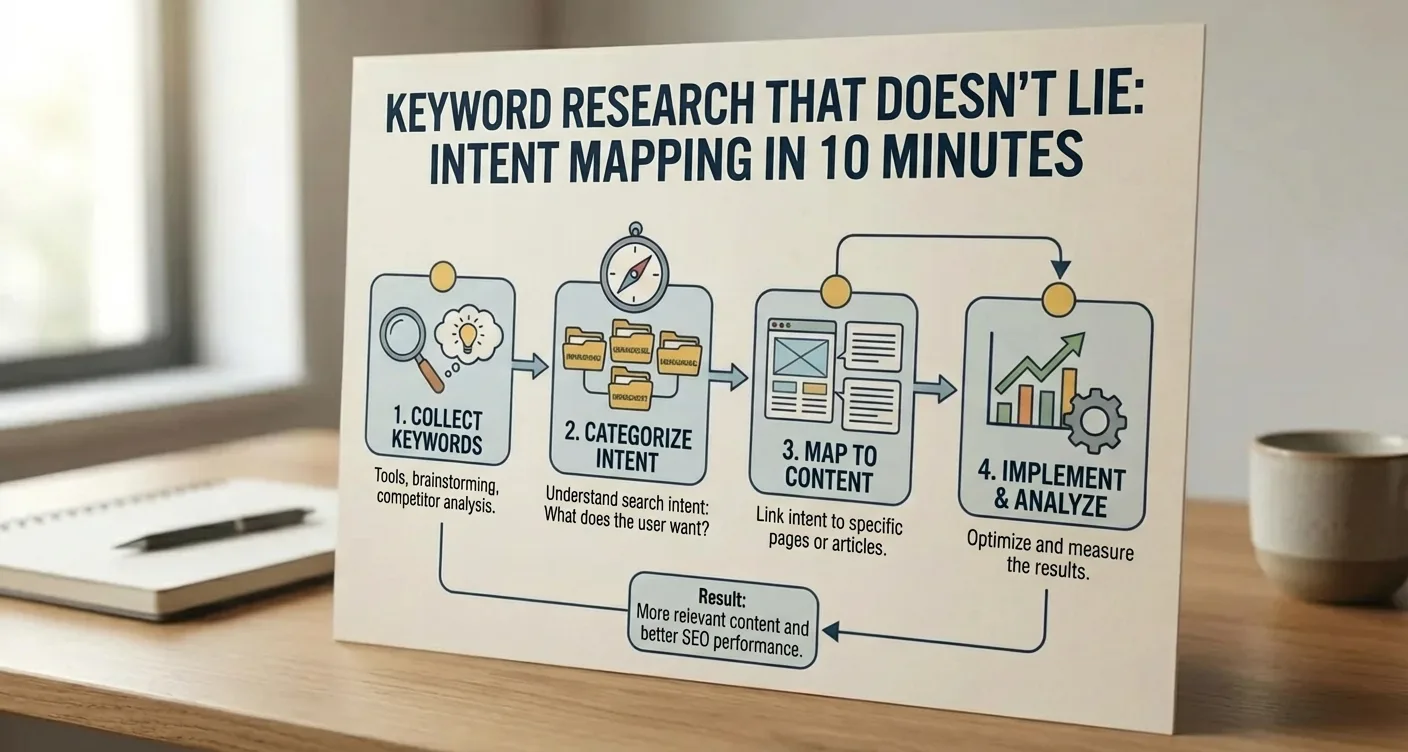
The essence of modern SEO no longer revolves around simply collecting high search volumes, but rather understanding the psychology behind the search query. When we talk about Keyword Research That Doesn't Lie: Intent Mapping in 10 Minutes, we refer to the process of directly linking keywords to the specific needs of the user. Many marketers make the mistake of fixating on numbers, while the true value lies in content relevance. By uncovering user intent, you prevent attracting traffic that immediately bounces because the page doesn't offer what they were looking for. This process enables you to rapidly prioritize within your content strategy.
The Four Pillars of Search Intent
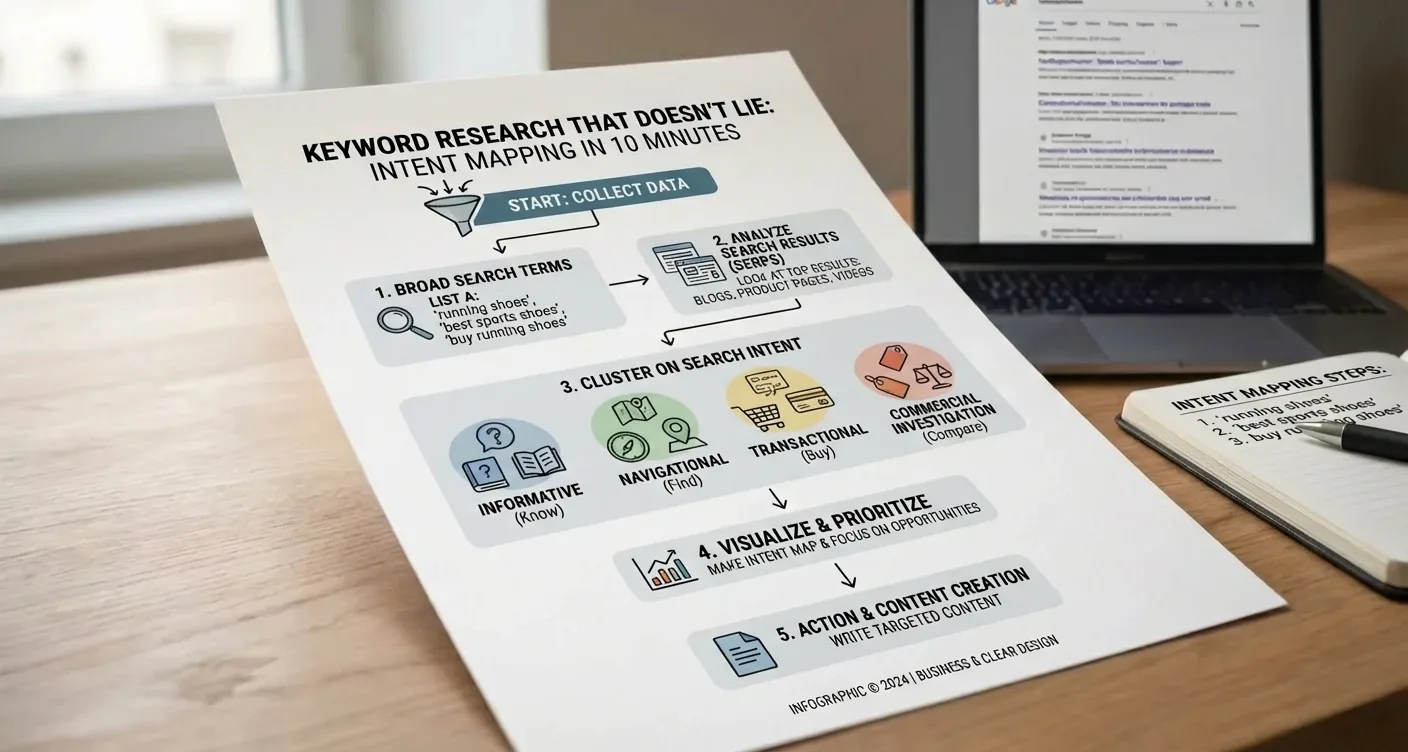
To work effectively, we usually divide search queries into four categories: informational, navigational, commercial, and transactional. It's essential to recognize whether someone is merely seeking information or is actually ready to make a purchase. An effective method for advanced users involves looking at the verbs in the search query, such as "buy", "compare", or "what is". This insight ensures that your website visitors are presented with the right information at the right moment in their customer journey. Understanding intent is the foundation of every successful SEO campaign that yields long-term results.
A strong technical foundation is indispensable here, such as a WordPress website design that effortlessly guides the user to the correct information.
Shortcuts to Better Intent Mapping
- Analyze the current top 10 results in Google for your primary terms.
- Group keywords based on the user's desired action.
- Verify that the landing page aligns with the chosen strategy.
By following these steps, you transform a simple list of words into a strategic plan. The process doesn't have to take hours if you know what to look for when analyzing search patterns in search engines. Ultimately, this leads to higher authority and better positions in the search results.
Step-by-Step Guide for Effective Keyword Intent Analysis
To structurally increase your online visibility, a methodical approach to your keyword list is essential. The process begins with collecting raw data, but the real value lies in categorization. By filtering your terms based on specific user needs, you prevent wasting valuable time creating the wrong content. Applying the Keyword Research That Doesn't Lie: Intent Mapping in 10 Minutes method enables you to rapidly determine whether a visitor is looking for general information, a specific website, or a direct purchase. Without this crucial step, your SEO strategy remains based on guesswork rather than hard facts and current user behavior.
Performing keyword intent mapping ensures a direct match between your offering and the target audience's search query.
SERP Analysis as Your Guide
Google's Search Engine Results Page (SERP) is your best guide for validating intents. When you enter a search term and primarily see extensive guides, the intent is informational. However, if you exclusively see product pages, the intent is commercial or transactional. By using this analysis, you can specifically tailor your strategy to what the algorithms are currently prioritizing. This prevents you from writing an informational blog for a search term where the user actually wants to check out directly from a webshop.

- Export your collected keywords to a clear spreadsheet.
- Analyze the top 3 results in Google for each relevant main topic.
- Label each keyword as Informational, Navigational, Commercial, or Transactional.
- Link the appropriate landing page to the searcher's specific intent.
"Intent mapping is the bridge between simply being found and actually converting."
Don't forget that your website's technical performance, as described in our guide on SEO search engine optimization, goes hand-in-hand with your content strategy. A perfect intent match loses its value if the page loads slowly or isn't mobile-friendly. Therefore, use smart tools to accelerate your workflow. For more in-depth information about search behavior, you can visit Search Engine Journal. Ultimately, success hinges on relevance, authority, and speed within your niche.
Stop guessing based on volume. True growth begins with understanding the user.
By applying this rapid method, you transform a simple list of terms into a strategic content plan that converts. You learn exactly what questions your target audience asks and how to immediately respond with relevant answers.
With Keyword Research That Doesn't Lie: Intent Mapping in 10 Minutes, you lay a solid foundation for your SEO strategy without wading through complex spreadsheets for hours. It's no longer about chasing meaningless clicks, but about attracting visitors who are truly ready to take action. Start today by restructuring your keyword list, optimizing your pages for the right search intent, and see your organic results improve instantly. Want to learn more about advanced optimization? Contact us now for a personalized consultation.
Frequently Asked Questions
What Exactly is Intent Mapping in SEO?
Intent mapping is the process of linking keywords to the specific needs of the user, such as seeking information or making a purchase. By applying this to Keyword Research That Doesn't Lie: Intent Mapping in 10 Minutes, you ensure your content precisely matches what the searcher expects.
How Can You Quickly Determine a Keyword's Search Intent?
You can quickly determine intent by analyzing current Google search results and observing whether primarily blogs, product pages, or videos appear. This method forms the basis for Keyword Research That Doesn't Lie: Intent Mapping in 10 Minutes, allowing you to instantly choose the right content strategy.
Why is Intent More Important Than Just Search Volume?
High search volume is worthless if visitors don't find what they're looking for and immediately leave your website. By focusing on intent, you attract quality traffic that is genuinely ready to take action, leading to higher conversions.
When Should You Review Your Existing Keyword List Based on Intent?
It's wise to review your list as soon as you notice you have rankings but conversions are lagging. By performing regular quick checks, you prevent wasting time on keywords that don't yield the desired results for your business.
How SEO Supercharged helps you here
SEO Supercharged is fully online (service area: online, worldwide), so you can use it from anywhere.
The platform is built for SME business owners with growth ambitions, Marketing managers at mid-sized organizations, E-commerce operators and webshop owners, SaaS companies and tech startups, B2B service providers and business consultants, Content and communication specialists, International exporters and global brands, Local entrepreneurs with a digital focus, Digital marketing agencies and agency owners.
You can use it for, among other things, GEO Strategy & AI Audit, Hybrid SEO & GEO Content Creation, LLM Visibility Analysis, Structured Data & Schema Optimization, Brand Authority & Citation Building, E-E-A-T Content Optimization.
Want to tackle this directly? Optimize your SERP snippet with the SERP Optimizer, or start a free SEO analysis.
Related articles
- From Keyword to Winning SEO Page: Generator + SERP Optimizer
Discover a practical workflow to build winning SEO pages: from keyword research and intent mapping to content generation and SERP snippet optimization. Boost.
- SERP Testing: Boost Your Click-Through Rate with A/B Tests
Learn how to conduct effective SERP A/B testing to significantly increase your click-through rate. Get practical tips and strategies for more organic clicks.
- Meta Descriptions: Boost Clicks Without Clickbait
Discover how to boost your CTR with meta descriptions without clickbait. Improve organic search results today with practical tips for effective snippets.
- Clickable Title Tags: Patterns & Sector-Specific Examples
Master clickable title tags with proven patterns & sector-specific examples. Learn to boost your CTR, drive more organic traffic, and optimize your website now!
- The On-page SEO Checklist (Scoring Model): What's 'Good Enough' for Google?
Master On-page SEO with our checklist & scoring model. Discover what's 'good enough' to rank on Google, optimize your content, and boost visibility today!