Service Page Structure: From 6 Topics to 30 Pages Without Overlap
Service Page Structure: Scale 6 Topics to 30 SEO Pages

An effective service page structure, scaling from 6 core topics to 30 niche pages without overlap, forms the foundation for a scalable, authoritative website. By cleverly applying this method, you transform general subjects into specific landing pages that precisely match your target audience's search intent. A clear hierarchy is essential for user experience and optimal indexing by Google. This process requires a thorough analysis of niche topics, ensuring each component adds unique value to your digital ecosystem without internal competition.
The core of an effective service page strategy (scaling from 6 broad topics to 30 unique pages without overlap) is eliminating keyword cannibalization by choosing strategic angles. This approach maintains clarity as your content offering grows, which is crucial for complex business services.

The Foundation of a Service Page Structure: From 6 Topics to 30 Pages Without Overlap
Building an effective website starts with a well-thought-out architecture that both visitors and search engines understand. Many businesses struggle with presenting their services too generally, missing out on valuable opportunities. A robust service page structure (scaling from 6 broad topics to 30 specific pages without overlap) offers the solution by breaking down broad topics into specific, relevant sub-pages. By starting with six core pillars, we weave a web of information that offers depth without pages competing for the same search terms. This process demands a keen eye for user intent and a logical hierarchy.
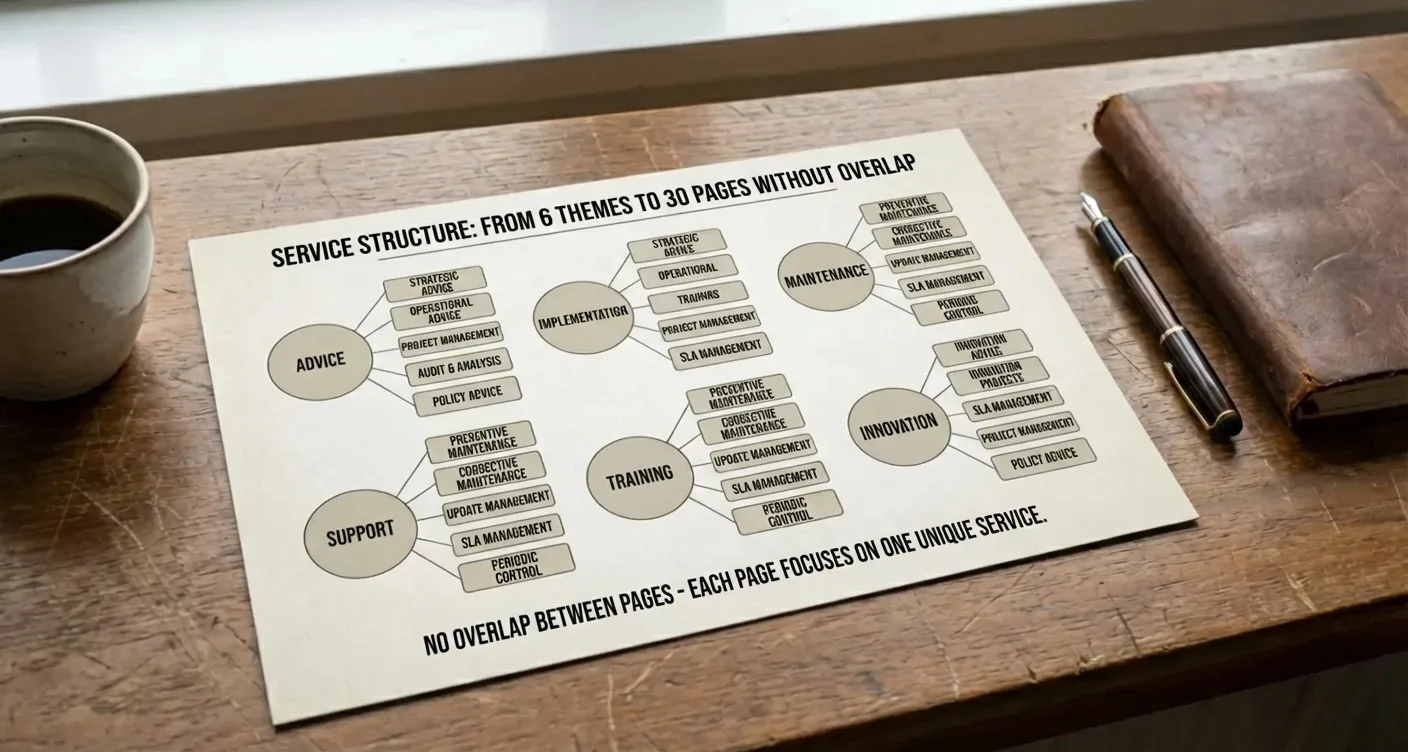
When you apply this method, you prevent keyword cannibalization, where multiple pages compete for the same ranking. The goal is to give each page a unique reason for existence within the larger framework.
To implement this successfully, one must understand how search engines connect topics. This scalable service page structure (from 6 topics to 30 pages without overlap) functions like a tree structure, where the trunk represents the main services and the branches form the specific niches. This ensures an authoritative position because you share valuable information on every facet of your expertise. It's essential to use strategic content mapping methods for this service page structure to maintain relevance. This layering helps Google better index the context of your expertise.
In practice, we see that a clear distribution leads to a better user experience, as visitors directly find the information that aligns with their specific questions. This principle of affordable search engine optimization for your website is crucial for growth.
The Power of Topic Clusters
Topic clustering is the foundation of a successful service page structure that scales from 6 topics to 30 pages without overlap. Instead of one long page about 'marketing,' for example, you create five specific pages, each highlighting a different aspect, such as strategy or analytics. This allows you to rank for long-tail keywords that often have a higher conversion rate. The secret lies in the internal link structure; by correctly linking sub-pages back to the main page, you strengthen the authority of the entire cluster. This way, you build a robust digital ecosystem that can withstand competition.
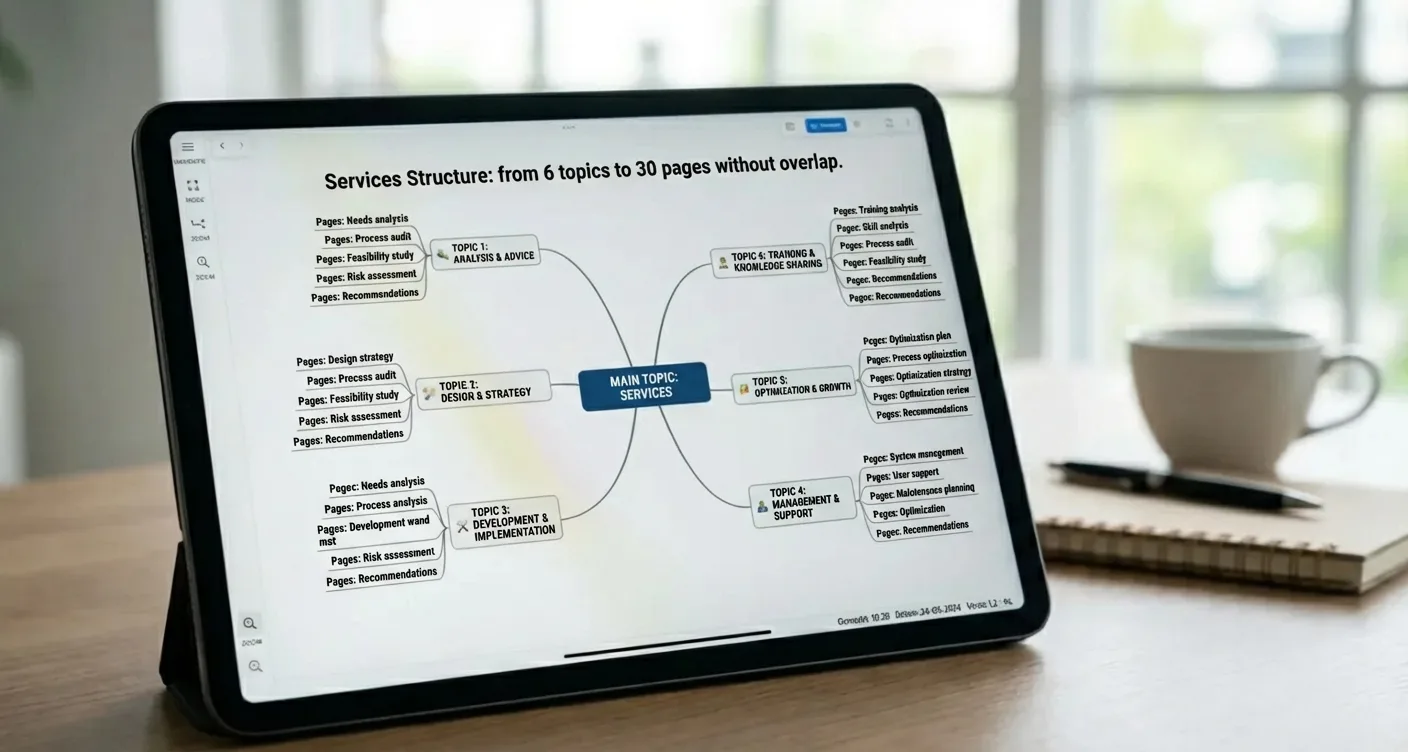
"A well-structured website is like a library where every book is precisely on the right shelf; it makes the reader's search effortless and logical."
- Identify the six main pillars of your service offerings that provide the most value.
- Split each pillar into five unique sub-topics that address a specific problem.
- Conduct keyword research for each sub-topic to determine unique focus keywords.
- Write unique content for each page, avoiding overlap in text and metadata.
- Implement an internal linking strategy that reinforces the hierarchy between the 30 pages and the 6 main topics.
Avoiding overlap is the biggest challenge when scaling. There's often a tendency towards repetition, but within this advanced service page structure (6 topics to 30 pages without overlap), each page must offer a fresh perspective. This can be achieved by varying the target audience or technical depth. For technical support in building such structures, you can refer to resources like Google Search Central. By ensuring consistency and uniqueness, you create a platform that performs strongly in organic search results.
Strategies for Content Differentiation and Preventing Cannibalization
Scaling a website requires a precise approach to prevent pages from competing with each other. When working with a service page structure (from 6 topics to 30 pages without overlap), it's essential to break down each main topic into unique sub-intentions. This means you don't simply tell the same story, but delve deeply into specific niche needs or technical specializations. Through this segmentation, search engines understand exactly which page is most relevant for a search query. Focus on the unique value of each URL to eliminate internal competition.
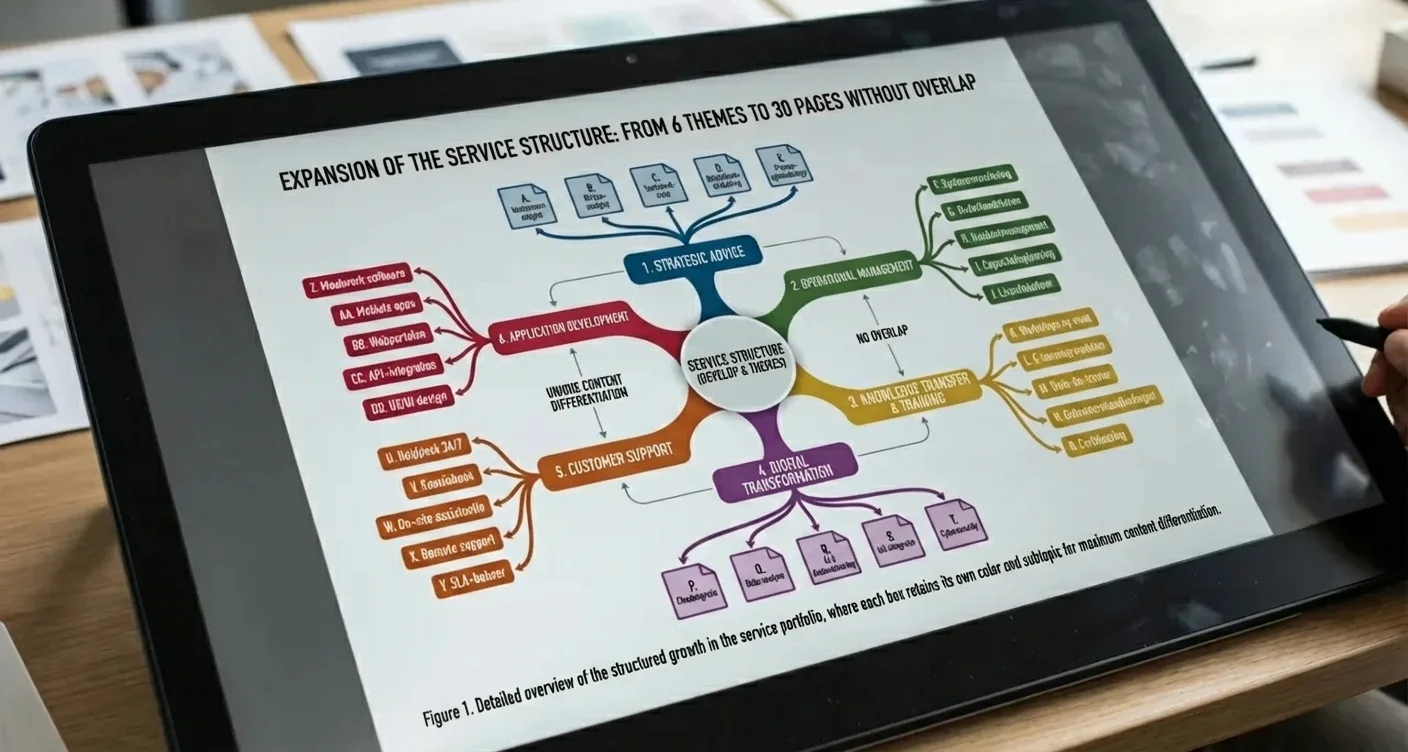
The Power of Semantic Variation and Search Intent
To implement a successful strategy, you must leverage semantic keywords and varying user intents. A visitor searching for 'maintenance' has different needs than someone searching for 'installation'. By capturing these nuances in separate pages, you increase relevance. Using an optimal structure for local SEO also helps build authority without main pages losing strength. Content cannibalization arises not from the quantity of pages, but from the lack of clear demarcation per URL.
A clear internal link structure is indispensable. Link from your sub-pages back to the main page on WordPress website design to confirm the hierarchy. This significantly strengthens the thematic relevance of your domain.
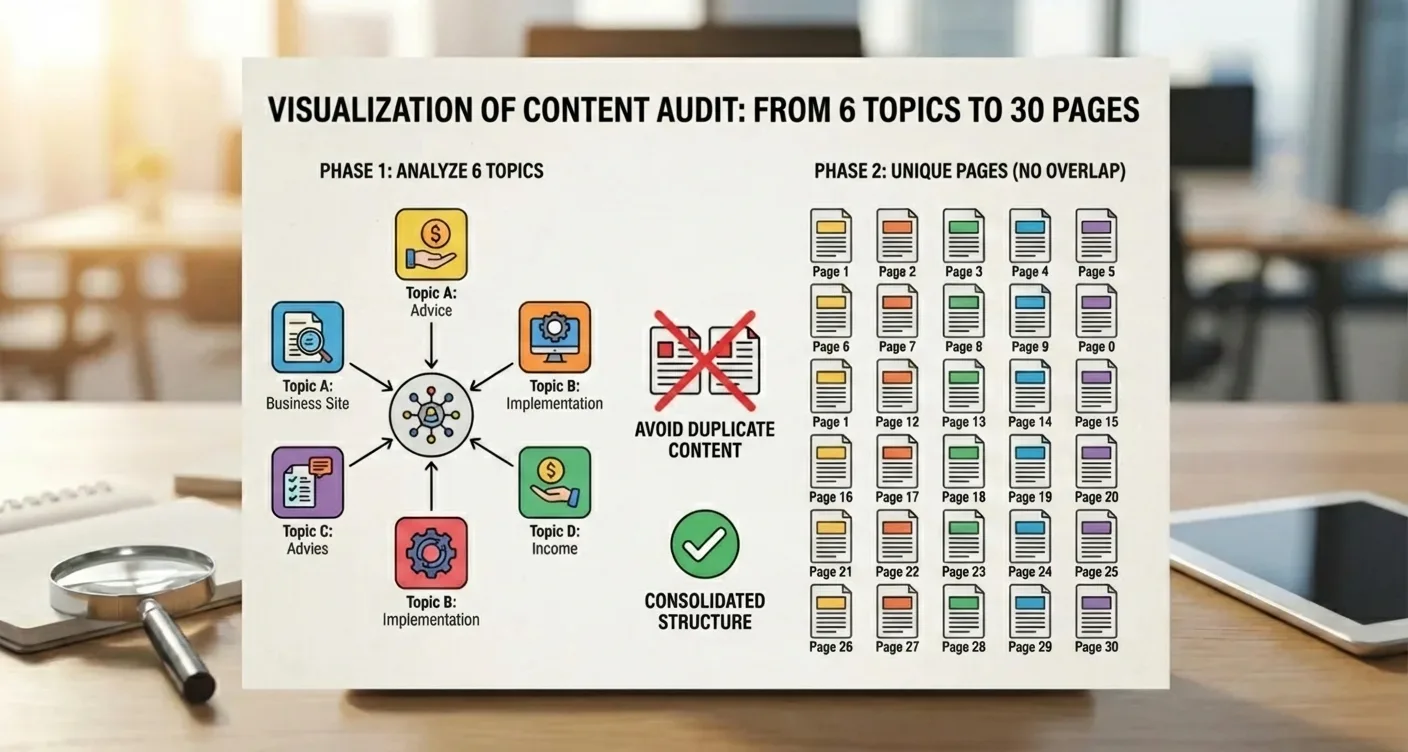
Practical Steps for Creating Unique Pages
- Add specific case studies per sector or service.
- Create unique FAQ sections relevant only to that specific sub-topic.
- Include technical specifications that vary by service level.
- Develop local landing pages with region-specific information.
By applying these elements, your scalable service page structure (6 topics to 30 pages without overlap) remains manageable and clear. For more information on technical management, you can consult the guidelines from Google Search Central for additional depth.
Roadmap for Scaling Your Service Pages into an Authoritative Website
Transforming a website into a sector authority requires a well-thought-out approach. When you start with a service page structure (scaling from 6 broad topics to 30 specific pages without overlap), you begin by identifying the core pillars. By splitting each main category into specific sub-services, you create a finely-meshed network. This process ensures that search engines view your website as a comprehensive resource, with each page serving a unique keyword segment without causing internal competition between your landing pages.
A strong strategy prevents pages from competing for the same terms, which is essential for organic growth in competitive markets.
Diving Deeper with Semantic Clustering
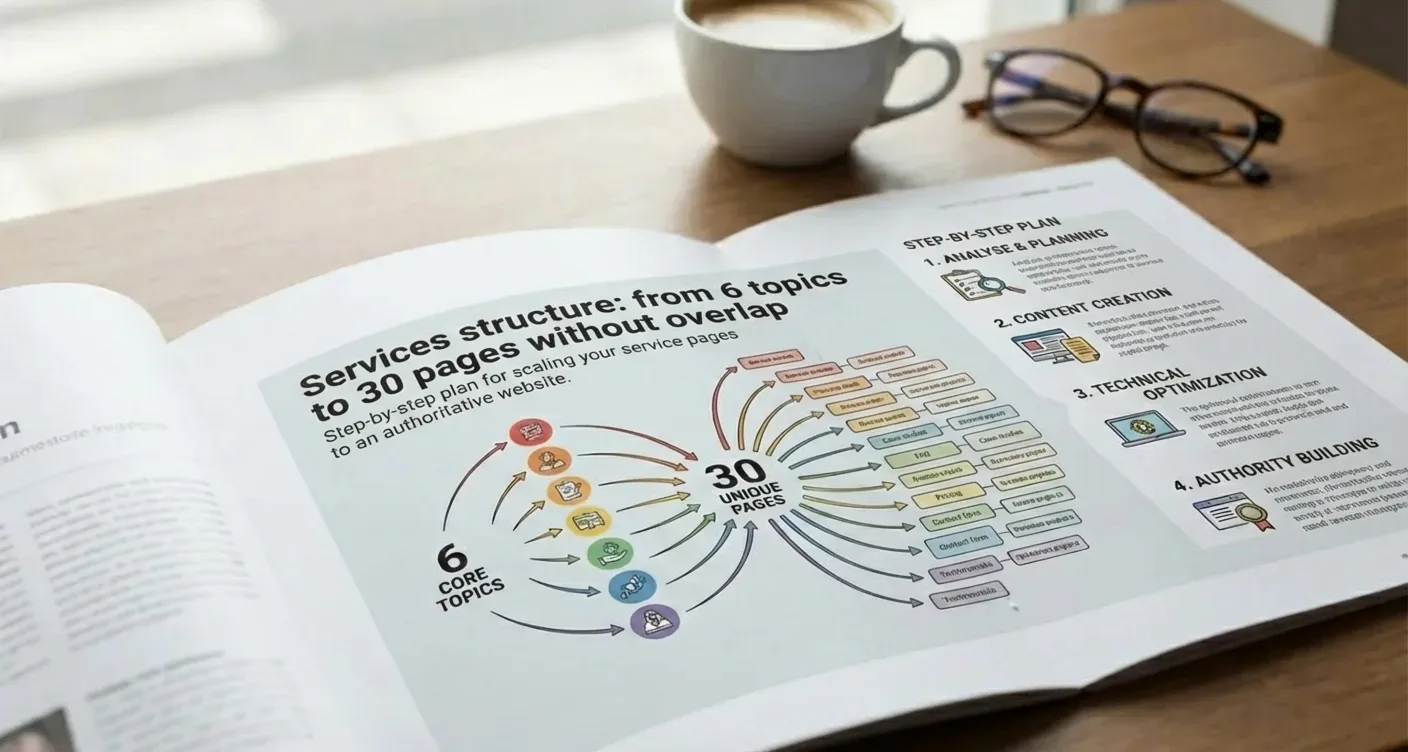
To achieve scalability, you must dissect each main topic into niche subjects that align with specific search intent. In practice, this means delving deeply into technical aspects or specific applications. By using an optimized method, you build a logical hierarchy. Here, the main page acts as the 'hub' that links to detailed 'spoke' pages, which strengthens internal link value and facilitates navigation.
"Search engine authority is built not only on volume but on the precision with which you illuminate every facet of a topic within your scalable service page structure (6 topics to 30 pages without overlap)."
Consistency in your internal linking strategy is essential for long-term success.
Technical Implementation and Monitoring
When rolling out this structure, it's crucial to monitor technical performance. Each page must meet quality requirements regarding page load speed and mobile-friendliness. Follow this roadmap for flawless execution:
- Inventory your current 6 main topics and determine 5 relevant sub-niches for each.
- Conduct keyword research to find unique long-tail keywords for each new page.
- Implement a strong internal link structure through SEO and search engine optimization techniques.
- Monitor performance using tools like Google Search Console to prevent cannibalization.
By applying this methodology, your website will grow into an authoritative position. A well-executed implementation ensures a sustainable flow of relevant traffic and a strong online reputation.
Optimizing your website starts with a smart service page structure (scaling from 6 broad topics to 30 specific pages without overlap) for maximum authority.
By strategically breaking down core topics, you create a logical hierarchy that search engines and users instantly understand. This method prevents internal competition and ensures that each unique keyword receives its own dedicated landing page.
Do you want to structurally improve your online visibility? Start today by transforming your offerings into a finely-meshed network of relevant pages that align with search intent. Contact our specialists for advice on your site structure and discover how we can accelerate your organic growth through data-driven SEO strategies and customized technical optimizations.
Frequently Asked Questions
What exactly does an effective service page structure: from 6 topics to 30 pages without overlap entail?
This approach focuses on breaking down broad main topics into specific sub-pages, each addressing a unique search intent. By establishing a logical hierarchy, you create a comprehensive service page structure (scaling from 6 to 30 pages without overlap), building authority within your niche.
How do you prevent content cannibalization when expanding your website?
You prevent overlap by choosing a unique focus keyword and a specific angle for each page. When implementing a service page structure (scaling from 6 topics to 30 pages without overlap), it's essential to meticulously manage the internal link structure so that search engines understand which page is most relevant for a specific search query.
Why is scaling to 30 pages beneficial for your SEO strategy?
By creating more specific pages, you can target long-tail keywords that often have a higher conversion rate. This significantly increases your online visibility and ensures you are found for a broader range of relevant search terms by potential customers.
When is the right time to revise your current topic structure?
It's time for a revision when you notice your general pages aren't ranking well for specific services or when the information on one page becomes too diverse. A transition to a more granular model ensures a better user experience and clearer relevance for search engines.
How SEO Supercharged helps you here
SEO Supercharged is fully online (service area: online, worldwide), so you can use it from anywhere.
The platform is built for SMEs with Growth Ambitions, Marketing Managers at Mid-sized Organizations, E-commerce Operators and Webshop Owners, SaaS Companies and Tech Startups, B2B Service Providers and Business Consultants, Content and Communication Specialists, International Exporters and Global Brands, Local Entrepreneurs with a Digital Focus, Digital Marketing Agencies and Agency Owners.
You can use it for, among other things, Geo-Strategy & AI Audit, Hybrid SEO & Geo Content Creation, LLM Visibility Analysis, Structured Data & Schema Optimization, Brand Authority & Citation Building, E-E-A-T Content Optimization.
Want to tackle this directly? Plan your structure with the Sitemap Architect, or start a free SEO analysis.
Related articles
- Sitemap Architect: Build a Site Structure That Ranks (SEO, AI, GEO)
Learn to use Sitemap Architect for a content map boosting rankings, internal links, indexing & AI answers. Templates, checklists, pitfalls included.
- Why You Should Build a Sitemap and Website Structure First for SEO
While content is key, effective SEO starts earlier. Discover why building a solid sitemap and clear website structure is the foundational step for improved search rankings.
- Scalable SERP Meta Optimization: Titles and Descriptions that Drive Clicks
Master scalable SERP meta optimization. Learn to craft click-worthy titles & descriptions that boost CTR, improve SEO strategy, & drive organic traffic. Get.
- Why WordPress XML Import Best Practices (and Pitfalls) Are Essential
Learn everything about WordPress XML import. Discover best practices and common pitfalls. Prevent errors and optimize your data transfer today. Read our.
- Multilingual Sitemaps: URL Structure & Hreflang Strategy for Global SEO
Master multilingual sitemaps, URL structure, and hreflang strategy for superior international SEO. Optimize your global website to attract more visitors now!