Multilingual Sitemaps: URL Structure & Hreflang Strategy for Global SEO
Multilingual Sitemap: URL Structure & Hreflang Strategy Guide

A well-defined multilingual sitemap, URL structure, and hreflang strategy is essential for international search visibility, as it helps search engines connect the correct language version to the right user. By implementing this configuration correctly, you prevent duplicate content issues and significantly enhance the user experience. Successfully managing your international SEO demands precise technical alignment of XML files and your page structure.
An effective multilingual sitemap, URL structure, and hreflang strategy forms the technical backbone of any international website.
Looking to expand your global reach? A thoughtful approach ensures that Google understands your subdomains or subfolders and indexes the correct regional content. Focus on the following crucial elements:
- Clear hierarchy within the URL structure.
- Accurate hreflang tags for language and region codes.
- XML sitemap validation for faster indexing.
- Preventing conflicting signals to search engines.

The Importance of a Multilingual Sitemap, URL Structure, and Hreflang Strategy
When a business decides to expand internationally, its digital architecture inevitably grows more complex. Simply translating content is no longer enough; search engines must understand which version of the content is intended for which user. A robust multilingual sitemap, URL structure, and hreflang strategy forms the foundation of your international search visibility. Without a clear structure, you risk Google indexing the wrong language version or considering your pages as duplicate content. This can lead to a lower ranking, directly impacting your growth ambitions and the overall user experience.
A well-executed strategy ensures that search engines effortlessly navigate your international pages and associate the correct context with each URL.
The Synergy Between URL Structure and Indexing
The choice of a specific URL structure is the first step within an effective multilingual sitemap and hreflang strategy. Whether you opt for subdomains, subfolders, or country-specific top-level domains (ccTLDs), each decision impacts how your sitemap needs to be configured. In practice, subfolders are often preferred due to the authority they inherit from the main domain. It's essential that your sitemap follows this hierarchy to prevent crawlers from getting lost. By adopting a structured approach, you help search engines quickly understand the relationship between different language versions.
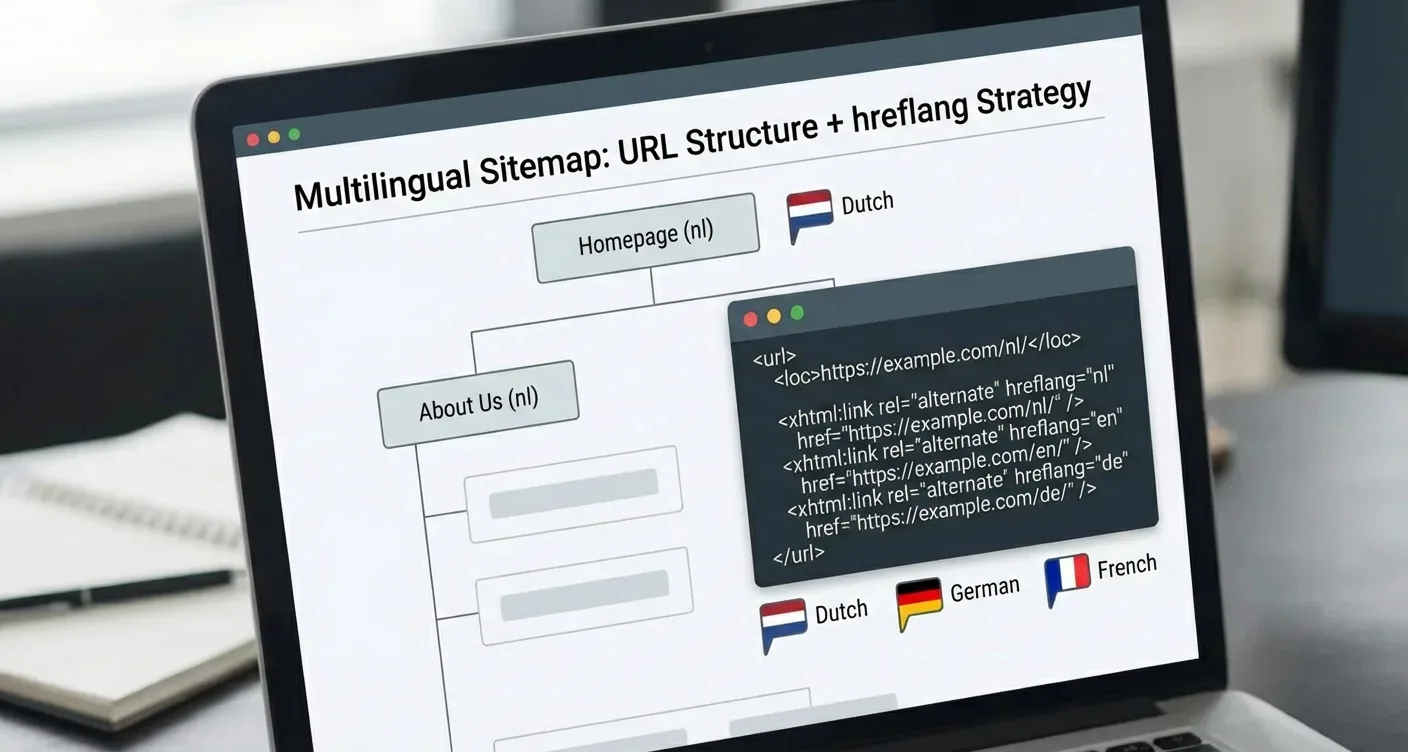
Implementing an optimal multilingual sitemap, URL structure, and hreflang strategy for international SEO requires precision. A common mistake is overlooking the 'x-default' tag, which indicates which page should be displayed when no specific language match is found. This is crucial for a global audience. Furthermore, each language version in the sitemap must reference itself and all alternative versions. This creates a web of cross-references that strengthens authority. For those looking to understand the basics, affordable search engine optimization for your website can be a good starting point to grasp the fundamentals.
Consistency is key: if the URL structure deviates from the information provided in the sitemap, it creates confusion for search engines.
Why Hreflang Attributes Are Indispensable
Hreflang tags act as signposts that tell Google in which language and for which region a page is written. Within a comprehensive multilingual sitemap, URL structure, and hreflang strategy, these tags serve as the crucial link between the technical sitemap and your content. When you include this information directly in the XML sitemap, you reduce the burden on your HTML code, which benefits page load speed. This method is frequently applied to large websites. According to the documentation from Google Search Central, correctly configuring these signals is essential to reach your intended audience.
"A multilingual sitemap is not just a list of links, but a strategic document that communicates your brand's geographical relevance to the world."
To ensure a successful multilingual sitemap, URL structure, and hreflang strategy, you must consider the following aspects:
- Always use the correct ISO 639-1 language codes and ISO 3166-1 alpha-2 region codes.
- Ensure reciprocity: if page A refers to page B, page B must also refer back to page A.
- Avoid broken links in the sitemap, as this undermines the reliability of your international URL structure.
- Automatically update the sitemap whenever a new language version is published.
Manually maintaining this data is prone to errors and time-consuming, especially for growing platforms.
Ultimately, a robust multilingual sitemap, URL structure, and hreflang strategy is about removing barriers. By combining technical precision with a logical structure, you lay the groundwork for a website that performs globally. It's an investment that pays for itself through higher relevance in local search results and an improved user experience for visitors from diverse regions.
Choosing Between Subdomains, Subfolders, or Country-Specific Domains
When scaling internationally, your website's architecture forms the foundation for success. The choice between country-code top-level domains (ccTLDs), subdomains, or subfolders directly impacts how search engines index your content. A multilingual sitemap, URL structure, and hreflang strategy is indispensable here to correctly distribute authority. While ccTLDs signal the strongest local relevance, they often require a larger budget for maintenance. Subfolders are simpler to manage as they benefit from the combined domain authority, which is essential for rapid organic growth in new markets.
Implementing an optimal multilingual sitemap, URL structure, and hreflang strategy for international growth ensures that users always land on the correct language version.
The Advantages of Subfolders and Technical Consistency
Subfolders are often preferred by SEO specialists due to the consolidation of link equity. When you choose this setup, a multilingual sitemap, URL structure, and hreflang strategy implementation is relatively straightforward. You don't need to manage separate SSL certificates or hosting packages for each region. This makes the process of WordPress website design more efficient, as global settings remain consistent across all language sections.
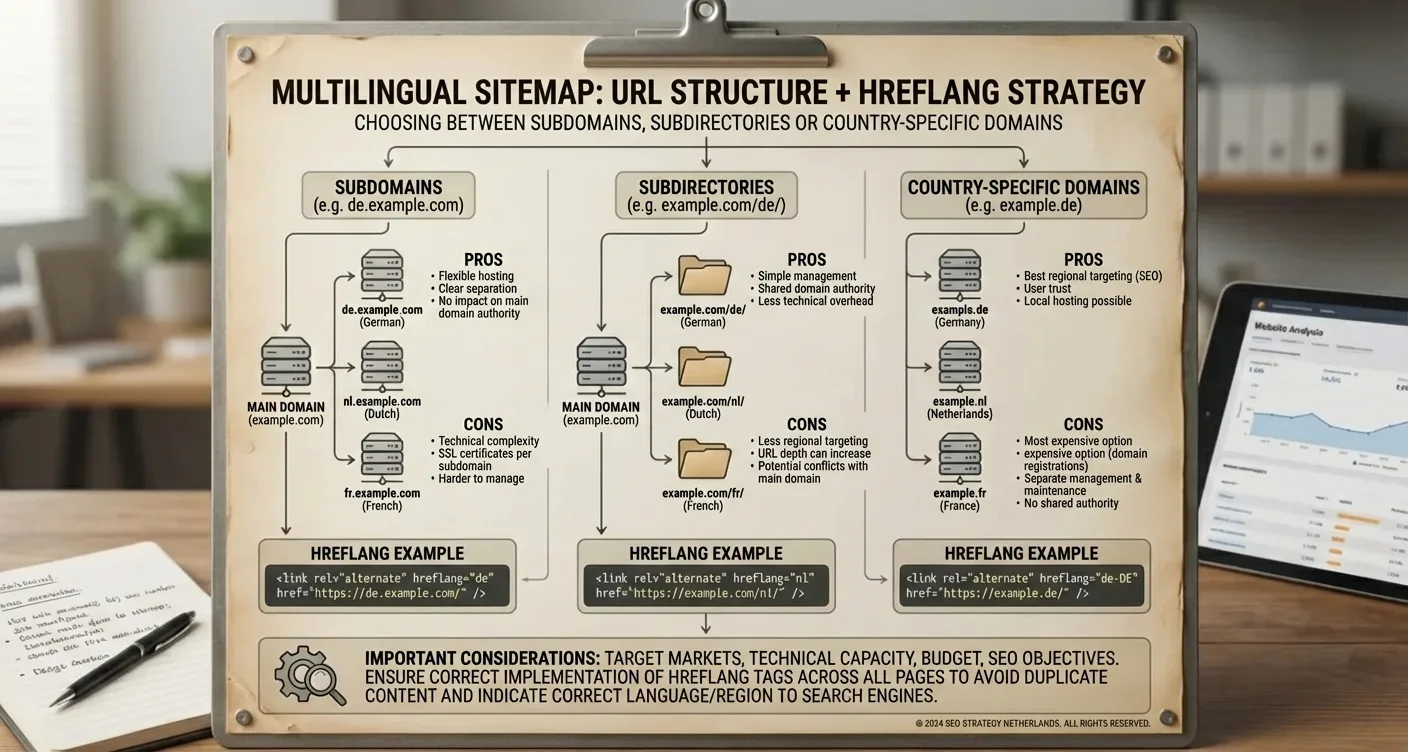
When making your choice, you should consider the following technical aspects:
- The geographical location of your target audience and server responsiveness.
- The complexity of the multilingual sitemap, URL structure, and hreflang strategy configuration.
- The available budget for building local backlinks per domain.
- The necessity for a unique brand identity per country versus a uniform appearance.
"A wrong choice in URL structure can lead to internal competition between language versions, which undermines the effectiveness of your multilingual sitemap, URL structure, and hreflang strategy."
According to the documentation from Google Search Central, a correct multilingual sitemap, URL structure, and hreflang strategy helps prevent duplicate content issues. This is crucial for healthy indexing.
Ultimately, the best approach depends on your long-term vision and available technical resources.
Best Practices for Implementing Hreflang Tags in XML Sitemaps
Correctly configuring a multilingual sitemap, URL structure, and hreflang strategy is essential for international websites aiming to strengthen their authority. When you manage hreflang annotations via an XML sitemap instead of within the HTML head, you reduce page load times. This is crucial because every URL in the sitemap must reference itself and all alternative language versions. A flawless execution prevents search engines from detecting duplicate content, while ensuring they show the right language version to the correct user based on geographical location and language settings.
A solid multilingual sitemap, URL structure, and hreflang strategy implementation ensures streamlined indexing by search engines.
Consistency in Language Codes and URL Validation
When preparing your XML files, it's paramount that you strictly adhere to ISO 639-1 codes for languages and ISO 3166-1 alpha-2 codes for regions. A common error within a multilingual sitemap, URL structure, and hreflang strategy for international SEO is using incorrect country codes, which can disrupt the logic. Ensure that every listed URL returns a 200 status code and that no redirects are present. This guarantees that crawlers process the correct information directly, without unnecessary detours.
For optimal search visibility, you can also look into SEO search engine optimization to further strengthen your technical foundation.
"A multilingual sitemap, URL structure, and hreflang strategy is truly effective only when each language version includes a reciprocal link to all other versions, including the x-default value for unspecified regions."
Automation and Maintenance of Your Sitemap
Manually maintaining a multilingual sitemap, URL structure, and hreflang strategy for large e-commerce sites is virtually impossible due to its complexity. Therefore, use tools that automatically update the sitemap as soon as new content is published. Pay attention to the following points:
- Always use absolute URLs instead of relative paths.
- Include the x-default tag for users without a specific language match.
- Regularly check for 'orphaned pages' that are not in the sitemap.
- Validate your XML file via Google Search Console to find syntax errors.
A well-maintained multilingual sitemap, URL structure, and hreflang strategy is the backbone of your global online presence. For more technical background information, you can consult Google Search Central's documentation.
A robust multilingual sitemap, URL structure, and hreflang strategy is essential for international success.
By correctly implementing hreflang tags within your XML sitemap, you prevent duplicate content issues and ensure that search engines display the correct language version to the relevant target audience. A logical structure of subfolders or domains significantly strengthens your local authority in this process.
Consistently managing your multilingual sitemap, URL structure, and hreflang strategy forms the basis for flawless indexing across different country borders. When you meticulously align these technical elements, you not only improve the user experience but also enhance search visibility in global search results. Therefore, regularly check your Search Console for error messages and optimize your source codes for maximum impact. Do you want to immediately improve your international SEO performance and eliminate technical errors? Start configuring your sitemap today and watch your organic traffic grow.
Frequently Asked Questions
What is the importance of a multilingual sitemap, URL structure, and hreflang strategy for international SEO?
A solid multilingual sitemap, URL structure, and hreflang strategy ensures that search engines understand which language version of a page is relevant for specific users. This prevents duplicate content issues and improves search visibility in different regions.
How do you correctly implement hreflang tags in an XML sitemap?
You implement this by adding an xhtml:link element for each URL that refers to all available language variants, including the page itself. This method, within a multilingual sitemap, URL structure, and hreflang strategy, is often more efficient than placing tags in the HTML head of each page.
Why is the choice of the correct URL structure crucial for multilingual websites?
The structure, such as subdirectories or subdomains, determines how search engines distribute your domain's authority across different languages. A consistent structure helps crawlers index and understand the logic behind your international content more quickly.
When should you use the x-default value in your sitemap?
The x-default value should be used when a user has no specific language setting or when there is no exact match for their region. It serves as a fallback page that directs visitors to the most general version of your website.
How SEO Supercharged helps you here
SEO Supercharged is fully online (service area: online, worldwide), so you can use it from anywhere.
The platform is built for SMEs with growth ambitions, Marketing Managers at mid-sized organizations, E-commerce Operators and Webshop Owners, SaaS Companies and Tech Startups, B2B Service Providers and Business Consultants, Content and Communication Specialists, International Exporters and Global Brands, Local Entrepreneurs with a Digital Focus, Digital Marketing Agencies and Agency Owners.
You can use it for, among other things, Geo-Strategy & AI Audit, Hybrid SEO & Geo Content Creation, LLM Visibility Analysis, Structured Data & Schema Optimization, Brand Authority & Citation Building, E-E-A-T Content Optimization.
Want to tackle this directly? Plan your structure with the Sitemap Architect, or start a free SEO analysis.
Related articles
- Sitemap Architect: Build a Site Structure That Ranks (SEO, AI, GEO)
Learn to use Sitemap Architect for a content map boosting rankings, internal links, indexing & AI answers. Templates, checklists, pitfalls included.
- Why You Should Build a Sitemap and Website Structure First for SEO
While content is key, effective SEO starts earlier. Discover why building a solid sitemap and clear website structure is the foundational step for improved search rankings.
- Scalable SERP Meta Optimization: Titles and Descriptions that Drive Clicks
Master scalable SERP meta optimization. Learn to craft click-worthy titles & descriptions that boost CTR, improve SEO strategy, & drive organic traffic. Get.
- Why WordPress XML Import Best Practices (and Pitfalls) Are Essential
Learn everything about WordPress XML import. Discover best practices and common pitfalls. Prevent errors and optimize your data transfer today. Read our.
- Service Page Structure: From 6 Topics to 30 Pages Without Overlap
Optimize your service page structure: scale from 6 core topics to 30 unique pages without overlap. Learn to expand content and boost SEO. Read our guide!