Topic Clusters vs. Content Silos: What's the Difference?
Topic Clusters vs. Content Silos: SEO Differences Explained
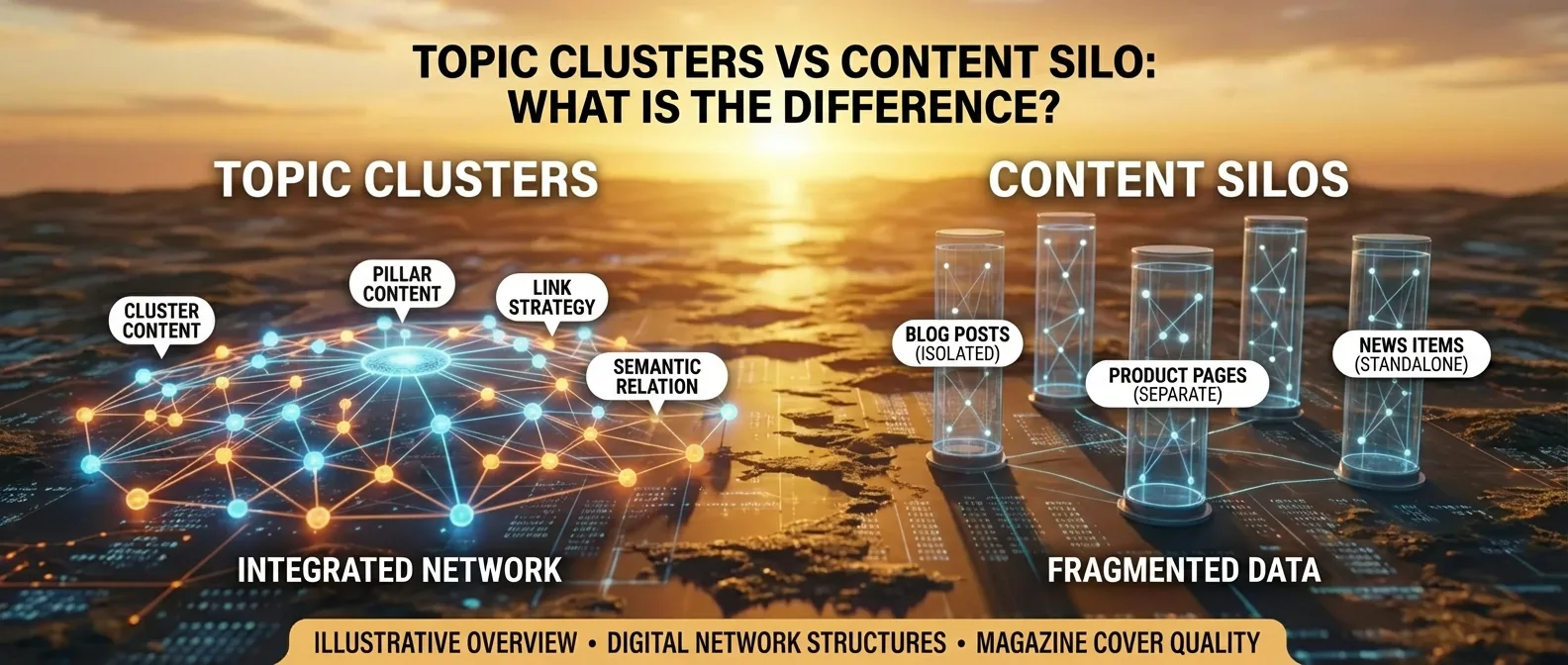
Topic clusters vs. content silos: what's the difference? This question is central to building an authoritative site structure that optimally serves both search engines and users. While content silos rely on a vertical hierarchy within folders, topic clusters operate through a network centered around a core pillar page. Understanding these nuances is crucial for SEO specialists aiming for maximum search visibility and a logical internal linking strategy.
Do you opt for a tree structure or a dynamic ecosystem? The comparison between these methods reveals how Google indexes relevance and domain authority. The main differences are:
- Silos emphasize a deep, hierarchical folder structure.
- Clusters connect supporting content to a main topic via internal links.
- The user experience differs based on navigation method.
- Search engine indexing is directly influenced by the chosen architecture.
The Fundamentals of Content Architecture Explained
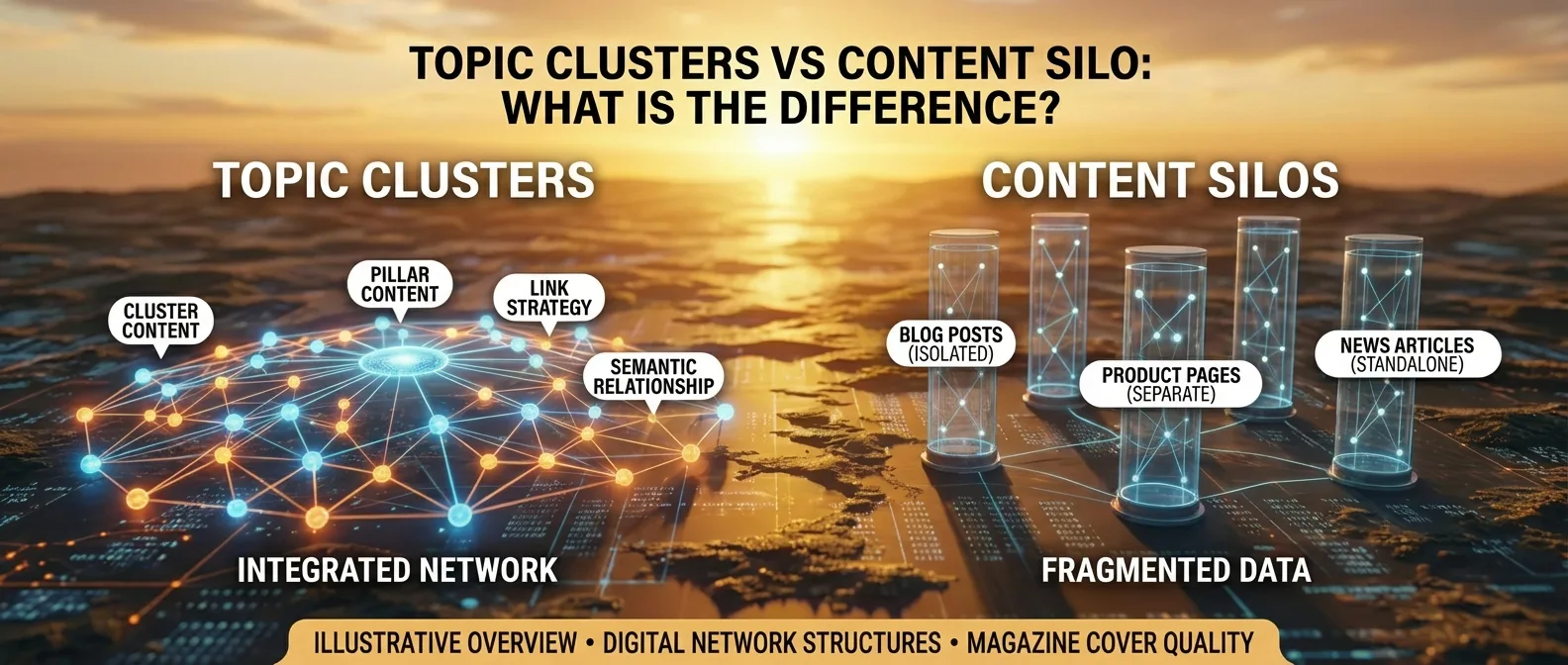
When you start structuring a website, it's essential to understand how information is organized. A well-thought-out hierarchy ensures Google comprehends the relevance of your pages faster, which impacts your organic search visibility. In the world of modern SEO, the discussion often revolves around the core question: Topic clusters vs. content silos: what's the difference? Both methods aim to build authority, but their technical execution and internal link structure differ significantly. Without strong architecture, your content remains fragmented, causing valuable rankings to be lost to competitors who have organized their information more logically.
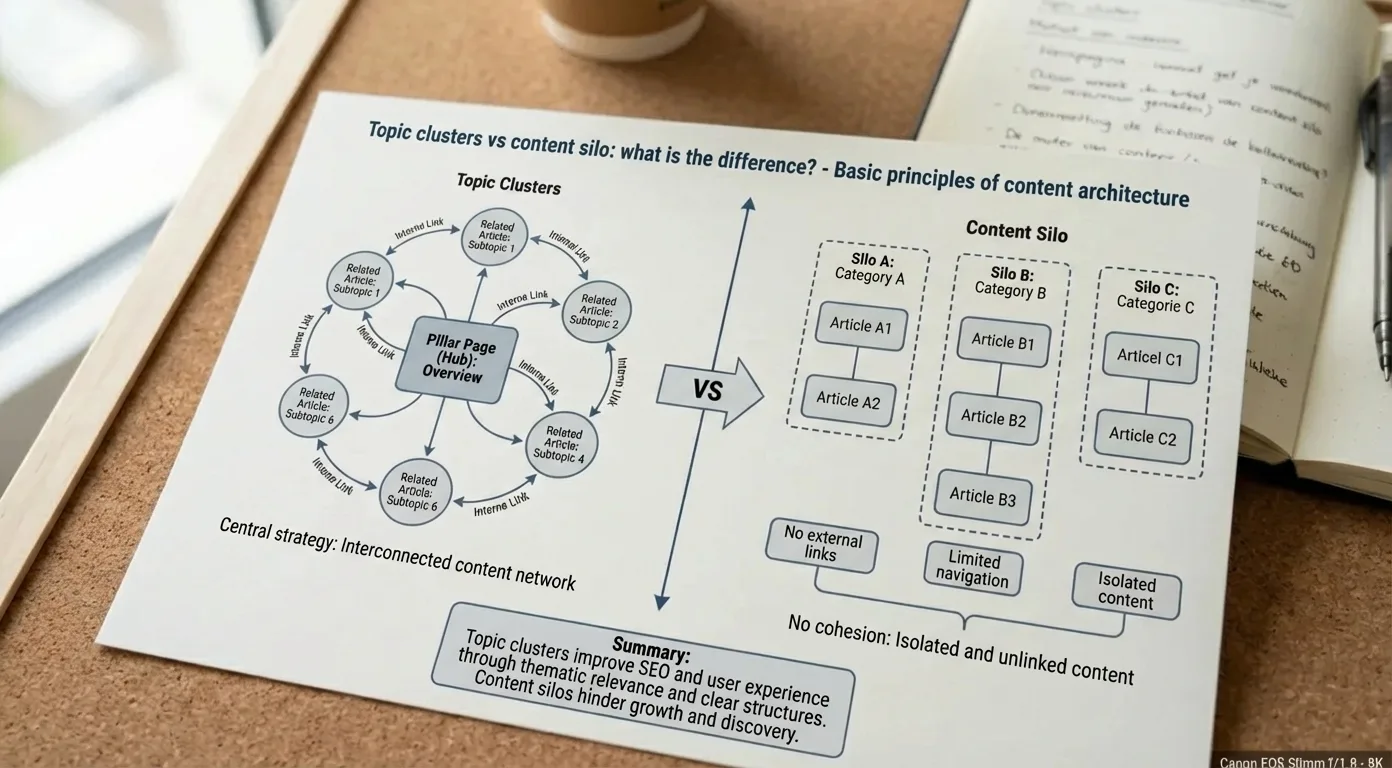
Choosing the right strategy depends on your business goals and the complexity of your website's topics. In practice, search engines value the contextual coherence between pages on a domain. When analyzing the dynamics between clusters and silos, it's clear that silos are strictly vertical, while clusters offer more flexibility by surrounding a central 'pillar' page with supporting articles. This interconnectedness helps cover a topic comprehensively, which is essential for demonstrating expertise and E-E-A-T.
"A good site structure is the foundation upon which all other SEO efforts rest; without this basis, long-term growth is impossible."
To gain a clear overview of the differences, let's look at the following characteristics:
- Silos use a strict folder structure in URL construction.
- Topic clusters focus on strategic internal links between related subtopics.
- The navigation experience often determines which method is most suitable for your target audience.
- Silos often prevent different categories from linking horizontally to each other.
Implementing an affordable search engine optimization strategy begins with this fundamental choice. For more technical background on web structures, you can consult the documentation from Google Search Central. Ultimately, the choice is about creating a logical path for the crawler and an optimal experience for the visitor. A hybrid approach is often most effective for modern websites.
Topic Clusters vs. Content Silos: What's the Difference?
When examining the architecture of a modern website, the pressing question often arises: Topic clusters vs. content silos: what's the difference? Fundamentally, a traditional silo structure revolves around a vertical hierarchy where pages are placed in isolated columns. This model is based on specific keywords and operates with rigid top-down navigation, offering few lateral connections between categories. The goal is to build authority within a defined niche, but it can limit the user experience if visitors seek related information outside the direct silo.
However, modern SEO specialists increasingly opt for a flexible approach. A well-considered strategy regarding Topic clusters vs. content silos: what's the difference? helps you make the right architectural choice for your specific platform and target audience.
The Dynamics of Internal Link Structures
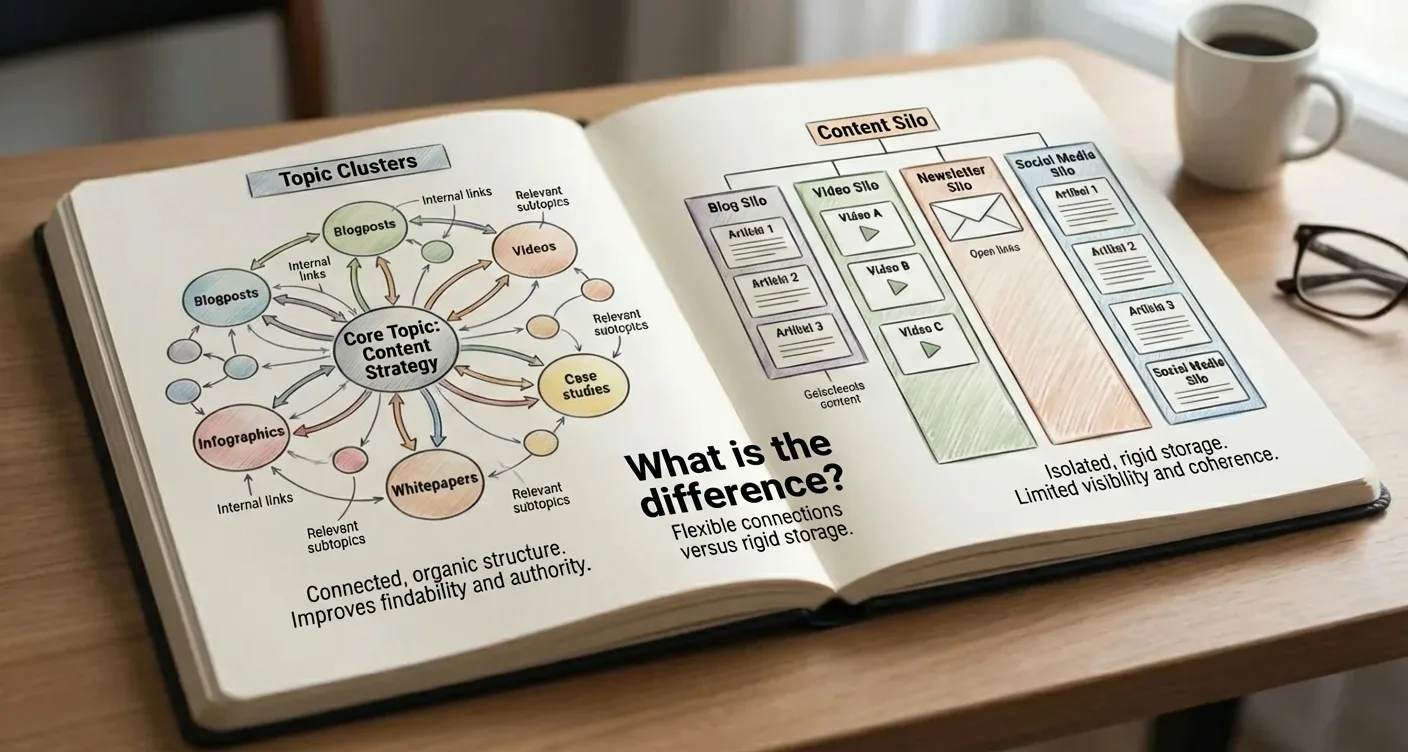
In contrast to the static silo, topic clusters utilize a central 'pillar page' connected to various 'cluster content' pieces. This creates a semantic web of relevant information that helps search engines better understand context and interconnections. Answering the question of Topic clusters vs. content silos: what's the difference? practically means choosing between a strict tree structure or a modern network of pages.
When designing a new site, for example, through WordPress website design, it's essential to determine these structures beforehand. A well-thought-out structure ensures that both users and crawlers navigate content effortlessly. Here are some key points that clarify the distinction:
- Silos primarily focus on hierarchical depth and keyword isolation within folders.
- Topic clusters emphasize semantic relevance and interconnectedness via hyperlinks.
- Clusters are often easier to adapt to the changing search intentions of modern users.
"The choice between Topic clusters vs. content silos: what's the difference? determines how effectively search engines can assess the authority of your entire domain and distribute it across individual pages."
For those who want to delve deeper into the technical aspects, Moz offers extensive documentation on how internal links influence page rankings. Understanding Topic clusters vs. content silos: what's the difference? is crucial for a future-proof SEO strategy that adapts to algorithm updates. Ultimately, the comparison boils down to balancing order and findability within your digital ecosystem.
Which Structure is Best for Your SEO Strategy?
The choice between different organizational models depends entirely on the nature of your website and the complexity of your offerings. When you ask yourself: Topic clusters vs. content silos: what's the difference?, it's essential to consider the user experience. A silo structure is often rigid and hierarchical, which works excellently for e-commerce sites with clear product categories. On the other hand, topic clusters offer more flexibility for informative blogs and knowledge bases because they align with how search engines make semantic connections between different articles on a broad topic.
The Power of Internal Link Structures
In practice, we often see that a hybrid approach yields the best results for modern websites.
Understanding the nuance behind Topic clusters vs. content silos: what's the difference? for advanced marketers helps in building authority. While silos direct link equity vertically downwards, clusters create a horizontal web of relevance. This means you don't have to choose; you can establish a hierarchical base and strengthen it with thematic clusters. For optimal technical implementation, you can rely on professional web design that seamlessly integrates both methodologies into your navigation and site structure.
"The architecture of your content determines how efficiently Google can validate your expertise."
Strategic Considerations for Your Growth
When evaluating Topic clusters vs. content silos: what's the difference? and its impact on ranking, you should consider the following factors for your long-term success:
- The depth of your keyword research per main topic.
- The technical scalability of the chosen folder structure.
- The searcher's intent: is it informational or transactional?
- The mutual relevance of sub-pages within a specific theme.
Ultimately, the discussion about Topic clusters vs. content silos: what's the difference? in 2024 revolves around relevance. A well-designed structure ensures that both visitors and crawlers find their way effortlessly. Do you want to know more about the technical implementation? Consult the official documentation from Google Search Central for in-depth guidelines. Correctly applying the insights from Topic clusters vs. content silos: what's the difference? is key to a future-proof online presence that continues to grow in search results.
Choose the right structure for your SEO success.
The answer to the question "Topic clusters vs. content silos: what's the difference?" depends on your website goals and desired user experience. While silos offer a strict hierarchy for large catalogs, clusters provide flexible interconnectedness that strengthens the authority of your entire domain.
The core of an effective strategy is understanding your visitor's intent. Silos often organize content top-down, which is ideal for e-commerce, while topic clusters excel at answering complex informational queries through strong internal links. By cleverly combining these methods, you create a well-organized website that both search engines and users understand. Analyze your current content architecture today and implement the structure that best fits your unique business objectives for maximum online growth.
Frequently Asked Questions
What is the main difference between a topic cluster and content silo?
The fundamental answer to 'Topic cluster vs. content silo: what's the difference?' lies in their structure. While content silos are based on a hierarchical, top-down folder structure, topic clusters revolve around a central 'pillar' topic connected to relevant sub-pages via internal links.
How do you implement an effective topic cluster strategy?
You start by creating a comprehensive pillar page that broadly covers a main topic. Then, you write specific cluster articles that delve deeper into subtopics, consistently using internal links to distribute authority among the pages.
Why would a website choose a content silo instead of clusters?
A content silo is often effective for very large websites with strictly separated categories, such as major e-commerce platforms. When considering 'Topic clusters vs. content silos: what's the difference?', you choose silos if you need a rigid, logical folder structure to help the search engine understand the site architecture.
When is it wise to combine both methods?
Many modern SEO strategies combine both by using a silo architecture for the main navigation, while deploying topic clusters within those sections. This provides both a strong technical hierarchy and a rich network of internal relevance for specific topics.
How SEO Supercharged helps you here
SEO Supercharged is fully online (service area: in the cloud), so you can use it from anywhere.
The platform is built for Independent copywriters and content creators, SME business owners with their own webshop, Digital marketing agencies in Flanders, SEO specialists and consultants, Marketing managers at Belgian scale-ups, Bloggers and affiliate marketers, Start-up founders in the tech sector, E-commerce managers of large retail chains, Communication officers at local governments.
You can use it for, among other things, AI SEO tooling audit, Implementation of AI content workflows, Strategic selection of the best AI SEO generator, Prompt engineering for Belgian SEO copy, Automation of SEO metadata via AI, Quality control for AI-generated texts, AI SEO workshop for marketing teams.
Want to tackle this directly? Plan your structure with the Sitemap Architect, or start a free SEO analysis.
Related articles
- WordPress Pillar Content: The Complete Guide to Categories, Canonicals, and Internal Linking
Discover how to build a robust WordPress pillar content strategy using categories, canonicals, and internal links to boost your Google rankings and AI.
- Mastering Internal Linking: Pillar and Cluster Strategy for SEO
Learn the best internal linking strategy for pillar and cluster content with examples. Instantly boost your SEO structure, domain authority, and organic.
- Blog Category SEO: Naming, URL Structure, and Indexing Strategy
Master blog category SEO! Learn how naming, URL structure, and indexing boost traffic & rankings. Get expert tips to optimize your content hierarchy today.
- Internal Link Audit: Which Links Maximize Your SEO Value?
Discover how to conduct an internal link audit to identify high-value links, distribute SEO authority effectively, and boost your rankings. Read our guide!
- Canonical Tag in WordPress: When to Use It (and When Not To)
Learn all about canonical tags in WordPress: when to use them, when to avoid them. Prevent duplicate content issues, consolidate link equity, and improve.