Multilingual Technical SEO Audit: Optimize Your Global Strategy
Technical Multilanguage SEO Audit: Optimal Global SEO Strategy

A multilingual technical SEO audit is essential for businesses scaling internationally without losing organic search visibility. By conducting a thorough multilingual technical SEO audit, you immediately identify critical issues such as incorrect hreflang implementations, inconsistent URL structures, and server-side redirects that confuse search engines. This process ensures that each language version is indexed correctly, directing users to the right regional landing page every time. Without this check, organizations risk duplicate content and fragmented authority.
This analysis optimizes sitemaps, canonical tags, and page load speed by region to eliminate technical barriers. A multilingual technical SEO audit focuses on:

- Correct hreflang tags for language and regional targeting.
- Optimization of international URL architecture.
- Preventing duplicate content across language versions.
- Improved crawl efficiency for global search engines.
This ensures maximum global relevance and authority within a competitive digital market.
What is a Multilingual Technical SEO Audit and Why Do You Need One?
In today's globalized digital market, simply translating text is no longer enough to achieve international success. A multilingual technical SEO audit forms the fundamental basis for any website aiming for cross-border visibility. It's an in-depth analysis of the underlying code, server configurations, and site structure, specifically geared towards correctly presenting different language versions to both users and search engines. Without such a check, businesses risk their carefully translated content remaining invisible in local search results, leading to missed opportunities and wasted marketing budgets in foreign markets.
Performing a thorough audit ensures that search engines understand which page is intended for which region.
The Essence of Technical Optimization for Multiple Languages
When we talk about a technical audit for international websites, we look beyond just the words on the screen. It's about implementing complex signals like hreflang tags, which tell Google: "This is the Dutch version for Belgium, and this is the Dutch version for the Netherlands." An error in this architecture can lead to duplicate content issues, where search engines don't know which version to prioritize. By conducting a multilingual technical SEO audit for international growth, you identify bottlenecks in the URL structure, whether you choose subdomains, subdirectories, or country-specific extensions like .de or .fr. This process is crucial to correctly distribute your domain's authority across all language sections.
"A technical error in a multilingual setup often acts as an invisible wall between a quality website and its international target audience."
A multilingual technical SEO audit is therefore indispensable for webshops and informational platforms that want to expand their reach without carrying technical baggage.
Why Your Business Can't Do Without This Analysis

The necessity of a multilingual technical SEO analysis often only becomes clear when organic growth in a specific country stagnates despite high content investments. Search engines enforce strict protocols for indexing international pages; if the server location, metadata, or sitemaps are not synchronized with the language settings, the relevance score will drop. Furthermore, such an audit significantly improves the user experience. Visitors are automatically guided to the correct language version based on their browser settings or IP address, which lowers the bounce rate and increases conversions. It's an investment in the sustainability of your digital infrastructure that pays for itself through a stable and error-free online presence in every target country.
- Correct implementation of hreflang attributes for language and region combinations.
- Optimizing page load speed per geographic region via CDNs.
- Preventing duplicate content across different language versions.
- Improving search engine indexing in local markets.
For those looking to learn more about improving online visibility, it's advisable to explore affordable search engine optimization for your website. The foundation of a successful multilingual technical SEO audit lies in details often overlooked by general SEO tools. According to Google Search Central's documentation, explicitly indicating language and country variants is one of the most important steps for international SEO. Ignoring these technical aspects can lead to your website being displayed in a language the user doesn't understand, directly impacting your brand's trustworthiness.
Ultimately, a strategic multilingual technical SEO audit provides the necessary insights to scale into new markets with a solid and error-free configuration.
The Role of Hreflang Tags in a Multilingual Technical Analysis
When discussing a comprehensive multilingual technical SEO audit, the implementation of hreflang tags is undoubtedly one of the most critical components. These small pieces of code tell search engines like Google precisely which version of a page is intended for a specific language or region. Without these signals, a website runs the risk of search engines showing the wrong language version to a user, which directly harms the user experience. In a complex digital environment where content is often available in multiple languages, hreflang attribution acts as a traffic controller, ensuring the right content reaches the right audience while simultaneously preventing duplicate content issues.
Correctly setting up these tags is essential for a successful multilingual SEO strategy.
The Technical Complexity of Hreflang Implementation
During a multilingual technical SEO audit, specialists often encounter errors that hinder organic visibility. A common problem is the absence of reciprocal links; if page A refers to page B as the French variant, page B must also refer back to page A as the Dutch variant. Additionally, the ISO codes for language and country must exactly match official standards. An incorrect code can lead to search engines completely ignoring the instructions. It is therefore crucial that every URL in the cluster also identifies itself, which is often forgotten in manual implementations within the header or via the sitemap.

A crucial aspect often highlighted in a multilingual technical SEO audit roadmap for professionals is the handling of the 'x-default' value. This specific tag is intended for users who do not directly fall within one of the defined language or region codes, such as a global landing page. By setting an x-default, you provide a safety net for international visitors, which benefits your domain's overall authority. The process of checking whether these tags are correctly placed in the source code, HTTP headers, or XML sitemaps forms the backbone of technical optimization for multilingualism.
"Technically, hreflang is one of the most challenging aspects of SEO because any incorrect reference can disrupt the entire logic of an international site structure."
To ensure the quality of your website, you can read more on an expert WordPress blog for further insights into website structure.
Common Pitfalls in Multilingual SEO Audits
When conducting a multilingual technical SEO audit, it's crucial to pay attention to the following points:
- Using non-canonical URLs in hreflang annotations.
- Conflicts between hreflang tags and robots.txt instructions.
- Pages linking to 404 error messages or redirects.
- Lack of a consistent language structure across the entire domain.
Ignoring these technical details can lead to a drop in search rankings. For a deeper dive into official guidelines, consult Google Search Central's documentation. An flawless multilingual technical SEO audit ensures that your investment in translations actually yields returns in the form of local traffic.
Thorough preparation and regular checks are indispensable for any webmaster.
URL Structures and Domain Choices for International Websites
When rolling out a global digital strategy, choosing the right URL structure is one of the most fundamental decisions an SEO specialist must make. Your website's architecture determines how search engines like Google interpret the relationship between different language versions and how authority is distributed across various domains. A comprehensive multilingual technical SEO audit therefore always begins with analyzing the current domain structure, examining whether Country Code Top-Level Domains (ccTLDs), subdomains, or subdirectories are used. Each choice has specific pros and cons regarding server location, crawl budget, and the extent to which local search engines consider content relevant for a specific region or language area.
The choice of a specific structure directly impacts the complexity of your multilingual technical SEO analysis and the scalability of your platform.
The Impact of ccTLDs vs. Subdirectories
In practice, we see that ccTLDs, such as .nl or .de, often send the strongest signal to local search engines and users, as they instantly build trust with the local target audience. However, from a multilingual technical SEO audit perspective, this brings significant challenges, as each domain must build authority independently, and maintenance costs for hosting and SSL certificates are higher. Subdirectories on a generic domain (.com/nl/), on the other hand, are easier to manage and benefit from combined domain authority, often resulting in faster indexing of new pages. It is crucial to determine, during a multilingual technical SEO audit process for international growth, which method best aligns with available resources and the organization's long-term objectives.

Correctly implementing these structures prevents search engines from getting confused by duplicate content on different country-specific pages.
Technical Requirements for Domain Management
Beyond the main structure, during a multilingual technical SEO audit, we must also examine the technical handling of redirects and geographic targeting in Google Search Console. It is essential that users are not forced to redirect based on their IP address without the option to manually switch languages, as this can hinder search engine indexing. A robust international domain structure ensures that both the user and the crawler effortlessly find the correct version of the website, regardless of their physical location or browser settings.
- Utilizing ccTLDs for maximum local relevance and user trust.
- Subdirectories for centralized authority and simpler technical maintenance.
- Subdomains as an intermediate solution for various server locations.
- Correct linking of Search Console properties per country or language.
- Avoiding automatic IP redirects that can block crawlers.
"A consistent URL structure is the foundation upon which all other international SEO efforts rest; without this basis, content loses its power in local search results."
During a comprehensive multilingual technical SEO audit, we also check whether the internal linking structure remains logical across different domains. For more information on modern search technologies, it is advisable to consult the guide on AIO optimization. For additional guidelines on web standards, you can visit the W3C. By precisely aligning these elements, you create a robust platform ready for global expansion without technical impediments.
Ultimately, the quality of the multilingual technical SEO audit determines whether your international ambitions translate into measurable success in search results.
Key Steps in Performing a Multilingual Technical SEO Audit
The process of a thorough multilingual technical SEO audit begins with precisely mapping the current site structure and how different language versions communicate with each other. An incorrect configuration can lead to search engines showing the wrong page to the wrong audience, directly impacting user experience and conversion rates. During this phase, we critically examine the source code to verify that hreflang tags are correctly implemented and that no conflicts arise between various country settings. It's essential to understand that a multilingual site is more than a simple translation; it requires a deep technical analysis of server response and URL architecture to guarantee maximum visibility in each specific region.
A multilingual technical SEO audit is the basis for international success.
Verifying Hreflang Implementation and URL Structure
One of the most critical components within the multilingual technical SEO audit is validating the hreflang attributes. These tags tell search engines like Google which language version of a page is relevant for a user in a specific country. We check not only for the presence of these tags but also for their reciprocity; each page must link back to the other versions. Additionally, we assess whether the chosen URL structure, such as subdomains or subdirectories, is consistently applied across the entire website. Errors in this architecture can lead to duplicate content issues, where search engines struggle to identify the original source, which can unnecessarily weaken your domain's authority.
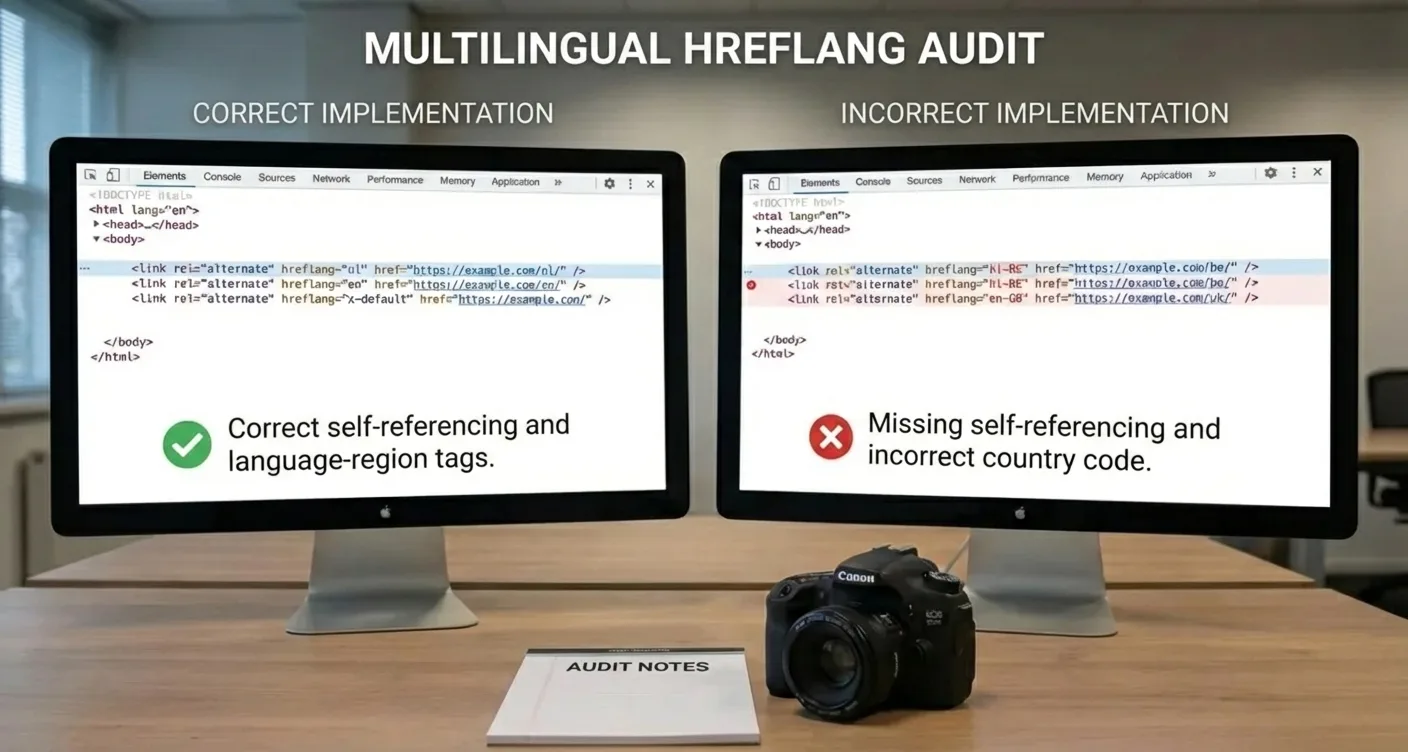
Correctly setting these parameters ensures your technical audit roadmap for multilingual websites proceeds flawlessly and yields results.
Beyond technical tags, server speed per region is a decisive factor for ranking. Slow load times in a specific country can indicate an incorrect server location or a lack of a Content Delivery Network (CDN). During the comprehensive multilingual technical SEO audit, we investigate whether the infrastructure is scalable enough to handle global traffic without performance loss. This also includes testing automatic language detection, where we advise always giving users a choice rather than forcing them to redirect based on their IP address, which is often perceived as disruptive by visitors and crawlers alike.
"A technical error in the international configuration can block organic visibility in an entire region, regardless of content quality."
Optimizing Metadata and Internal Link Structure
When performing a multilingual technical SEO audit, the internal link structure must not be overlooked. It is crucial that internal links within a language version consistently point to pages in that same language. When a Dutch-language page links to an English variant without a clear reason, this confuses both the user and search engine bots. We therefore analyze navigation menus, footers, and sitemaps to ensure that each language section functions as a self-contained, logical unit. For optimal results, consider applying specific search engine optimization SEO strategies that align with your platform's technical requirements.
- Check if XML sitemaps are separated by language or correctly combined with hreflang data.
- Evaluate canonical tags to prevent language versions from being seen as copies of each other.
- Test page load speed using tools like PageSpeed Insights to identify regional bottlenecks.
- Verify that robots.txt files do not unintentionally block access to specific language paths.
Finally, we look at the localization of technical elements such as date formats, currency, and forms. A complete multilingual technical SEO audit ensures that all underlying systems seamlessly align with local user expectations.
Common Errors in Multilingual SEO Implementations
Rolling out an international website often comes with complex hurdles that can severely hinder search engine visibility. One of the most common mistakes is incorrectly configuring hreflang tags, preventing Google from understanding which language version is intended for which region. Without a thorough multilingual technical SEO audit, such errors often go unnoticed, leading to internal competition between different language versions of the same page. Additionally, we regularly see companies blindly relying on automatic translations without human review, which harms both user experience and local relevance. Ignoring local search intent and cultural nuances means content simply doesn't resonate with the target audience, no matter how good the technical foundation may seem.
A flawed site structure often reveals that the architecture is not logically built for international growth. A crucial aspect frequently overlooked is the consistent implementation of URL structures. Whether you choose subdomains, subdirectories, or country-specific extensions, consistency is essential for search engines to correctly index your site.

During a technical check, specialists often discover that redirects are not correctly set up, causing visitors to land on the wrong language page. This increases the bounce rate and lowers your domain's authority. It is therefore advisable to invest in professional SEO support to effectively remove these technical barriers and lay a solid foundation for global success. Errors in the technical architecture of a multilingual site can delay organic growth in new markets for years. Remember that page load speed can also vary by region, which is an essential part of any webmaster's checklist.
Besides the technical aspects, the quality of localized content is crucial for your conversions. Many organizations make the mistake of not translating metadata, such as alt texts and meta descriptions, thereby missing opportunities in local search results. Providing a unique experience per region is critical for success. Therefore, use the right tools to analyze and improve your results. Avoiding these errors requires constant vigilance and expertise.
The Impact of Server Location and Page Load Speed on Global Rankings
The physical distance between the server and the end-user plays a crucial role in user experience and search engine optimization. When a website operates globally, a thorough multilingual technical SEO audit is necessary to determine if the infrastructure supports its international ambitions. Google uses page load speed as a direct ranking factor, where delays in data transfer lead to higher bounce rates and lower positions in local search results for distant markets. Optimizing response time is therefore not a luxury, but a fundamental requirement for international success.

A multilingual technical SEO audit helps identify bottlenecks in server response for specific regions. To maintain consistent load times worldwide, many companies use a Content Delivery Network (CDN). This network of distributed servers stores static content at locations closer to the user, which is essential for a good multilingual technical SEO audit for international webshops. By serving files such as images and scripts locally, the load on the main server is reduced, and speed is significantly improved. During a multilingual technical SEO audit, it is often checked whether the CDN configuration is correctly set up for all language domains and subdirectories.
Furthermore, choosing a hosting provider with data centers in the target region is often the most effective strategy. In practice, local hosting signals to search engines about the site's relevance for that specific geographical location. Performing a multilingual technical SEO audit allows webmasters to evaluate whether the current server location still aligns with growing international visitor streams. For more information on successful implementations, you can view our client testimonials on the website.
Technical Optimization and Core Web Vitals
- Minimize HTTP requests for each language version.
- Implement browser caching for returning international visitors.
- Use modern image formats like WebP to save bandwidth.
"Speed is the universal language of the internet; a slow site translates everywhere to lost opportunities."
A multilingual technical SEO audit also examines Core Web Vitals, which can vary by region due to local internet infrastructure. It is advisable to use tools like PageSpeed Insights for deeper analyses. By constantly monitoring and adjusting, the website remains competitive in every market in which it operates.
A multilingual technical SEO audit is essential for international success.
By removing technical barriers and correctly implementing hreflang tags, you lay a solid foundation for global search visibility. A thorough analysis prevents search engines from viewing your different language versions as duplicate content, which is crucial for your authority.
Do you want to harness the full potential of your international website and systematically expand your organic reach across borders? Our specialists are ready to optimize your platform so that every language version performs optimally in the local search results of your target audience. Contact us today for a free consultation about your multilingual technical SEO audit and discover how we can elevate your global SEO strategy with proven techniques and in-depth expertise. Don't wait any longer; start dominating the international market now by perfectly aligning your technical infrastructure with each specific region.
Frequently Asked Questions
What is a Multilingual Technical SEO Audit?
A multilingual technical SEO audit is a thorough analysis of the technical architecture of a website available in multiple languages. Its purpose is to verify that search engines can correctly index different language versions and display them to the appropriate users.
How Do You Conduct an Effective Multilingual Technical Audit?
You perform this by critically examining hreflang tags, URL structure, and server configuration for different regions. During a multilingual technical SEO audit, these elements are optimized to prevent duplicate content issues between various languages.
Why is a Technical Audit Essential for International SEO?
Without a solid technical foundation, search engines can become confused about which page is intended for which country. This can lead to lower rankings in local search results, directly impacting your international visibility and conversions.
When Should a Company Get This Audit Done?
It is advisable to do this when launching a new language version or when you notice that foreign pages are not performing well. Regular checks ensure that technical errors in the multilingual structure are detected and resolved promptly.
How SEO Supercharged helps you here
SEO Supercharged is fully online (service area: cloud-based / global), so you can use it from anywhere.
The platform is built for International e-commerce entrepreneurs, Marketing managers at multinational corporations, SEO specialists at international agencies, Product owners of SaaS platforms, Export managers in manufacturing, Content strategists for multilingual websites, IT architects at international organizations, Web developers specializing in localization, Owners of technical translation agencies.
You can use it for, among other things, Hreflang Configuration Audit, International URL Structure Scan, Multilingual Core Web Vitals Analysis, Technical Sitemap Optimization, Local Crawlability Check, Multilingual Content Architecture Audit.
Want to tackle this directly? Run a Page Audit, or start a free SEO analysis.
Related articles
- Webpage Audit: From 'Why Isn't My Page Ranking?' to Actionable Fixes
Learn how a Webpage Audit quickly identifies why your page isn't ranking and reveals the most impactful fixes. Includes a checklist, prioritization guide.
- Boost Your Google Rankings: Get a Professional SEO Audit
Want more organic traffic? Get a professional SEO audit to uncover all improvement areas. Start boosting your Google rankings today!
- Prioritizing Your Audit Action Plan: A Step-by-Step Guide
Learn how to effectively prioritize your audit action plan for maximum business impact. Optimize processes, allocate resources wisely, and achieve better.
- Core Web Vitals Content
Discover how Core Web Vitals content improves search results. Learn about LCP, FID, and CLS, and optimize your website today for SEO success!
- Audit Content Overlap Solutions: Boost Your SEO Performance
Discover effective content overlap audit solutions to stop keyword cannibalization. Improve your SEO rankings and read our guide for immediate results!