Content Governance: When to Update Pillar vs. Cluster Content for SEO
Content Governance: Pillar vs Cluster Update Strategy 🚀

At the core of Content Governance: When to Update Pillar vs. Cluster Content? lies the principle of prioritizing authority over granular detail. Update a pillar page when overarching strategic shifts occur, and refresh cluster content as specific facts or search terms evolve. Effectively managing this hierarchy ensures your SEO value is maintained without wasting resources.
A disciplined schedule prevents your most important pages from losing relevance. Strategic methods dictate how search engines perceive your expertise. A pillar page acts as a foundation, requiring updates for major industry changes, while clusters are refreshed more frequently to stay current. By adopting a consistent approach, you significantly strengthen your internal link structure and user experience.
- Update pillar pages for strategic course corrections.
- Refresh cluster content for current facts and data.
- Review internal links during each update cycle.
- Monitor user search intent for optimal results.

The Foundation of Content Governance: When to Update Pillar vs. Cluster Content?
Managing an extensive website requires a strategic approach that extends beyond merely publishing new texts. Content governance forms the backbone of your digital presence, with the central question always being: Content governance: when do you update pillar vs cluster? To become an authority within your niche, it's essential to understand that a static website quickly loses value in the eyes of search engines. Maintaining the relationship between your main topics and supporting articles is an ongoing process that determines whether you remain visible to your target audience. Without a solid maintenance plan, internal link structures can weaken, and content loses relevance, directly impacting your search engine rankings. Effective strategies ensure information remains accurate and that your website's hierarchy is logically built for both users and crawlers.
Within a topic cluster model, the pillar page serves as the foundation, while clusters delve into specific sub-themes. The dynamic between these two demands specific timing for updates. A pillar page should be broad enough to cover all aspects of a topic but requires regular refreshing when the general market consensus shifts. Cluster pages, on the other hand, are often more sensitive to trends and specific facts, requiring more frequent minor adjustments. Answering how to tackle this for advanced users begins with monitoring the performance of both page types and recognizing signals of content decay. If you notice a decline in the click-through rate to your in-depth articles, it's often a sign that the central hub is no longer functioning optimally. It's then time to evaluate whether the methodology still aligns with current user search intent. By maintaining a fixed cycle, you prevent valuable information from being buried under new, but less relevant, content.
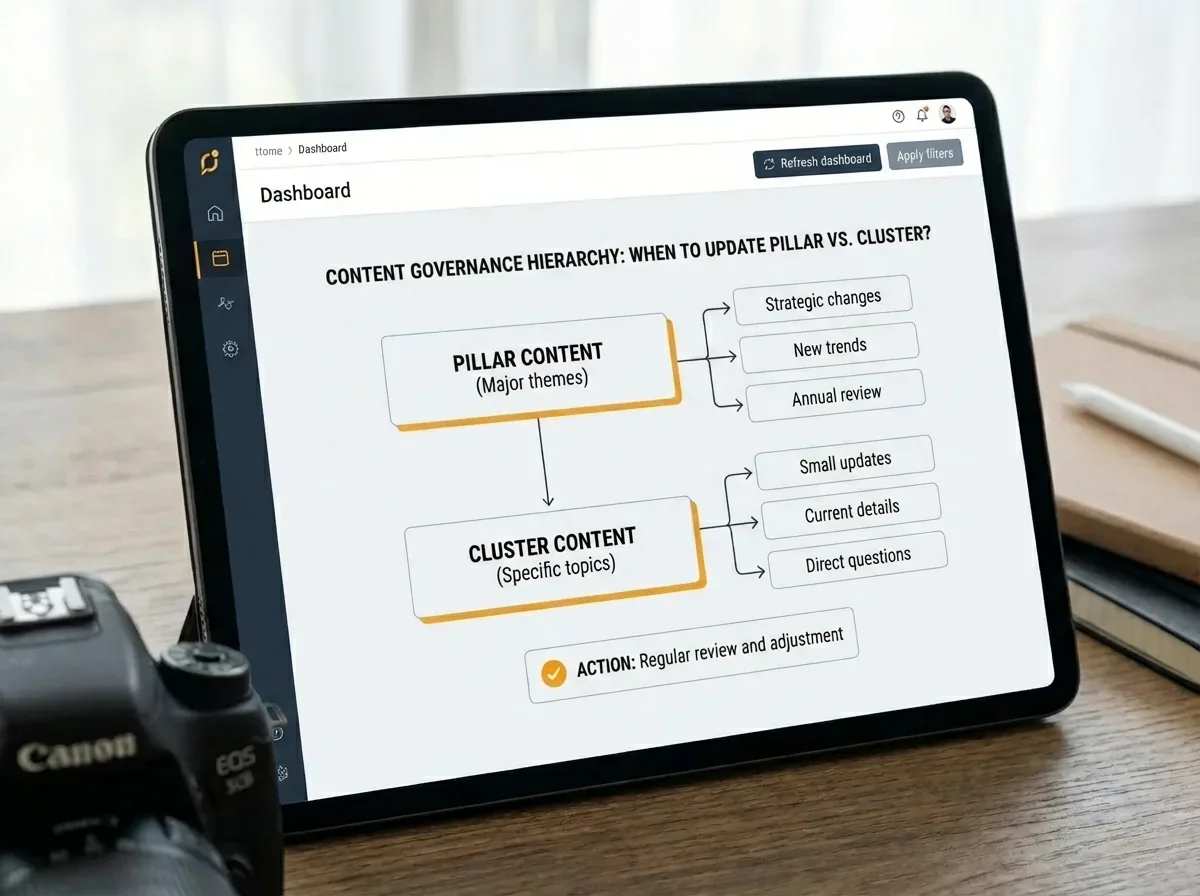
Content governance isn't a one-time set of rules, but a continuous refinement of the balance between overview and detail within your information architecture. Several indicators suggest that a revision of your content structure is necessary to maintain your SEO value. In practice, we see that technical changes or shifts in user behavior often prompt a thorough check of your editorial guidelines. Pay specific attention to a significant drop in organic traffic on specific cluster pages or new competition offering more comprehensive information on a sub-topic. Outdated external links or internal references that no longer lead to the correct sources are also important signals for action. Furthermore, changes in search intent, where users increasingly demand current data, compel faster interventions in your clusters.
The process requires an analytical look at your Google Search Console data. If a pillar page ranks well but the underlying clusters lag, this will eventually weaken the entire topic's authority. It is therefore advisable to conduct an audit of key clusters at least quarterly. For more in-depth information on structuring your website, you can visit the Frankwatching website for current insights into digital marketing. By being proactive in your approach, you stay ahead of the competition and always offer visitors the most relevant information. Consistency is the absolute keyword for long-term success in the dynamic world of search engine optimization and content management.
The Importance of a Structured Maintenance Schedule for Pillar Pages
Establishing a robust content architecture is only half the battle for a successful SEO strategy. Once the foundation is laid, the focus shifts to maintaining the authority and relevance of your most important pages. A structured maintenance schedule ensures that the hierarchy between main topics and sub-topics remains intact, while search engines receive signals that the information is still current. Without a clear vision on Content governance: when do you update pillar vs cluster?, a website risks content decay, where outdated information drags down the rankings of the entire cluster. It is therefore essential to find a rhythm that suits the dynamics of the market in which you operate.
Effective Content governance: when do you update pillar vs cluster? strategies prevent valuable backlinks from leading to pages that no longer provide the best answers to user search intent.
The Synergy Between Core Content and Supporting Articles
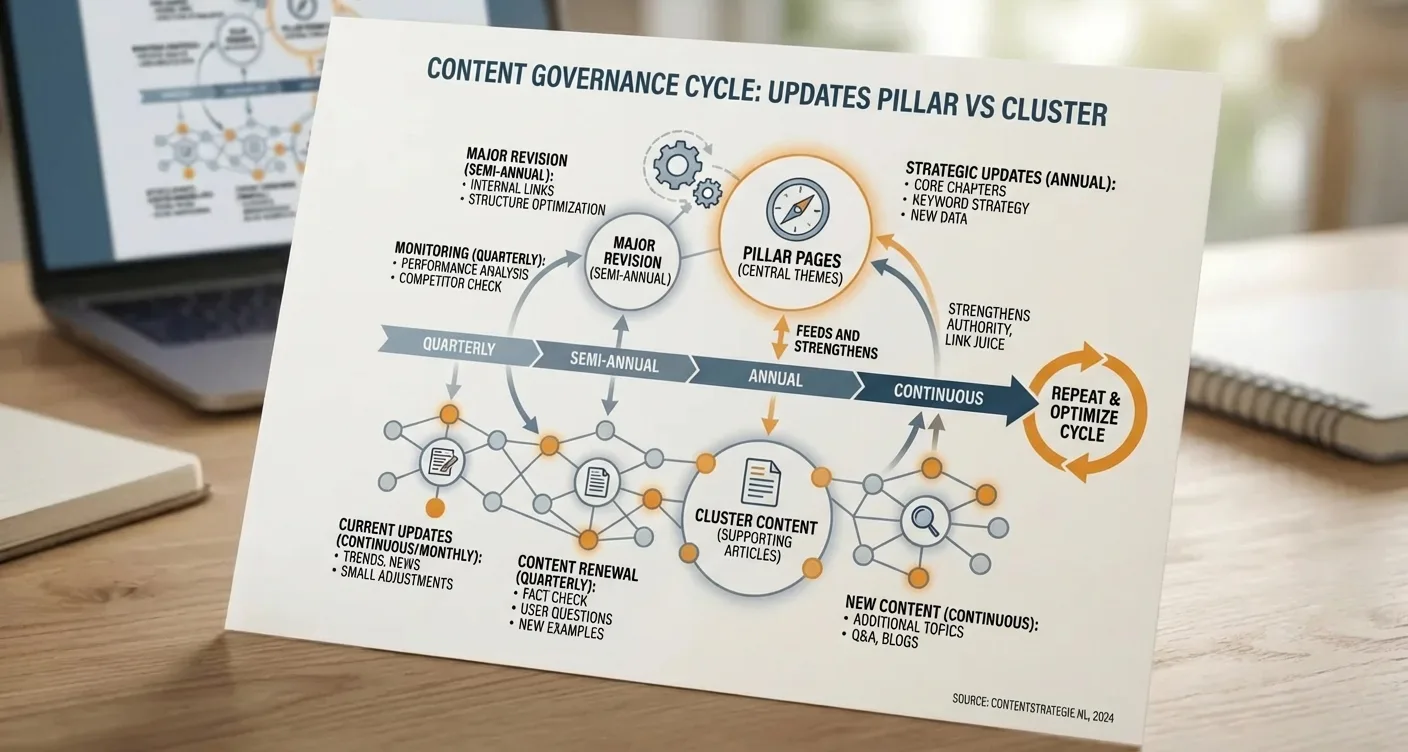
The relationship between a pillar page and its associated cluster content is symbiotic. The pillar serves as the foundation that sets the broad strokes, while the clusters delve into specific details. When considering Content governance: when do you update pillar vs cluster?, you must understand that the pillar page often plays a curatorial role. Here, you check whether the internal links are still accurate and whether the summaries of the sub-topics still align with the refreshed cluster articles. If a cluster article is rewritten with new insights, the reference on the main page must be immediately evaluated to avoid inconsistencies. This process requires precise planning where the editorial team knows exactly which change in a small article affects the overarching authority of the main page.
It is crucial to remember that Content governance: when to update pillar vs cluster? for advanced SEO specialists is about maintaining a logical information structure for both human visitors and search engine crawlers.
When managing these complex structures, it is advisable to use external frameworks for quality assurance. For more in-depth information on structuring digital information, you can consult the W3C guidelines, which help in understanding accessible and well-structured content. By combining these standards with your own Content governance: when to update pillar vs cluster? methodology, you build a sustainable digital ecosystem that is resilient to algorithm updates.
A good schedule includes the following elements for successful execution:
- A quarterly audit of pillar pages for factual inaccuracies.
- Monthly review of top-performing cluster articles for current search trends.
- Immediate updates to the pillar page as soon as a related cluster topic significantly changes.
- Monitoring the internal link equity between the different layers.
"Consistency in maintaining your content cluster is the only way to claim and retain long-term authority in search engines."
Ultimately, the pace of your industry determines how often you need to answer the question of Content governance: when to update pillar vs cluster? In a rapidly changing tech environment, this will be more frequent than in a conservative industry, but the need for a documented process remains the same everywhere for optimal SEO results.
When to Refresh Cluster Content for Maximum Relevance?
Maintaining a robust SEO architecture requires a sharp eye for detail, especially concerning the supporting pages within your silo structure. Cluster content serves as the foundation that supports and strengthens the authority of your main topics. When the information in these specific sub-pages becomes outdated, not only does that individual page lose its value, but the overarching pillar page can also drop in search results. Effective Content governance: when do you update pillar vs cluster? begins with timely recognition of subtle signals, such as a declining click-through rate (CTR) or outdated facts within your niche. It is essential to maintain a fixed cycle where the relevance of each article is periodically assessed against the current user search intent. Consistency in these updates ensures that search engines like Google continue to view your website as a reliable source of current knowledge.
There are specific times when cluster content should take absolute priority over larger, static pillar pages. Consider sudden changes in legislation, new technological breakthroughs, or simply a shift in how consumers view a specific problem. Within the strategic framework of Content governance, it is crucial to make data-driven decisions based on Google Search Console and analytics. If a cluster page loses a lot of organic traffic while the pillar page remains stable, that is a direct sign that the specific information in the cluster no longer meets modern expectations. Refreshing statistics, adding new internal links, and optimizing headings can immediately revive the page and restore its authority.

The renewal process must be structured to prevent the proliferation of irrelevant content. Use the following checklist to determine if your cluster content needs replacement or improvement: First, check if external links still refer to active and relevant sources. Then, evaluate whether the keywords used still have high search volume and the correct intent. Additionally, assess whether visual elements, such as images and graphs, are still modern and clear. Finally, determine if the methodology for sustainable growth is still being applied correctly to the page structure. By systematically reviewing these points, you guarantee the quality of your entire content ecosystem without wasting unnecessary time on pages that still perform excellently in the rankings.
Not every page needs monthly adjustments, but an annual audit is often the absolute minimum for competitive sectors. When applying a smart SEO strategy, it's wise to consider the interdependence of your pages. An update to a cluster page is often less time-consuming than a complete revision of a pillar page, but the cumulative effect of multiple updated clusters can significantly strengthen the pillar page's authority. For more in-depth information on structuring these processes, you can visit the Frankwatching website for current marketing insights. Ultimately, it's about providing the best user experience through accurate and factually correct information. Always monitor how the market reacts to your adjustments to further refine your strategy and maintain your competitive position.
Strategic Signals for Revising Your Internal Link Structure
Maintaining a healthy authority flow within your website requires a proactive approach to your link architecture. When search engines signal that the hierarchy between main topics and supporting articles is blurring, that's a direct sign you need to evaluate your Content governance: when do you update pillar vs cluster? A strong internal structure ensures that the value of your pillar pages is optimally passed on to the underlying clusters, increasing the relevance of the entire domain in the eyes of algorithms.
Performance Indicators for Link Adjustments
Content governance: when to update pillar vs cluster? often coincides with shifts in search intent or declining click-through rates within your navigation menus.

When you notice that specific cluster content performs better than the central pillar, it's time for a strategic revision of the interconnections. In practice, a skewed ratio in organic traffic between these layers often indicates an outdated link strategy. It is essential to determine whether current anchor texts still align with user search terms. An effective Content governance: when to update pillar vs cluster? approach helps identify 'content gaps' that can undermine the authority of your main topic if not timely filled with new links.
Symptoms of a Diluted Structure
- Increase in the number of 'orphan pages' within a specific knowledge domain.
- Pillar pages no longer representing the highest authority within their cluster.
- Confusion for search engines about which page is the primary source for a main topic.
"Consistent evaluation of internal link equity is the backbone of any sustainable SEO strategy."
The process surrounding Content governance: when to update pillar vs cluster? for advanced users also includes monitoring external competition. If competitors claim new sub-themes, your cluster structure must adapt to remain relevant. Use reliable tools like Google Search Console to see which pages are losing strength. By applying strategic Content governance: when to update pillar vs cluster? methods, you ensure that internal link equity always flows to the most converting pages.
A timely Content governance: when to update pillar vs cluster? review prevents your website from becoming a labyrinth for both users and crawlers.
Measure and Adjust: KPIs for Effective Content Management
The success of a modern SEO strategy hinges on accurate data analysis. To determine if your digital efforts are truly bearing fruit, you need to look at specific performance indicators that provide in-depth insight into the health of your information architecture. Within a solid Content governance: when to update pillar vs cluster? plan, you don't just look at total organic traffic, but also at the internal link equity and the authority of your strategic main pages. When the conversion rate on a pillar page suddenly drops, that's often a crucial signal that the underlying clusters are no longer relevant enough or that the information has simply become outdated compared to current market standards and user needs.
Effective monitoring ensures you can act proactively instead of reactively repairing when rankings have already been lost.
Data-Driven Decision Making for Updates
When making strategic choices about maintenance, it is essential to understand how different pages influence each other. A pillar page functions as the foundation, while cluster content delves deeper. By using tools like Google Search Console, you can see exactly which search terms generate traffic. If you notice that specific long-tail keywords are getting fewer impressions, this is a direct answer to the question within your strategy: it's time to refresh the cluster content to maintain relevance. Keeping a logbook helps evaluate the optimal update frequency for your specific niche.
"Content that is not measured simply cannot be improved; therefore, always steer based on user signals and current search intent."
Prioritizing in Your Maintenance Schedule
Not every page requires the same level of attention. Prioritize pages with high commercial value or pages that serve as the main traffic sources for your website. Within the framework of your processes, it is advisable to maintain a fixed cycle for your main topics, while updating smaller articles based on current trends or declining rankings in search results.
- Analyze the click-through rate (CTR) of your most important pillar pages monthly.
- Regularly check the timeliness of external links in your cluster articles.
- Evaluate the internal link structure within your framework for maximum authority.
By consistently measuring, you prevent valuable content from sinking in the search engines. A strict approach guarantees that your website continues to exude authority to both users and algorithms.
Effective content governance is essential for SEO success.
Managing your digital authority requires a strategic approach. By consistently evaluating when to revise your content, you maintain a strong position within search results and prevent valuable information from becoming outdated or irrelevant to your target audience.
The core question remains in content governance: when to update pillar vs cluster? For pillar pages, focus on structural changes and broad trends, while refreshing cluster content more frequently based on specific search queries and current data. A healthy balance between these two creates a current ecosystem that satisfies both search engines and users. Do you want to immediately get started with optimizing your own content strategy? Download our comprehensive checklist now for a future-proof content plan and improve your online visibility and authority today.
Frequently Asked Questions
What is the main difference in content governance between a pillar page and a cluster page?
In content governance: when to update pillar vs cluster? it is crucial to understand that a pillar page safeguards overarching authority, while cluster pages focus on specific sub-topics. The pillar more often requires updates at a strategic level, while clusters are more frequently revised based on current trends and search volume.
How do you determine the frequency for updating your content clusters?
The frequency depends on the speed at which information changes in your niche and performance in search results. Within an effective strategy for content governance: when to update pillar vs cluster?, you check clusters monthly for relevance, while the pillar often receives a quarterly overview to ensure the internal link structure.
Why is a strict plan essential for pillar content maintenance?
Pillar content functions as the foundation of your website's authority and often contains many internal links. Without a strict plan, you risk outdated information that undermines the credibility of your entire cluster, which is detrimental to your SEO positions.
When is it time to completely rewrite a cluster page instead of just updating it?
You completely rewrite a cluster page when the user's search intent has changed or when the information has become factually incorrect. If a small update no longer leads to an increase in rankings, a complete revision within your governance model is necessary.
How SEO Supercharged helps you here
SEO Supercharged is fully online (service area: worldwide, online), so you can use it from anywhere.
The platform is built for Content Managers, SEO Specialists, Digital Marketing Strategists, Heads of Content Marketing, B2B Marketing Managers, Content Marketing Agency Owners, SMEs with an active content strategy, Freelance SEO Copywriters.
You can use it for, among other things, Pillar vs Cluster Audit, Content Decay Analysis, Update Cycle Strategy, Governance Framework Design, Interlinking Health Check, SEO Content Maintenance Plan.
Want to tackle this directly? Plan your structure with the Sitemap Architect, or start a free SEO analysis.
Related articles
- WordPress Pillar Content: The Complete Guide to Categories, Canonicals, and Internal Linking
Discover how to build a robust WordPress pillar content strategy using categories, canonicals, and internal links to boost your Google rankings and AI.
- Mastering Internal Linking: Pillar and Cluster Strategy for SEO
Learn the best internal linking strategy for pillar and cluster content with examples. Instantly boost your SEO structure, domain authority, and organic.
- Blog Category SEO: Naming, URL Structure, and Indexing Strategy
Master blog category SEO! Learn how naming, URL structure, and indexing boost traffic & rankings. Get expert tips to optimize your content hierarchy today.
- Internal Link Audit: Which Links Maximize Your SEO Value?
Discover how to conduct an internal link audit to identify high-value links, distribute SEO authority effectively, and boost your rankings. Read our guide!
- Canonical Tag in WordPress: When to Use It (and When Not To)
Learn all about canonical tags in WordPress: when to use them, when to avoid them. Prevent duplicate content issues, consolidate link equity, and improve.